USAID DEC
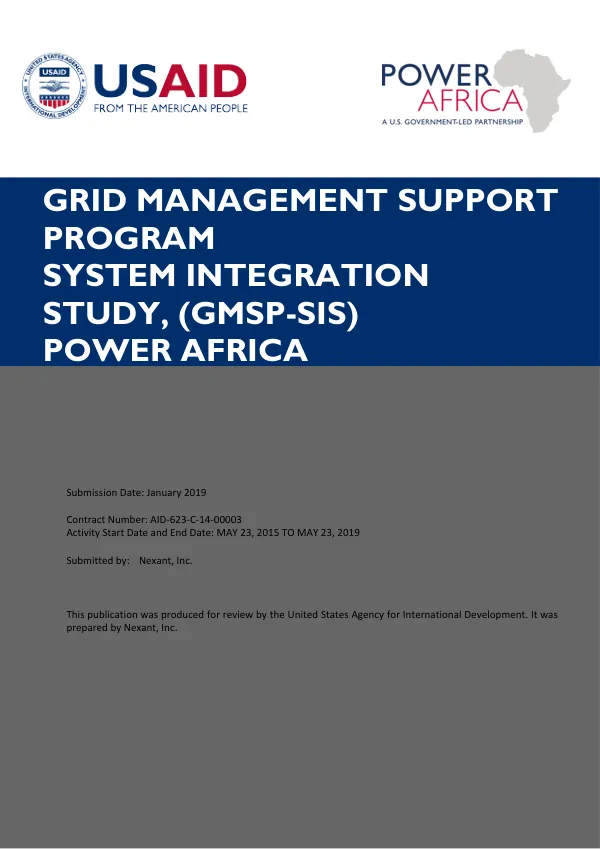
GRID MANAGEMENT SUPPORT PROGRAM PHASE II POWER AFRICA TRANSACTIONS AND REFORM PROGRAM (PATRP) SYSTEM INTEGRATION STUDY
Sign inTETRA TECH
GRID MANAGEMENT SUPPORT PROGRAM PHASE II POWER AFRICA TRANSACTIONS AND REFORM PROGRAM (PATRP) SYSTEM INTEGRATION STUDY
The Grid Management Support Program (GMSP) is a system integration study conducted by Nexant, Inc.
2019 · 145 pages
Sign in to readA free account is required to download.
Abstract
for the Power Africa Transactions and Reform Program (PATRP). The study aims to provide a comprehensive analysis of the power system expansion planning and operational analysis for the region. The study was conducted from May 23, 2015, to May 23, 2019, and was supported by the United States Agency for International Development (USAID). The study's objectives include developing a demand forecast for the region, conducting power system expansion planning, and performing operational analysis. The demand forecast is based on historical data, economic growth rates, population growth rates, and other factors. The study uses regression analysis to forecast electricity demand for various sectors, including residential, commercial, industrial, and agricultural. The power system expansion planning involves analyzing the generation mix, transmission system, and reserve requirements. The study uses a production simulation to evaluate the performance of different generation technologies, including hydro, geothermal, biomass, waste-to-energy, thermal, wind, and solar. The study also conducts a reserve modeling analysis to determine the reserve requirements for the region. The operational analysis involves evaluating the performance of the power system under different scenarios, including high and low demand scenarios. The study uses a renewable integration methodology to evaluate the impact of integrating renewable energy sources into the power system. The study also conducts a sensitivity analysis to evaluate the impact of different factors, such as delayed exports to Kenya and delayed wind and solar development. The study's findings indicate that the region's electricity demand is expected to grow significantly, with a total demand forecast of 13,444 GWh by 2025. The study recommends that the region invest in renewable energy sources, such as wind and solar, to meet the growing demand for electricity. The study also recommends that the region improve its transmission system to ensure reliable and efficient transmission of electricity. The study's results are presented in various figures and tables, including a total demand forecast comparison, forecasting process and steps, and historical electricity demand and losses. The study's appendices include a load distribution factors appendix and a transmission system appendix. The study's methodology involves using a combination of historical data, economic growth rates, population growth rates, and other factors to forecast electricity demand. The study also uses a production simulation to evaluate the performance of different generation technologies and a reserve modeling analysis to determine the reserve requirements for the region. The study's results indicate that the region's power system is expected to face significant challenges in meeting the growing demand for electricity. The study recommends that the region invest in renewable energy sources, improve its transmission system, and develop a robust reserve management system to ensure reliable and efficient transmission of electricity.