WATER MANAGEMENT INSTITUTE
Groundwater and Ecosystem Services framework document
Over 2,500 farmers received training in sustainable agriculture practices during the first year, with demonstration plots established in 38 communities showing yield improvements of 60% when applying the practices.
2015 · 29 pages
Sign in to readA free account is required to download.
Abstract
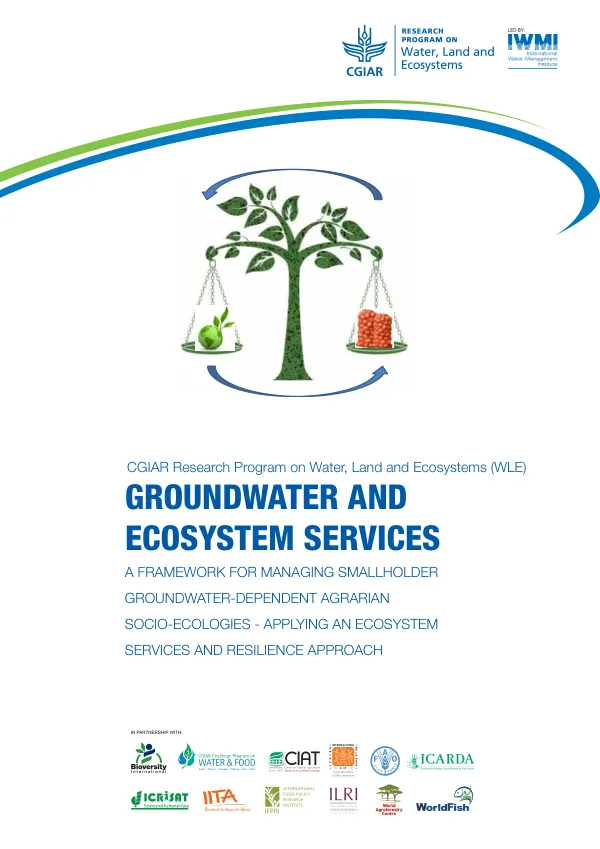
The Water, Land and Ecosystem (WLE) Program promotes sustainable intensification in agriculture through research and policy development. The program aims to achieve this goal by applying an ecosystem services and resilience-based approach. The WLE Program recognizes the importance of groundwater-dependent and groundwater-impacting ecosystem services in agrarian socio-ecologies. The program's framework outlines the WLE's understanding of these services and devises an approach to guide research and policy development. Groundwater development has enhanced socio-economic resilience of smallholder farming systems and increased food security. However, groundwater abstraction for irrigation has threatened the sustainability of intensive groundwater use in agriculture. The pressure on groundwater resources has compromised the livelihoods and ecosystems dependent on groundwater. An urgent need is to develop governance and management regimes that balance livelihood resilience and socio-economic development with ecological resilience of groundwater-dependent agrarian landscapes. The WLE Program has at its core the promotion of sustainable intensification in agriculture through research and policy development. Fundamental to the achievement of this goal is the application and uptake of an ecosystem services and resilience-based approach. The present framework outlines the WLE's understanding of groundwater-dependent and groundwater-impacting ecosystem services and devises an approach to guide research and policy development related to agrarian socio-ecologies highly dependent on groundwater. Groundwater provides many ecosystem services in addition to water pumped for irrigation. Other uses of groundwater by people may be compromised when aquifers are over-abstractions for irrigation. One simple example is the lack of water available from shallow wells. In addition, groundwater supports many ecosystems, including wetlands, lakes, estuaries, lagoons, springs, and terrestrial systems like forests. People rely on the products and processes of these ecosystems for their health and livelihoods.