USAID DEC
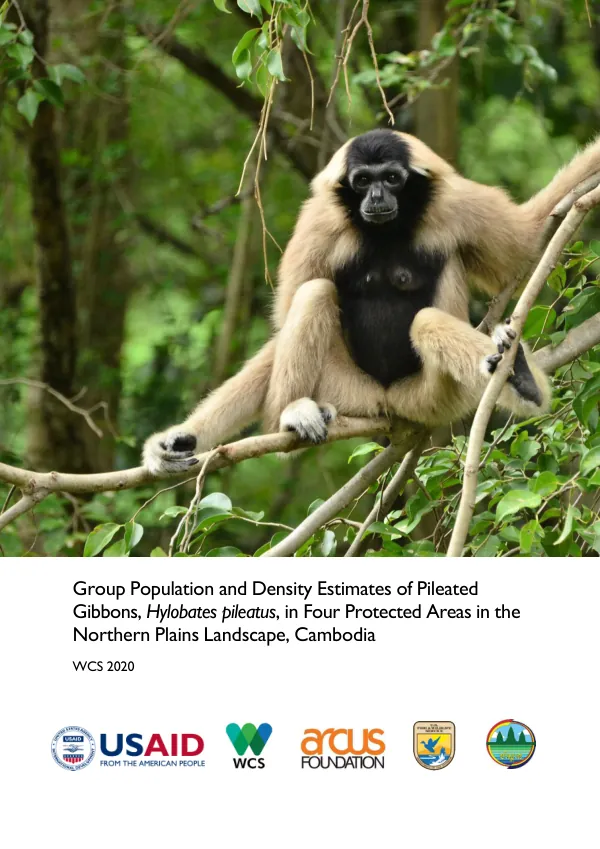
Group Population and Density Estimates of Pileated Gibbons, Hylobates pileatus, in Four Protected Areas in the Northern Plains Landscape, Cambodia
Sign inUSAID
Group Population and Density Estimates of Pileated Gibbons, Hylobates pileatus, in Four Protected Areas in the Northern Plains Landscape, Cambodia
The Northern Plains Landscape Gibbon Survey Report was conducted between 2016 and 2019 to estimate populations of pileated gibbons, Hylobates pileatus, in four protected areas in Cambodia.
2020 · 15 pages
Sign in to readA free account is required to download.
Abstract
The study sites included Chhep Wildlife Sanctuary (CWS), Kulen Promtep Wildlife Sanctuary (KPWS), Preah Roka Wildlife Sanctuary (PRWS), and Phnom Tbeng Natural Heritage Park (PTNHP). The survey used a call-based distance sampling methodology, with listening posts established to record gibbon vocalizations. The study found that the estimated group densities of pileated gibbons in the four protected areas were similar to those recorded in Thailand in 2008. The estimated group densities were 1.35 groups/km2 in CWS, 1.13 groups/km2 in KPWS, 0.75 groups/km2 in PRWS, and 0.54 groups/km2 in PTNHP. The results suggest that the estimated group density in PRWS has declined over the past 15 years, from 1.55 and 0.78 groups/km2 in 2005 to 0.75 groups/km2 in 2019. However, the 2005 surveys were limited in sample size, and the 2019 estimates are limited in their estimation of cue rate and lack of triangulation. The estimated group densities in CWS and KPWS are close to the average density for sites surveyed across Cambodia at this time. Pileated gibbons are found in significant numbers in two main blocks of forest in Cambodia: the Cardamom Mountains and adjacent areas in southwestern Cambodia, and the Prey Lang forest complex in northern Cambodia. The species is threatened by illegal logging and land encroachment, which have resulted in habitat fragmentation and scarcity. The study found that pileated gibbons are territorial and will defend a specific territory, with groups roaming an area of up to 34 ha and defending an area of approximately 26.6 ha against intrusion by other groups. The diet of pileated gibbons consists mainly of soft, fleshy fruit and figs, supplemented with leaves, flowers, and insects. The study sites are managed by the Royal Government of Cambodia's Ministry of Environment, with financial and technical support from WCS. Chhep Wildlife Sanctuary is a 1,900.27 km2 protected area in northern Preah Vihear Province, comprising large tracts of deciduous dipterocarp and evergreen forests, as well as seasonally inundated grasslands and small wetlands. Kulen Promtep Wildlife Sanctuary covers 4,068.25 km2 and includes a range of habitats, including deciduous dipterocarp and evergreen forests, as well as grasslands and wetlands. The study highlights the importance of continued conservation efforts to protect the pileated gibbon and its habitat in Cambodia. The results of the study provide valuable information for conservation planning and management, and highlight the need for further research to better understand the ecology and behavior of this species.
Related documents