USAID
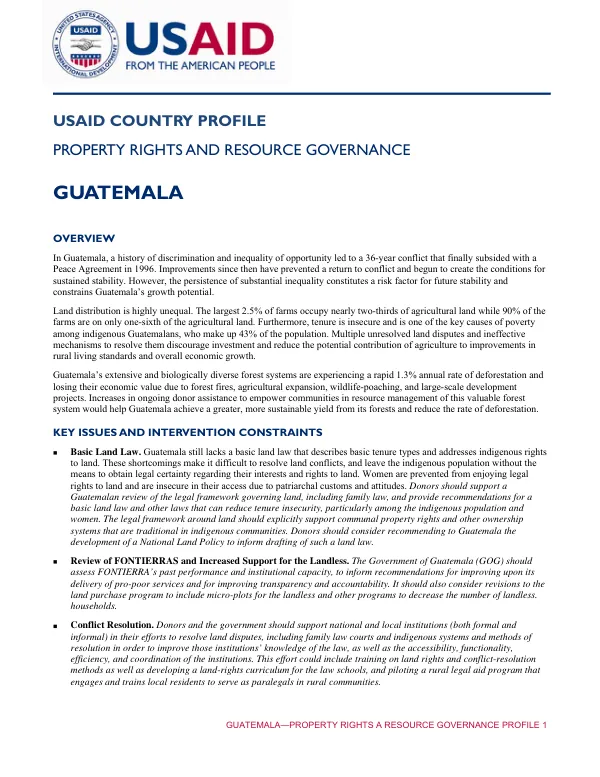
GUATEMALA—PROPERTY RIGHTS AND RESOURCE GOVERNANCE PROFILE
Guatemala has a history of rural poverty, distorted land distribution patterns, and severe income inequality.
2010 · 23 pages
Sign in to readA free account is required to download.
Abstract
Land-related issues were a fundamental cause of the 36-year Guatemalan Civil War, which ended in 1996. The Peace Accords attempted to address land issues, including access for the poor, legal reform, and land administration. However, political will for reform has been limited, and Guatemala continues to have the most inequitable and concentrated distribution of land ownership in Central America. Land conflicts are a major issue in Guatemala. Observers have noted that the country's economic development and competitiveness will be stunted until land conflicts are addressed. Although widespread violence in the near future is unlikely, land disputes could lead to political instability. Indigenous and peasant populations face systemic exclusion from access to land. Tenure insecurity is one of the key causes of poverty among these groups. The rural population comprises 52% of the total population, of which 80% is indigenous. Three-quarters of the rural population live in poverty, which correlates with their geographic isolation and ethnic exclusion. The Guatemalan Civil War and resulting human rights abuses led to the displacement of between 500,000 and 1.5 million people. Many of these internally displaced persons (IDPs) moved to informal squatter settlements in and near Guatemala City. Guatemala's over 200 informal settlements are characterized by inadequate housing and hazardous living conditions. Twenty-three percent of children living in these settlements suffer from malnutrition. Although there are no legal restrictions on women's access and rights to land, the percentage of female landowners is extremely low due to prevailing patriarchal influences. Within indigenous communities, women are even more marginalized. Women-headed households, particularly those headed by indigenous women, are more susceptible to poverty. Guatemala is rich in water resources, primarily from streams and lakes. However, surface water is unevenly distributed, seasonal, and often polluted. Water resources are stressed by growing demand, deforestation, and agricultural pressure. Contamination by biological and chemical agents occurs in varying degrees throughout the country. This problem is compounded by the limited capacity of sewage systems in urban centers; raw effluent flows directly into the streams. Guatemala has one of the most extensive and biologically diverse forest systems in Central America. Some 2.8 million hectares of forest are protected under the Guatemalan Protected Areas System. The Maya Biosphere Reserve, the largest protected area in Mesoamerica, is threatened by forest fires, unsustainable agricultural expansion, poaching, and poorly planned large-scale development projects. These threats have resulted in rapid deforestation. Land area in Guatemala is approximately 108,890 square kilometers, with 13.3% of the land area being arable. Agricultural land accounts for 42.9% of the land area, while permanent cropland accounts for 5.6%. Irrigated land accounts for 6.3% of cropland. Forest area accounts for 36.3% of the land area, with nationally protected areas accounting for 32.6% of the total land area. Renewable internal freshwater resources per capita in Guatemala are approximately 8,180.9 cubic meters. Annual freshwater withdrawals for agriculture, domestic use, and industry account for 80.1%, 6.5%, and 13.4% of total freshwater withdrawal, respectively. Crop production index in Guatemala is 103.8, based on a 1999-2001 baseline of 100. Livestock production in Guatemala is also significant, with a focus on cattle, pigs, and chickens.
Related documents