DAI GLOBAL, LLC
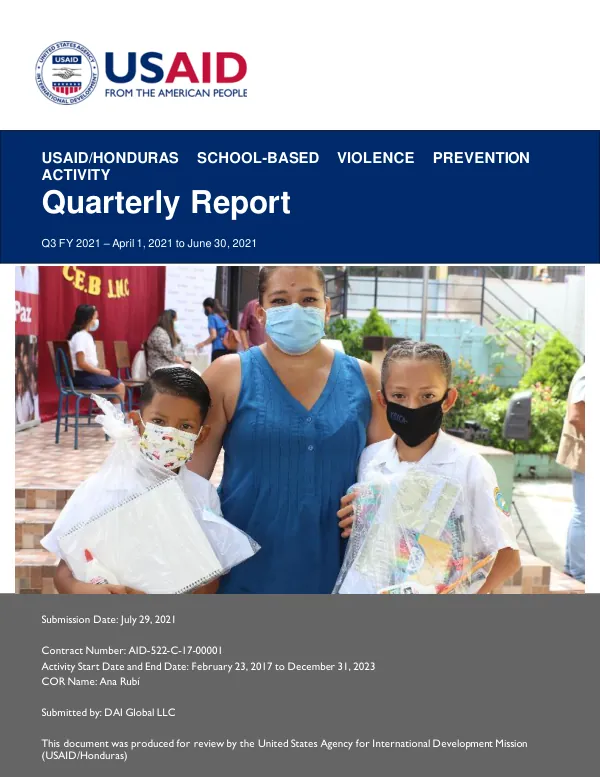
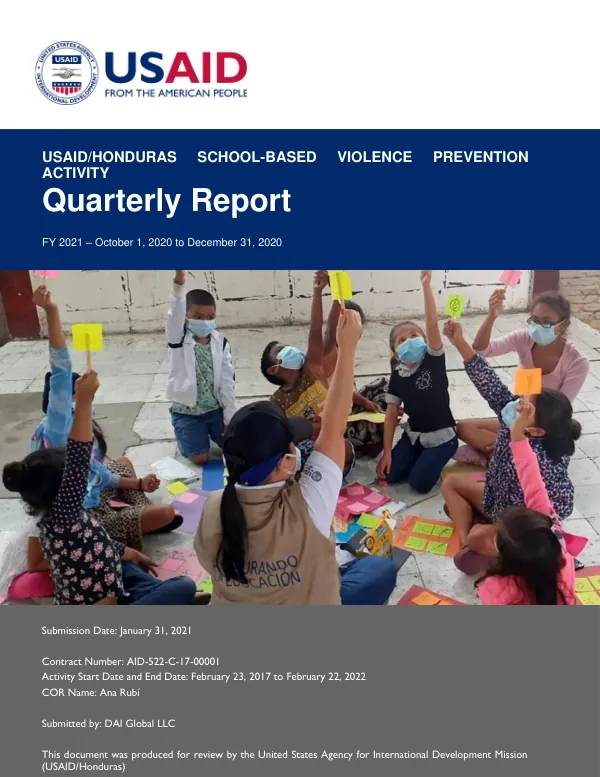
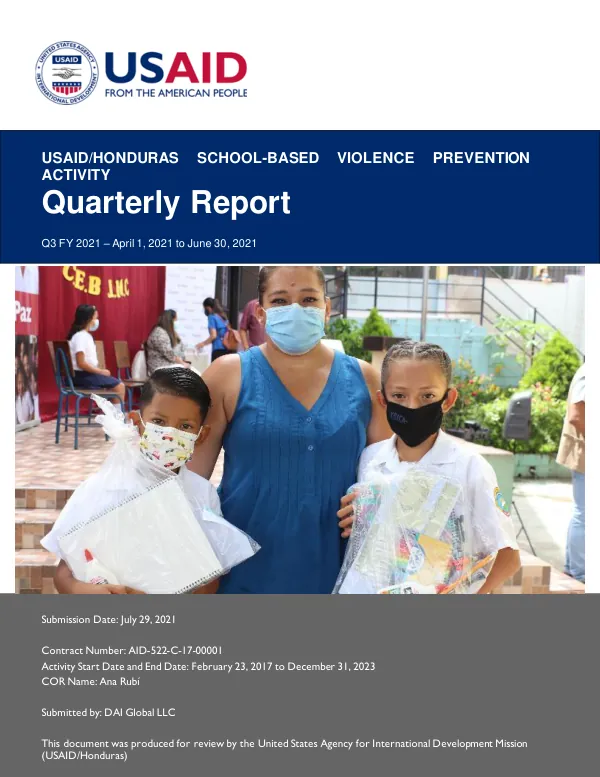
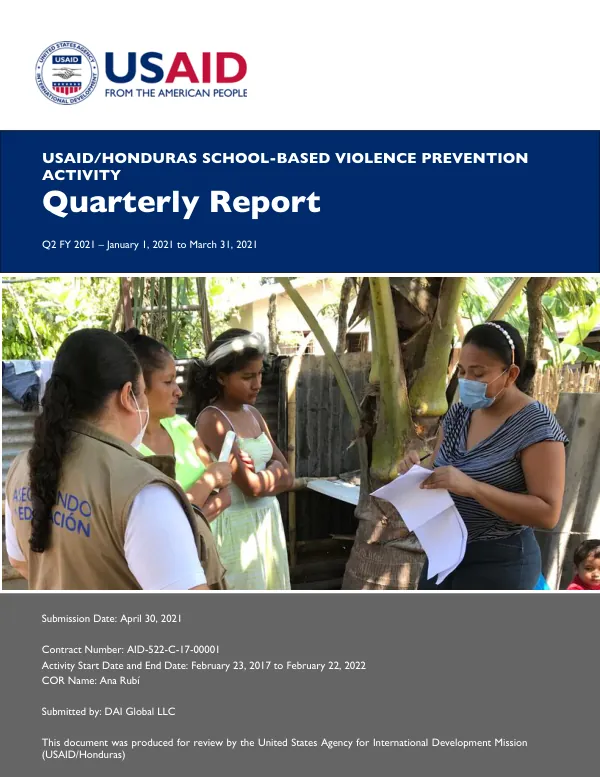
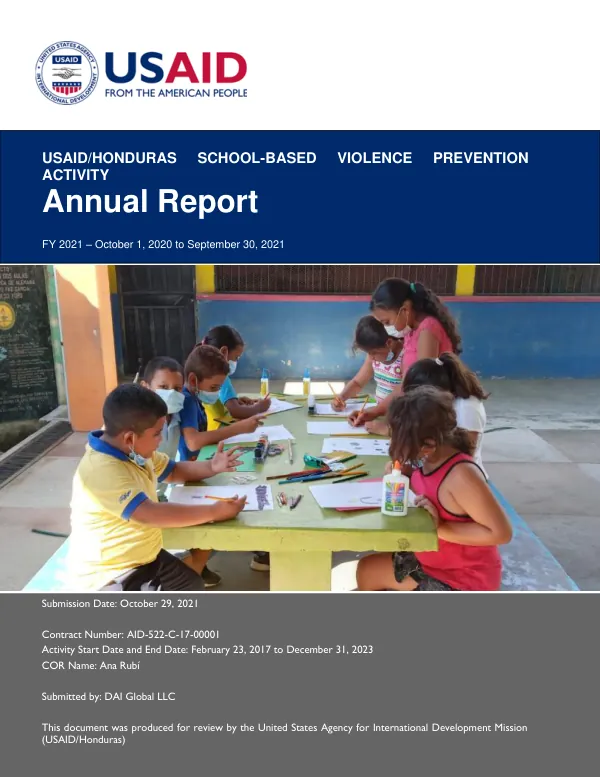
USAID/Honduras School-Based Violence Prevention Activity Annual Report – Q4 FY 2021
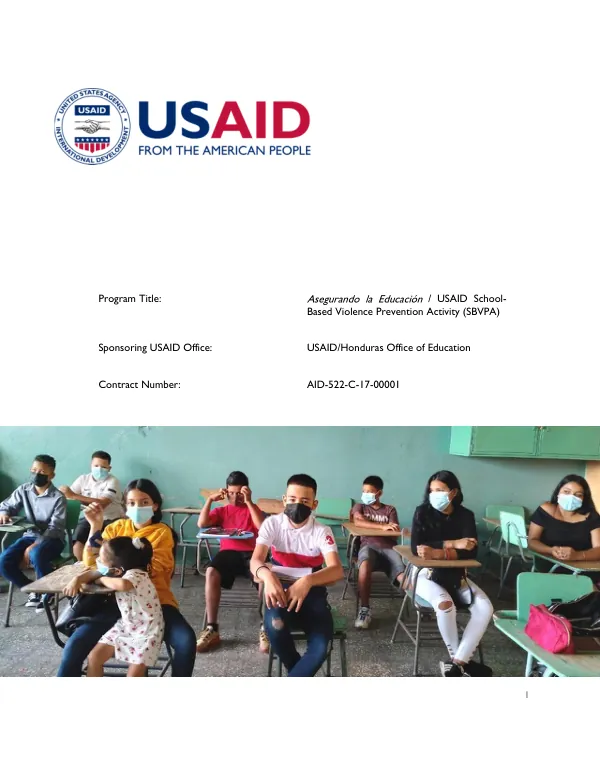
The USAID School-Based Violence Prevention Activity (SBVPA), also known as Asegurando la Educación, is a five-year, $20 million flagship effort funded by USAID.
2021 · 92 pages
Sign in to readA free account is required to download.
Abstract
The project aims to address school-based violence that impedes the delivery of education and its goals of access, retention, and learning. The project seeks to contribute to violence prevention and migration reduction in target communities by using education and school processes. The project has four strategic objectives: to improve schools' ability to reduce school-based violence and out-migration through the creation of safe learning environments; to strengthen local networks that increase school safety and curb migration; to increase the capacity of the Ministry of Education (MOE) and social protection actors to prevent, respond to, report on, and monitor school-based violence; and to lower risk factors and enhance protective factors for students that qualify for secondary prevention services (SPS) and are at risk of school drop-out and undocumented migration. The project is implemented by DAI Global, LLC, with support from Partners of the Americas, under a period of performance from February 23, 2017, to December 31, 2023. The project works in targeted schools across eight municipalities in Honduras, including Tegucigalpa, San Pedro Sula, Choloma, La Ceiba, and Tela, as well as Comayagua, Puerto Cortés, El Progreso, and others. These municipalities are central to the 2020-2021 USAID/Honduras Country Development Cooperation Strategy under Development Objective 1 (DO1) and Development Objective 3 (DO3). The project is also an integral part of the 2014 Alliance for Prosperity and the Central America Regional Security Initiative. Asegurando contributes to the second objective of the GOH 2010 Visión del País by supporting a commitment to democracy, security, and non-violence. It also responds to the Plan del País by linking education and violence prevention through the promotion of greater cohesion, and the Ley Fundamental de Educación, which makes education for prevention and rehabilitation a cross-cutting issue in the national curriculum. The project supports Pillar I of the U.S. Strategy for Addressing the Root Causes of Migration in Central America by helping improve access to safe and quality education, better-preparing students to pursue economic opportunity. This report reflects the adaptations made to the Year Five Work Plan in coordination with USAID to respond to the COVID-19 crisis that began in Honduras in mid-March 2020. Implementation of the project has focused on several key areas, including the creation of safe learning environments, strengthening local networks, increasing the capacity of the MOE and social protection actors, and lowering risk factors and enhancing protective factors for students. The project has also worked to enhance the capacity of Government of Honduras (GOH) institutions, such as the MOE, the Ministry of Security (MOS), and other key social network actors at the national and municipal levels and among local civil society organizations (CSOs). The project has made significant progress in achieving its objectives, including the creation of safe learning environments, strengthening local networks, and increasing the capacity of the MOE and social protection actors. The project has also worked to lower risk factors and enhance protective factors for students, and has made adaptations to the Year Five Work Plan in response to the COVID-19 crisis. The project has also implemented several key interventions, including the development of a comprehensive school safety plan, the establishment of a school community committee, and the implementation of a teacher wellbeing program. The project has also worked to enhance the capacity of the MOE and social protection actors to prevent, respond to, report on, and monitor school-based violence. The project has also made significant progress in achieving its key performance indicators (KPIs), including the reduction of school-based violence and out-migration, the strengthening of local networks, and the increase in the capacity of the MOE and social protection actors. The project has also worked to enhance the capacity of the GOH institutions, including the MOE, the MOS, and other key social network actors at the national and municipal levels and among local civil society organizations (CSOs).