USAID DEC
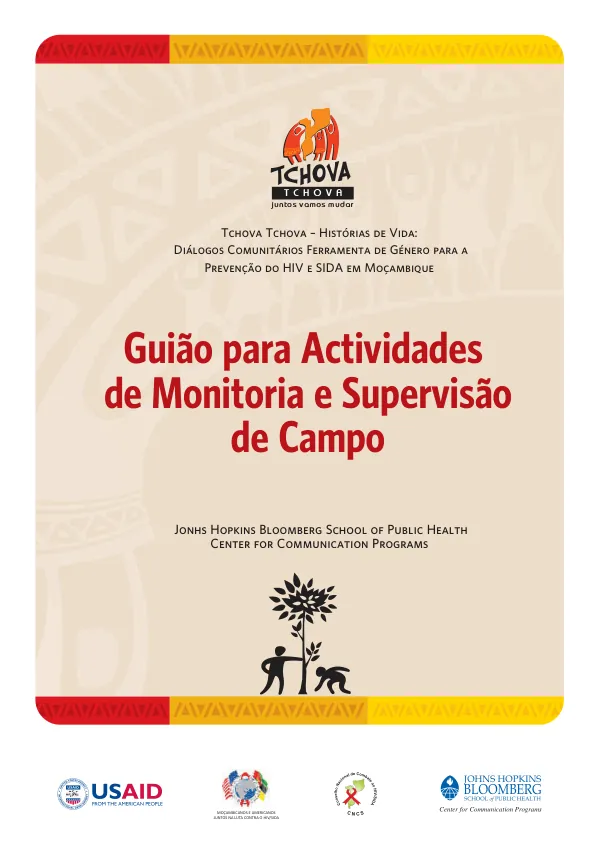
Guião para Actividade de Monitoria e Supervisão de Campo: Tchova Tchova – Histórias de Vida: Diálogos Comunitários Ferramenta de Género para a Prevenção do HIV e SIDA em Moçambique
Sign inJOHNS HOPKINS UNIVERSITY
Guião para Actividade de Monitoria e Supervisão de Campo: Tchova Tchova – Histórias de Vida: Diálogos Comunitários Ferramenta de Género para a Prevenção do HIV e SIDA em Moçambique
The Tchova Tchova program is a community-based initiative aimed at preventing HIV and AIDS in Mozambique.
2010 · 22 pages
Sign in to readA free account is required to download.
Abstract
The program is a collaboration between Mozambican and American organizations, including the Johns Hopkins Bloomberg School of Public Health Center for Communication Programs. The program's main goal is to reduce the vulnerability of men and women to HIV and AIDS through community dialogues and education. The program's methodology is based on the African Transformation approach, which emphasizes the importance of community-based initiatives and the use of storytelling as a tool for social change. The program's core component is the use of "Histórias de Vida" (Stories of Life), which are video and written profiles of individuals who have overcome gender-based barriers and other challenges in their lives. These stories serve as a basis for community dialogues, where participants discuss and share their opinions, needs, and aspirations. The program's implementation involves a series of community dialogues, each lasting 2.5 hours, which are facilitated by trained facilitators. The dialogues are designed to stimulate discussion and debate among participants, with the goal of reducing their vulnerability to HIV and AIDS. The program's activities are monitored and supervised by a team of facilitators and supervisors, who use a set of instruments to track the program's progress and identify areas for improvement. The program's monitoring and supervision activities are guided by a set of principles, including the verification of the program's objectives, the collection of opinions and reactions from participants, and the identification of areas for improvement. The program's facilitators and supervisors use a set of instruments, including the Ficha Técnica, the Ficha de Participação nas Sessões, and the Ficha de Opinião Sobre os Temas, to track the program's progress and identify areas for improvement. The program's evaluation is based on a set of indicators, including the number of participants, the number of sessions held, and the level of participation and engagement among participants. The program's evaluation also includes a review of the program's impact on participants' knowledge, attitudes, and behaviors related to HIV and AIDS. The Tchova Tchova program is funded by USAID and PEPFAR, and is implemented in partnership with local organizations in Mozambique. The program's implementation is guided by a set of principles, including the use of community-based initiatives, the use of storytelling as a tool for social change, and the emphasis on the importance of community dialogues and education in reducing the vulnerability of men and women to HIV and AIDS. The program's activities are designed to be flexible and adaptable to the needs of local communities, and are guided by a set of principles, including the importance of community participation, the use of local resources, and the emphasis on the importance of community-based initiatives in reducing the vulnerability of men and women to HIV and AIDS. The program's evaluation is based on a set of indicators, including the number of participants, the number of sessions held, and the level of participation and engagement among participants. The program's facilitators and supervisors are trained to use a set of instruments, including the Ficha Técnica, the Ficha de Participação nas Sessões, and the Ficha de Opinião Sobre os Temas, to track the program's progress and identify areas for improvement. The program's evaluation is based on a set of indicators, including the number of participants, the number of sessions held, and the level of participation and engagement among participants.