USAID DEC
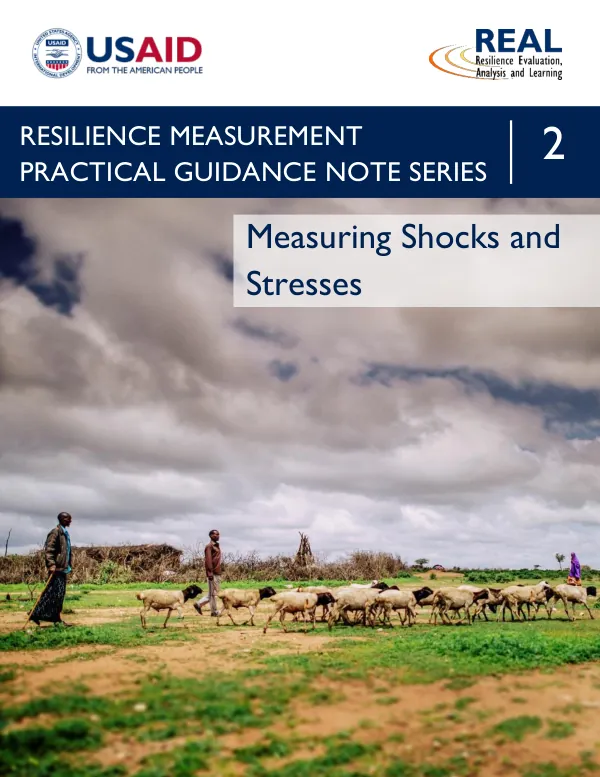
Resilience Measurement Practical Guidance Note Series 2: Measuring Shocks and Stresses
Sign inFOOD FOR THE HUNGRY, INTERNATIONAL
Resilience Measurement Practical Guidance Note Series 2: Measuring Shocks and Stresses
The Resilience Measurement Practical Guidance Note Series 2: Measuring Shocks and Stresses is a document that provides practical guidance on measuring and analyzing shocks and stresses.
2018 · 26 pages
Sign in to readA free account is required to download.
Abstract
The document is part of the Resilience Evaluation, Analysis and Learning (REAL) Associate Award, a consortium-led effort funded by the USAID Center for Resilience. The document introduces the concept of shocks and stresses, which are defined as external short-term deviations from long-term trends that have substantial negative effects on people's current state of well-being, level of assets, livelihoods, safety, or their ability to withstand future shocks. Shocks can be slow-onset, such as drought, or relatively rapid onset, such as flooding, disease outbreak, or market fluctuations. Stresses, on the other hand, are long-term trends or pressures that undermine the stability of a system and increase vulnerability within it. The document provides a simplified resilience measurement framework, which centralizes the measurement of a disturbance, or shock/stress. This framework is adapted from Mercy Corps' resilience framework and illustrates how resilience capacities, when measured in connection with a shock or stress, can help understand programs' impacts on development and well-being outcomes. The document also discusses the importance of understanding the impacts of shocks and stresses on individuals, households, communities, and the systems they live in. It highlights the need to understand how household and community response evolves over time, whether household or community resilience has been eroded by repeated events, and whether the negative effects are compounded by multiple, intersecting shocks/stresses. The document provides guidance on measuring shocks and stresses, including identifying and understanding key indicators, data sources, and when and how to collect these data to suit various needs and constraints. It also discusses analytical approaches to shock measurement, their purposes, and how they may be incorporated into broader resilience analyses and project management. The document categorizes shocks and stresses into different types, such as geophysical/meteorological, human-induced, and economic. It provides examples of common types of shocks and stresses experienced, including natural disasters, conflict, terrorism, and market failures. The document concludes by emphasizing the importance of measuring and analyzing shocks and stresses in order to design and evaluate initiatives focused on building resilience. It highlights the need for a basic understanding of analytical approaches to shock measurement and the importance of incorporating shock measurement into monitoring and evaluation frameworks. Overall, the document provides practical guidance on measuring and analyzing shocks and stresses, which is essential for understanding the impacts of these events on individuals, households, communities, and the systems they live in. It highlights the importance of understanding the complex relationships between shocks and stresses and the need for a comprehensive approach to resilience measurement and analysis.