USAID DEC
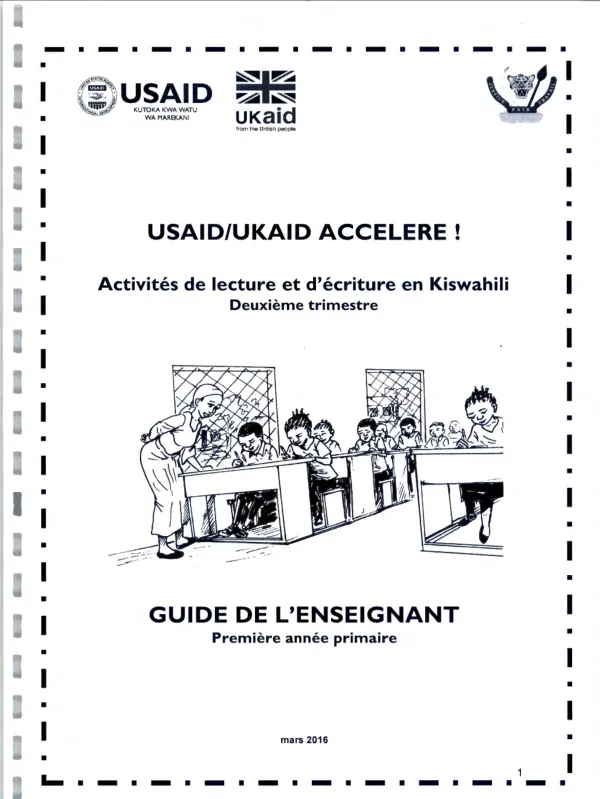
Guide de l'enseignant: Activités de lecture et d'écriture en Kiswahili pour la première année primaire
Sign inUSAID DEC
Guide de l'enseignant: Activités de lecture et d'écriture en Kiswahili pour la première année primaire
The USAID/UKAID ACCELERE !
2016 · 146 pages
Sign in to readA free account is required to download.
Abstract
project aims to support the Congolese government in implementing international curriculum reforms in primary education, specifically in reading and writing. The project is aligned with the National Primary Education Program, which emphasizes the teaching of reading and writing in both Congolese and French languages. The program for reading and writing in Congolese language is designed to be taught from the first to the sixth year of primary school, while the French language is introduced orally in the first year and reading and writing skills are developed from the third to the sixth year. The program is based on a systematic, reasoned, and educational progression, allowing students to gradually acquire knowledge and skills that take into account their prior knowledge in the Congolese language. The main objectives of the program are to enable students to "know how to read and write," "read and write well," and "enjoy reading and writing." To achieve these goals, students need to develop specific skills, including developing their oral language, enriching and knowing vocabulary, recognizing letters and sounds, identifying sounds in words, reading sounds in words, manipulating sounds in words, reading with precision, understanding what they read, writing letters and small words based on letter-sound relationships, and learning text conventions. The guide for teachers provides a framework for implementing the program, including a table of time allocation for each reading activity, a global plan for lessons, a weekly plan for activities, and daily lesson plans. The guide also includes complementary tools, such as a Grand Book and a student manual, which provide additional resources for teachers to support student learning. The program is structured around familiar and interesting themes for students, which are identical in both Congolese and French languages. These themes are explored through simple, short, and engaging texts, as well as attractive and adapted songs. Students learn new words and practice segmenting them into syllables orally, and they also learn to write correctly and decode syllables and simple words. The time allocation for each reading activity is as follows: collecting ideas (10 minutes), reading the text with the help of images (15 minutes), posing questions (15 minutes), recalling the text read (5 minutes), decoding syllables (15 minutes), reading the text independently (15 minutes), writing syllables, words, or phrases (10 minutes), giving news (5 minutes), and composing a drawing (15 minutes). The global plan for lessons outlines the themes, titles of the Grand Books, pages of the student manual, letters to be learned, syllables to be decoded, and phrases to be written for each week. The weekly plan for activities presents the chronological and logical sequence of activities for each week, including the activity that students will do at home with the help of a family member. The daily lesson plans provide the teacher with the text of the song, words, syllables, and/or letters to be exploited for each activity, questions to ask students, and evaluation activities to monitor student progress. The teacher is invited to respect the approach and follow the sequence of activities outlined in the guide. The program is designed to be implemented in a way that allows students to learn to read and write in a fun and engaging way, while also developing their language skills and knowledge. The guide provides teachers with the necessary tools and resources to support student learning and ensure that students achieve the program's objectives.
Related documents