ABT. GLOBAL
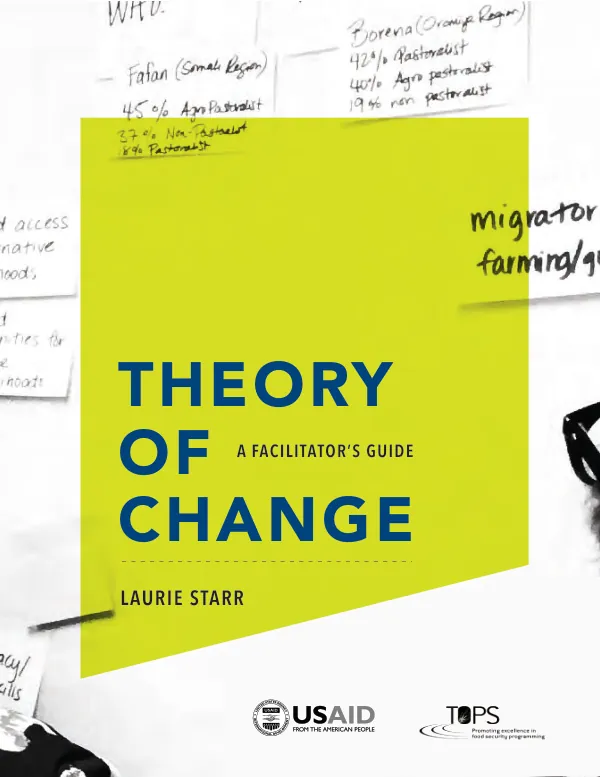
Theory of Change: A Facilitator's Guide
The Theory of Change (TOC) is a development hypothesis that serves as the foundation for programs and activities in the international development community.
2019 · 130 pages
Sign in to readA free account is required to download.
Abstract
The TOC requires a more in-depth causal analysis of issues, rooted in a rigorous and evolving evidence base. This approach builds common understanding among stakeholders around the actions needed to achieve desired changes and enables efficient monitoring, learning, and evaluation based on a clear and testable set of hypotheses. The Technical and Operational Performance Support (TOPS) Program, funded by USAID's Office of Food for Peace (FFP), has developed a curriculum to guide the design and use of a TOC. The curriculum, Theory of Change: Facilitator's Guide, is designed to align with the requirements of creating a development hypothesis for a Development Food Security Activity (DFSA) funded by FFP. The guide presents a method for developing a TOC that has been refined through six years of TOPS workshops and input from the FFP Monitoring and Evaluation Team. The TOC is a critical component of the program cycle, as it provides a clear and testable set of hypotheses that can be used to monitor, learn, and evaluate progress. The TOC is also essential for building common understanding among stakeholders around the actions needed to achieve desired changes. By using a TOC, programs can ensure that they are working towards a clear and achievable goal, and that they are using the most effective strategies to achieve that goal. The TOPS Program has developed a comprehensive curriculum to support the development and use of a TOC. The curriculum includes five modules, each of which focuses on a different aspect of the TOC development process. Module 1 provides an overview of the TOC and its conceptual frameworks, while Module 2 focuses on making the TOC plausible through causal analysis and problem trees. Module 3 explores how to make the TOC plausible by identifying problems and solutions, and Module 4 focuses on making the TOC feasible by selecting project outcomes and purposes. Finally, Module 5 provides guidance on making the TOC testable and using it throughout the program cycle. The TOC is a critical tool for program managers and implementers, as it provides a clear and testable set of hypotheses that can be used to monitor, learn, and evaluate progress. By using a TOC, programs can ensure that they are working towards a clear and achievable goal, and that they are using the most effective strategies to achieve that goal. The TOPS Program's curriculum provides a comprehensive guide to developing and using a TOC, and is an essential resource for anyone working in the field of international development. The TOPS Program has also developed a range of tools and resources to support the development and use of a TOC. These include a TOC checklist, a range of handouts and tools, and a comprehensive set of PowerPoints. The program has also established a community of practice, the Food Security and Nutrition (FSN) Network, which provides a platform for program managers and implementers to share knowledge and best practices. The TOPS Program's Theory of Change: Facilitator's Guide is a critical resource for anyone working in the field of international development. The guide provides a comprehensive overview of the TOC development process, and includes a range of tools and resources to support the development and use of a TOC. By using the guide, program managers and implementers can ensure that they are working towards a clear and achievable goal, and that they are using the most effective strategies to achieve that goal.
Related documents