USAID DEC
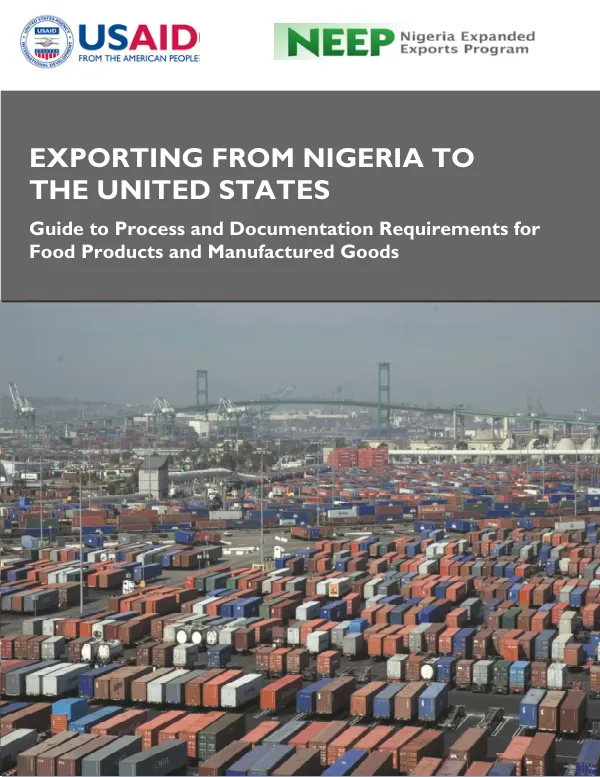
Guide to Process and Documentation Requirements for Food Products and Manufactured Goods: Exporting from Nigeria to the United States
Sign inROBERT NATHAN ASSOCIATES
Guide to Process and Documentation Requirements for Food Products and Manufactured Goods: Exporting from Nigeria to the United States
The Nigeria Expanded Export Program (NEEP) through the TCBoost facility has produced a guide to exporting from Nigeria to the United States.
2012 · 39 pages
Sign in to readA free account is required to download.
Abstract
The guide focuses on the process and documentation requirements for food products and manufactured goods. Exporting from Nigeria to the United States involves following two sets of procedures: Nigerian laws and regulations governing the export process and the laws and regulations of the destination country governing imports. Exporting is a complex process that requires exporters to conduct research to ensure compliance with regulations. The guide assumes that the exporter or potential exporter has already conducted necessary market research. Exporting involves selling products across international borders, which poses challenges such as making complicated pricing calculations, keeping adequate documentation, and communicating with a greater variety of people. Exporters also assume greater risks than businesses that work strictly within their own countries. The guide highlights the importance of establishing and nurturing partnerships with intermediaries in the distribution channel. Intermediaries, such as agents, brokers, and sales representatives, present products to potential buyers and handle complementary product lines that do not compete. They usually work on a commission basis, assume little risk, and are under contract for a defined period of time. Traders, importers, and distributors also play a crucial role in the export process, as they have relationships with suppliers and buyers all over the world. The Harmonized System (HS) of customs tariff codes is used to classify products according to their type and country of origin. The United States uses the Harmonized Tariff Schedule (HTS) for determining the tariff classification of imported goods. The HTS is composed of 99 chapters, and products are categorized to the 10-digit level. Selecting the correct HS code is essential, as it determines the import tariff that a buyer pays and the rules and regulations for importing. The guide emphasizes the importance of consulting the customs database of the importing country to determine the correct product code and applicable import duties. If there is ambiguity about the correct code, the U.S. Customs and Border Patrol will determine the classification and resulting tariff for a given product through an advance ruling. Many countries' customs authorities issue such rulings. The guide also highlights the role of freight forwarders in arranging transport and preparing documentation for cargo. Freight forwarders may assist with container packing and unpacking, customs clearance, filing insurance claims, and arranging for customs clearance on behalf of the shipper. Imports are usually handled by agents or distributors, though some packers and food processors also import directly. The guide provides an overview of the technicalities involved in exporting food and manufactured goods from Nigeria to the United States. It covers topics such as export readiness, trade promotion organizations, Nigerian government agencies and parastatals, procedure and documentation requirements, Nigeria Export Supervision Scheme, quality control, export prohibitions, and documentation. The guide also covers U.S. import requirements, including import process, regulatory requirements for food products, packaging and labeling, imports arriving by ocean vessel, registering food processing facilities, and traceability. The guide is intended to assist Nigerian exporters in gathering market intelligence, forming business linkages, and obtaining access to finance so they can enter overseas markets. It provides an overview of the technicalities involved in exporting food and manufactured goods from Nigeria to the United States, and it highlights the importance of establishing and nurturing partnerships with intermediaries in the distribution channel.
Related documents