SAVE THE CHILDREN FUND
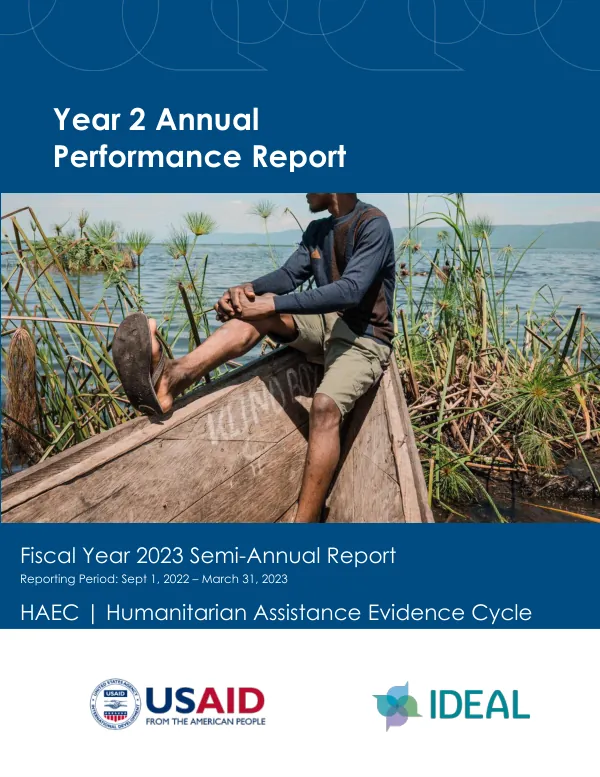
HAEC Year 2 Annual Report Fiscal Year 2023 Semi-Annual Report
The Humanitarian Assistance Evidence Cycle (HAEC) Associate Award is a three-year activity funded by the USAID Bureau for Humanitarian Assistance (BHA) to increase the efficiency and effectiveness of emergency food security activities.
2023 · 20 pages
Sign in to readA free account is required to download.
Abstract
HAEC aims to increase the use of cost-effective and timely impact evaluations in humanitarian contexts to inform technical approaches and improve the impact of humanitarian interventions. HAEC's Year 2 Annual Report highlights the organization's systematic approach to advancing the use of impact evaluations in humanitarian contexts. One pivotal achievement was the completion of a thorough analysis of the Evidence Gap Map (EGM) and consultation outcomes, resulting in the publication of the "Improving Food Security in Humanitarian Emergencies" report. This document outlines and highlights known evidence gaps, challenges, and strategies for expanding robust evidence bases for policymakers and guiding future researchers. The report also notes that HAEC operationalized its commitment to capacity-strengthening endeavors through the development and successful delivery of six impactful training modules. These modules covered a spectrum of topics, from the basics of impact evaluation to research planning, and were delivered during successful training sessions in Bangkok and Istanbul. HAEC tailored these sessions for BHA-funded Emergency implementing partners (IPs) in Asia and the Middle East, North Africa, and Europe (MENA-E) regions, underscoring HAEC's practical contributions to strengthening the skills and knowledge of on-the-ground humanitarian practitioners. In Year 3, HAEC plans to integrate practical examples from the six HAEC-funded research studies into these training sessions, providing practical, real-world examples of various impact evaluation methods to enrich the learning experienced for participants across diverse contexts. HAEC is also committed to reaching more emergency IPs across regions through future workshops, including a four-day workshop in Latin America for Spanish-speaking BHA emergency IPs, a one-day workshop in West Africa in partnership with IDEAL, and two workshops based in Washington, DC. HAEC's evaluability assessment process, which involved review of 27 expressions of interest and a co-creation process with 15 applicants, resulted in progressing six applicants to receive final funding, marking a significant milestone in Year 2. This demonstrated the efficacy of the evaluability assessment process in refining impactful research proposals. Concurrently, HAEC played a pivotal role in fostering robust research partnerships between IPs and Principal Investigators (PIs), strengthening the quality and relevance of impact evaluations and contributing to a collaborative ecosystem within the humanitarian assistance community. HAEC's 10 workplan activities include sense-making of EGM and consultation results, technical training and research partnership curriculum, evaluability assessments for BHA-funded activities, facilitating research partnerships between PIs and IPs, impact evaluation guidance on budgets and costing, template evaluation survey tools and consent forms, design of expedited Institutional Review Board (IRB) process, and funding impact evaluations of BHA-funded Emergency Awards.