ADVENTIST DEVELOPMENT AND RELIEF AGENCY INTERNATIONAL
Haiti Earthquake Fact Sheet #64
The international community, led by the Government of Haiti (GoH), continues to address the aftermath of the January 12 earthquake.
2010 · 7 pages
Sign in to readA free account is required to download.
Abstract
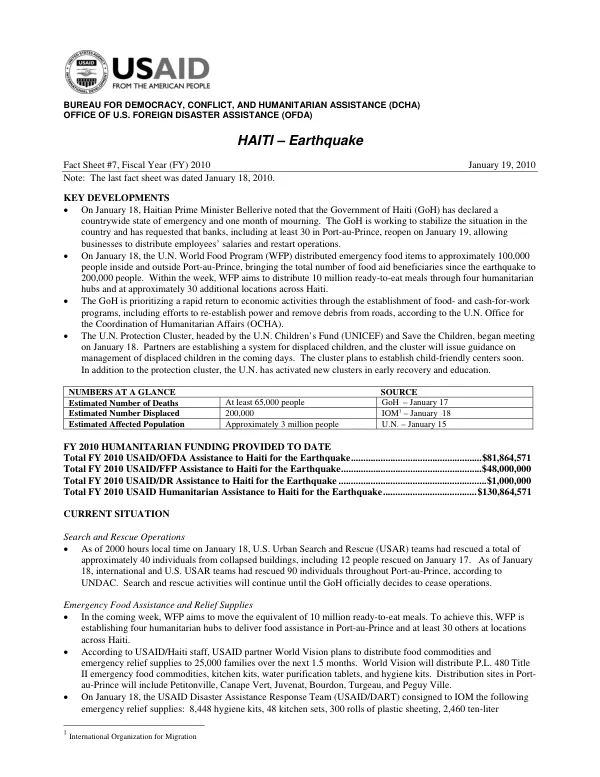
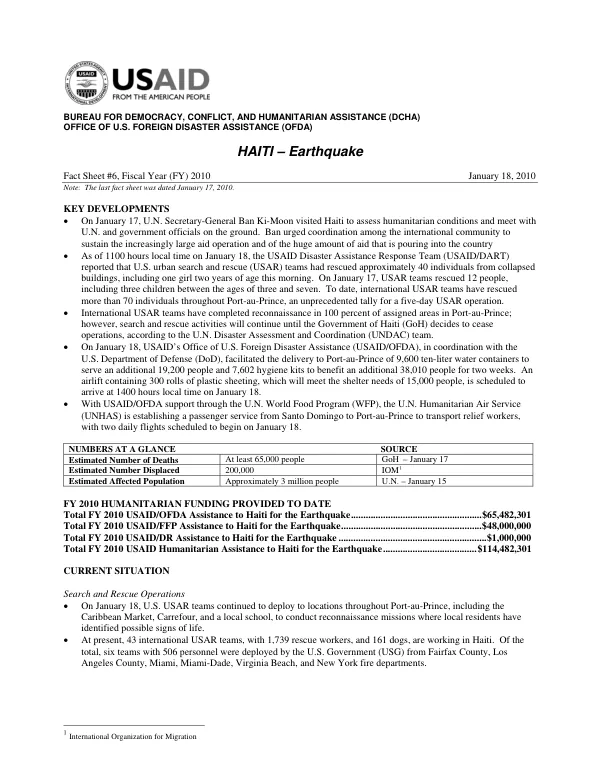
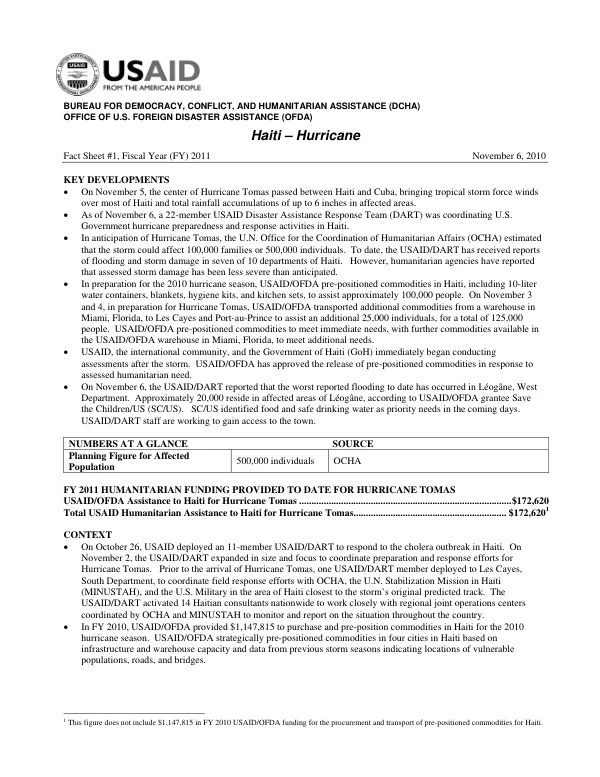
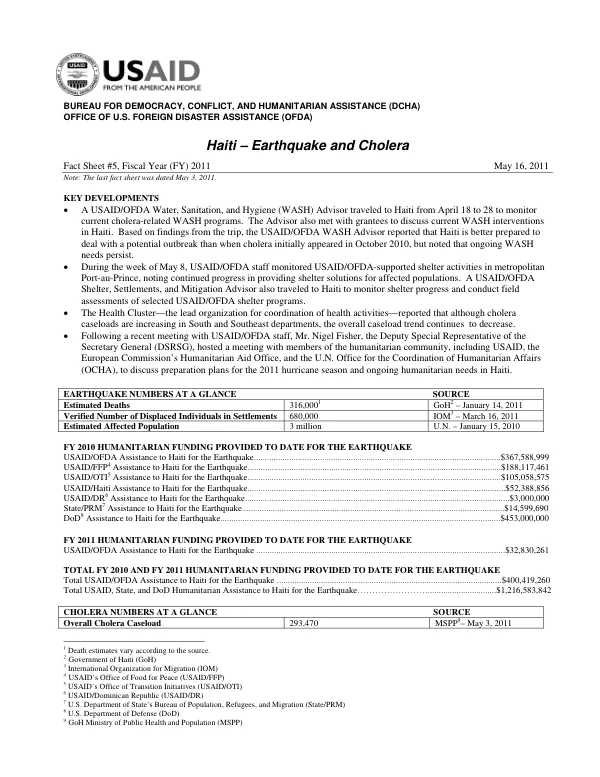
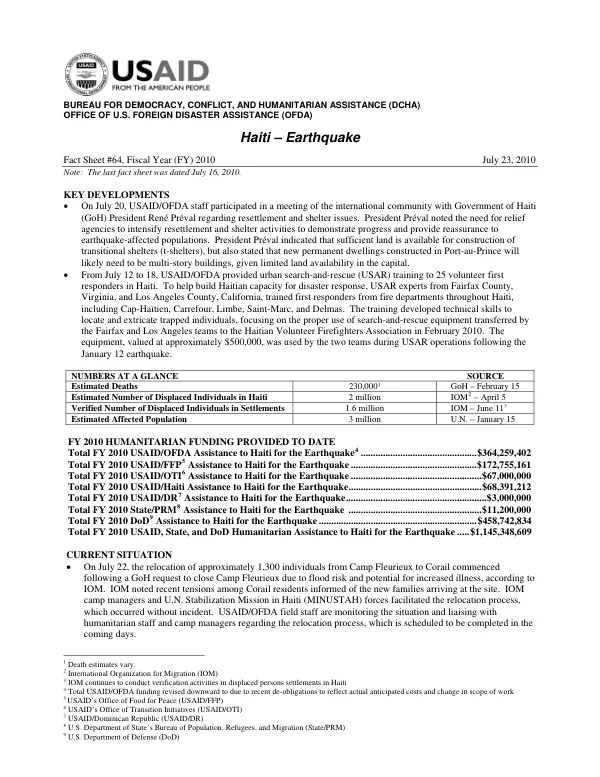
President René Préval emphasized the need for relief agencies to intensify resettlement and shelter activities to demonstrate progress and provide reassurance to earthquake-affected populations. The GoH has identified sufficient land for the construction of transitional shelters, but permanent dwellings in Port-au-Prince will likely require multi-story buildings due to limited land availability. The relocation of approximately 1,300 individuals from Camp Fleurieux to Corail commenced on July 22, following a GoH request to close Camp Fleurieux due to flood risk and potential for increased illness. IOM camp managers and U.N. Stabilization Mission in Haiti (MINUSTAH) forces facilitated the relocation process, which occurred without incident. USAID/OFDA field staff are monitoring the situation and liaising with humanitarian staff and camp managers regarding the relocation process. The Mitigation Task Force has assessed 137 of a targeted 250 settlement sites, averaging three assessed sites per day. Of the 137 sites, 115 require mitigation activities to prevent flooding or landslides during the hurricane season. The GoH and the international community are working together to prepare for the 2010 hurricane season, with U.N. agencies significantly improving their preparedness compared to 2008. Identification and evaluation of potential evacuation and shelter sites continue. USAID/OFDA staff participated in the U.S. Southern Command (SOUTHCOM) Rehearsal of Concept (ROC) drill, focused on preparedness for responding to a Category 3 hurricane. The ROC drill rehearsed a scenario starting 96 hours before a hurricane is predicted to make landfall in Gonaïves and ending with preparations to return to a steady state 96 hours after the hurricane. The Joint Exercise for interagency disaster preparedness in Gonaïves simulated a scenario starting 48 hours before a hurricane is predicted to hit Gonaïves. Logistical issues pertaining to hurricane preparedness and pre-positioning of emergency relief supplies were discussed by USAID/OFDA staff with the Logistics Cluster coordinator and the U.N. World Food Program (WFP). The cluster has made available an in-house customs advisor for the humanitarian community and is in negotiations with the GoH to obtain a general waiver for humanitarian goods. In addition to working to pre-position relief supplies throughout Haiti and rebuild warehouse space lost during the earthquake, the cluster has a barge and helicopter available for transport of relief commodities. The humanitarian community continues to enhance protection mechanisms through ongoing trainings and capacity building activities. Several partners have reported an increase in gender-based violence (GBV) in camps, and the community is working to address this issue. USAID/OFDA conducted a humanitarian protection workshop in San José, Costa Rica, for NGOs and U.N. agencies working in Latin America and the Caribbean. The workshop covered USAID/OFDA's approach to protection in disasters, including mainstreaming protection into multi-sectoral relief activities and addressing specific areas such as child protection and GBV. To date, USAID has contributed more than $675 million in earthquake response funding, including more than $364 million from USAID/OFDA. The estimated number of displaced individuals in Haiti is 2 million, with 1.6 million verified in settlements. The estimated affected population is 3 million. The total FY 2010 USAID/OFDA assistance to Haiti for the earthquake is $364,259,402.
Related documents