DEPARTMENT OF HEALTH AND HUMAN SERVICES
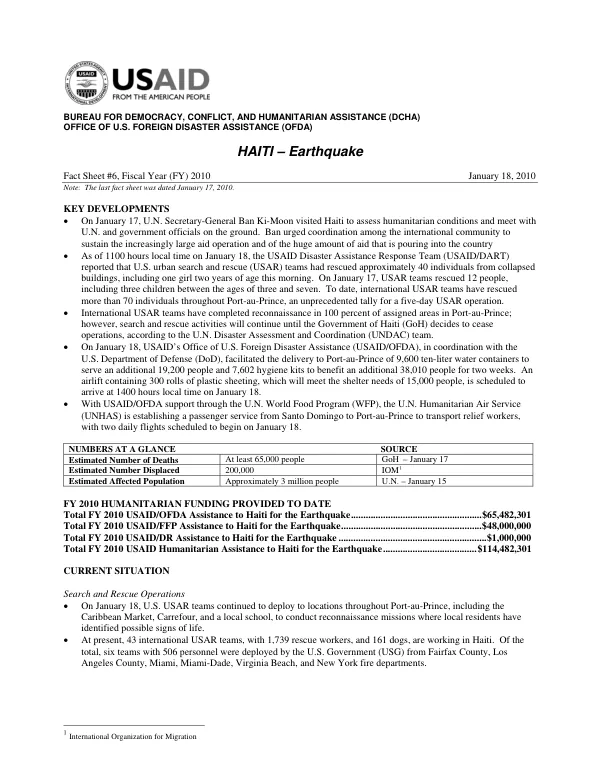
USAID-DCHA Haiti Earthquake Fact Sheet #7 1/19/2010
The Government of Haiti declared a countrywide state of emergency and one month of mourning following the devastating earthquake on January 12, 2010.
2010 · 4 pages
Sign in to readA free account is required to download.
Abstract
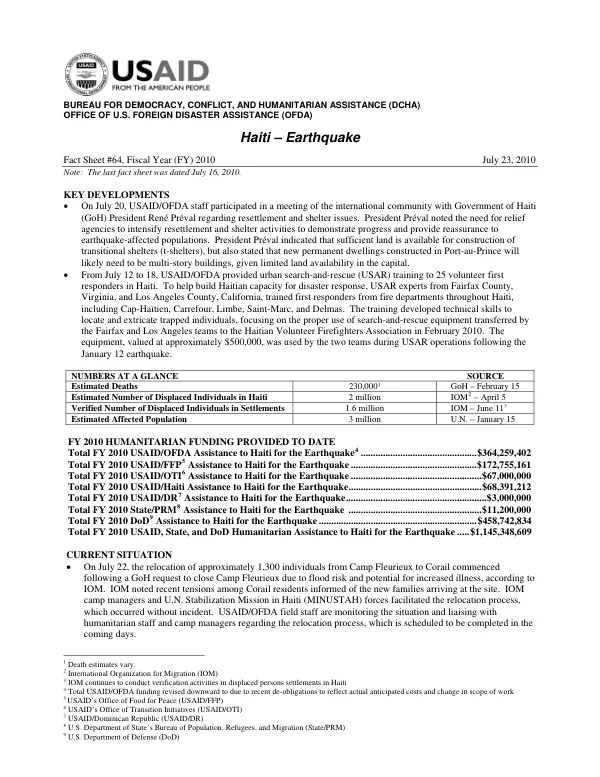
The Government of Haiti is working to stabilize the situation in the country and has requested that banks reopen on January 19, allowing businesses to distribute employees' salaries and restart operations. The United Nations World Food Program (WFP) has been distributing emergency food items to approximately 100,000 people inside and outside Port-au-Prince, bringing the total number of food aid beneficiaries since the earthquake to 200,000 people. WFP aims to distribute 10 million ready-to-eat meals through four humanitarian hubs and at least 30 additional locations across Haiti within the week. The Government of Haiti is prioritizing a rapid return to economic activities through the establishment of food- and cash-for-work programs, including efforts to re-establish power and remove debris from roads. The U.N. Protection Cluster, headed by the U.N. Children's Fund (UNICEF) and Save the Children, has begun meeting to establish a system for displaced children and will issue guidance on management of displaced children in the coming days. Search and rescue operations are ongoing, with U.S. Urban Search and Rescue (USAR) teams having rescued approximately 40 individuals from collapsed buildings as of January 18. International and U.S. USAR teams have rescued a total of 90 individuals throughout Port-au-Prince. The Government of Haiti has declared that search and rescue activities will continue until the Government officially decides to cease operations. Emergency food assistance and relief supplies are being distributed to affected populations. The WFP aims to move the equivalent of 10 million ready-to-eat meals, establishing four humanitarian hubs to deliver food assistance in Port-au-Prince and at least 30 others at locations across Haiti. USAID partner World Vision plans to distribute food commodities and emergency relief supplies to 25,000 families over the next 1.5 months. Logistics operations are being coordinated to facilitate the receipt and transfer of relief supplies into Haiti's earthquake-affected areas. The U.N. has established a logistics cluster in Santo Domingo to assist with the receipt and transfer of relief supplies, and has obtained a warehouse in Santo Domingo for this purpose. The U.N. has also begun developing a significant support capacity in the Dominican Republic to provide the humanitarian community with additional ports of entry. Health services are being provided to affected populations, with the Government of Haiti Ministry of Health (MoH) creating a National Health Commission to coordinate the local and international response. The U.N. health cluster is working to support these Government of Haiti priorities, including by coordinating the arrival and deployment of field hospitals. Multiple field hospitals are operating in Haiti, and additional hospitals are en route. Water, sanitation, and hygiene (WASH) services are being provided to affected populations, with the USAID/OFDA-funded Department of Health and Human Services (HHS) Disaster Medical Assistance Team (DMAT) and an International Medical Surgical Response Team providing patient care using temporary medical stations. The WASH cluster, led by the Government of Haiti, is capable of pumping 1 million gallons of water per day, a sufficient amount to service metropolitan Port-au-Prince.