USAID DEC
Handheld Ultra-Fast Duplex Polymerase Chain Reaction Assays and Lateral Flow Detection and Identification of Leishmania Parasites for Cutaneous Leishmaniases Diagnosis
Sign inUSAID DEC
Handheld Ultra-Fast Duplex Polymerase Chain Reaction Assays and Lateral Flow Detection and Identification of Leishmania Parasites for Cutaneous Leishmaniases Diagnosis
The development of handheld ultra-fast duplex polymerase chain reaction (PCR) assays coupled to amplicon detection by lateral flow (LF) immunoassay is a key step for timely disease diagnosis, patient management, and follow-up in the context of infectious diseases.
2023 · 18 pages
Sign in to readA free account is required to download.
Abstract
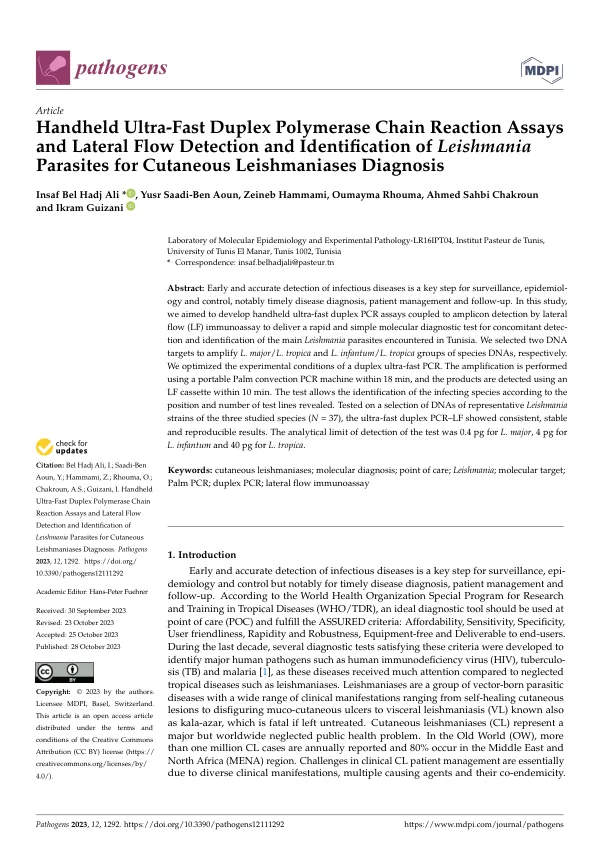
This study aimed to deliver novel cutaneous leishmaniases (CL) molecular diagnosis assays that satisfy point of care (POC) criteria for timely patient management and disease control. The study focused on the development of a rapid and simple molecular diagnostic test for the concomitant detection and identification of the main Leishmania parasites encountered in Tunisia and the Old World, including L. major, L. tropica, and L. infantum/donovani. The test was designed to equip areas with low resources and poor laboratory infrastructure with equitable access to high-quality patient diagnosis and management. The study used a selection of 37 well-characterized Leishmania DNAs belonging to L. major, L. infantum, L. tropica, L. donovani, L. aethiopica, L. arabica, and L. turanica species for test development. The DNAs were extracted from Leishmania strains obtained from reference centers in Monpellier, clinical isolates from health centers in Tunisia, and strains isolated from reservoirs in the frame of a field study in Tunisia. The ultra-fast duplex PCR assays were optimized using a portable Palm convection PCR machine, which is able to perform DNA amplification in ultra-fast speed (10-18 minutes). The amplification products were detected using an LF cassette within 10 minutes. The test allows the identification of the infecting species according to the position and number of test lines revealed. The analytical limit of detection of the test was 0.4 pg for L. major, 4 pg for L. infantum, and 40 pg for L. tropica. The test showed consistent, stable, and reproducible results when tested on a selection of DNAs of representative Leishmania strains of the three studied species (N = 37). The study demonstrated the potential of handheld ultra-fast duplex PCR assays coupled to amplicon detection by lateral flow (LF) chromatography on a generic cassette (PCRD) as rapid and simple molecular diagnostic tests for the concomitant detection and identification of the main Leishmania parasites encountered in Tunisia and the Old World. The test intends to equip areas with low resources and poor laboratory infrastructure with equitable access to high-quality patient diagnosis and management. The study's findings have significant implications for the diagnosis and management of cutaneous leishmaniases, particularly in areas with limited resources and poor laboratory infrastructure. The development of this test has the potential to improve patient outcomes and reduce the burden of disease in these regions.
Related documents