USAID
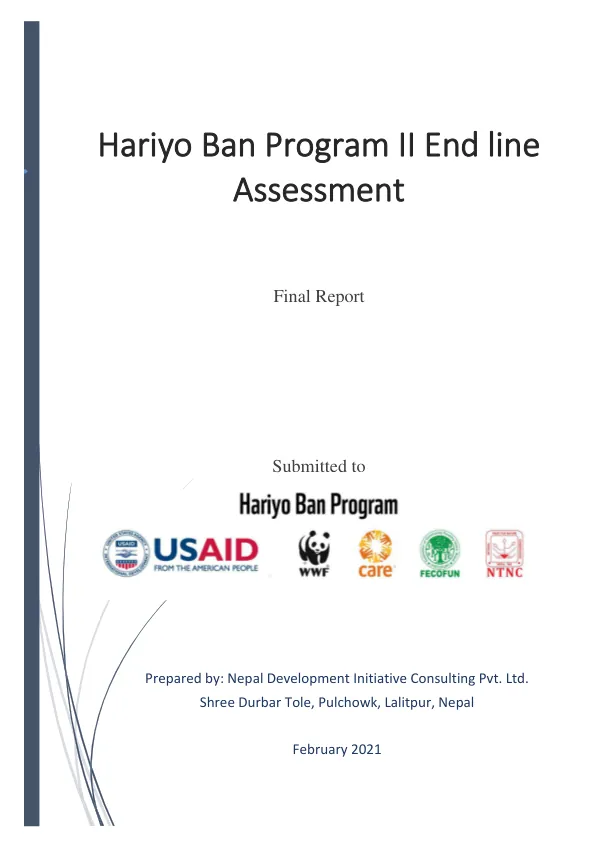
Hariyo Ban Program II End line Assessment
The Hariyo Ban Program II End line Assessment Final Report was submitted to various stakeholders in February 2021.
2021 · 54 pages
Sign in to readA free account is required to download.
Abstract
The report presents the findings of an end line evaluation of the program, which aimed to assess its impact and effectiveness in achieving its objectives. The program, implemented in Nepal, focused on biodiversity conservation, natural resource management, and community development. The evaluation was conducted in six districts, including Kaski, Tanahun, Chitwan, Banke, and Bardiya. The study area was selected based on the program's working areas, which are depicted in Figure 1. The evaluation used a mixed-methods approach, combining both quantitative and qualitative data collection methods. The study involved focus group discussions (FGDs) with community members, household surveys, and executive committee member interviews. The questionnaire used for the household survey is presented in Annex V.1, while the FGD guide is presented in Annex V.2. The evaluation collected data on various socio-economic indicators, including demography, income, and performance indicators. The results showed that the program had a positive impact on the socio-economic conditions of the communities. For instance, the average annual household cash income increased significantly in all districts, with the highest increase observed in the Chitwan district (Figure 3). The evaluation also assessed the program's impact on biodiversity conservation and natural resource management. The results showed that the program had a positive impact on these aspects, with a significant increase in the percentage of respondents involved in conservation activities (Figure 4). The program also provided benefits to respondents involved in conservation activities (Figure 5). In terms of gender equality and social inclusion (GESI), the evaluation found that the program had a positive impact on the GESI behavior of NRM members. The results showed a significant increase in the perception of respondents about the GESI behavior of NRM members from baseline to end line (Figure 6). The evaluation also identified some limitations, including the lack of data on certain indicators and the limited sample size. However, the results provide valuable insights into the impact and effectiveness of the Hariyo Ban Program II. The evaluation concludes that the program had a positive impact on the socio-economic conditions of the communities, biodiversity conservation, and natural resource management. The program also had a positive impact on GESI behavior. The evaluation recommends that the program be continued and scaled up to reach more communities. The report includes several annexes, including the terms of reference, sampled NRM groups, participants of FGD, executive committee members interviewed, and the questionnaire used for the household survey. The report also includes several figures, including a graph showing gender, age, and wellbeing, and a graph showing the annual household cash income in different districts.