DELOITTE CONSULTING, LLP
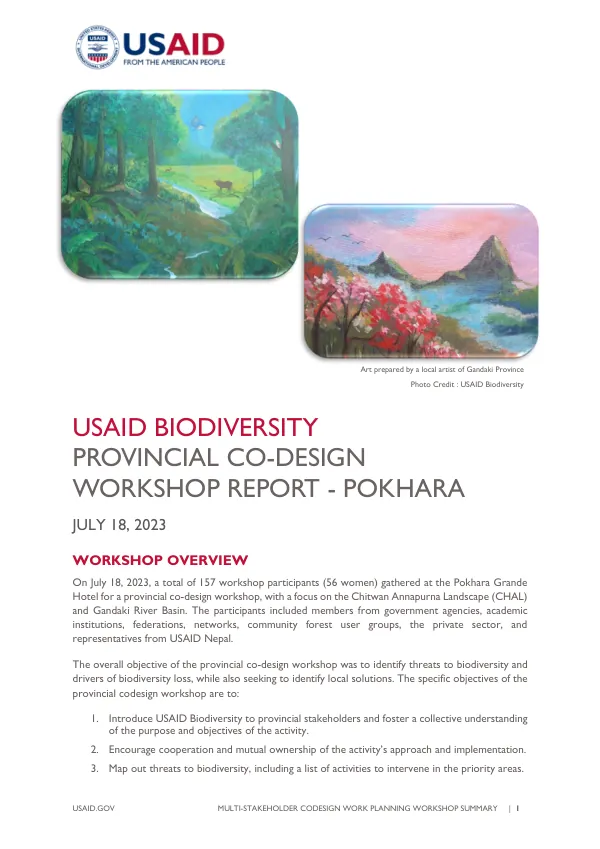
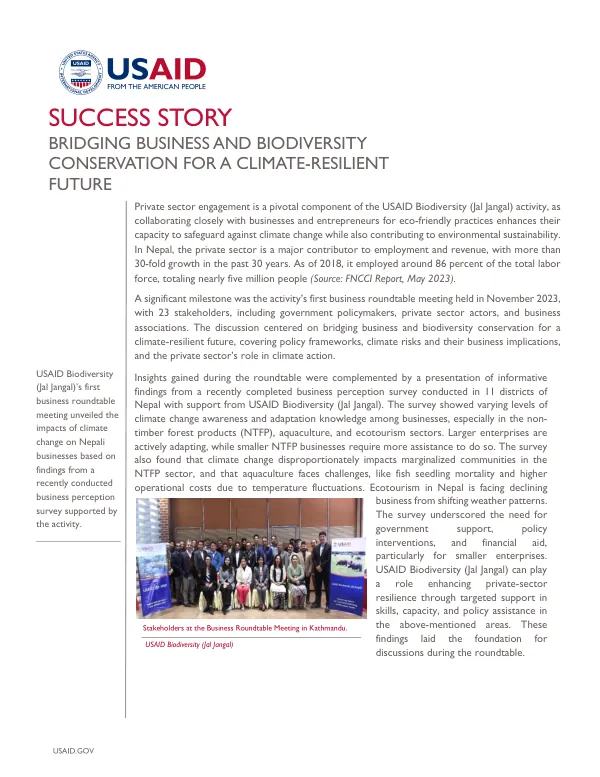
USAID Biodiversity Multi-Stakeholder Co-design Work Planning Workshop Summary
The USAID Biodiversity initiative in Nepal is a 5-year program that aims to empower the next generation of environmental practitioners, strengthen provincial and municipal government, and catalyze new resources for climate adaptation.
2023 · 30 pages
Sign in to readA free account is required to download.
Abstract
The program is built on past successes in Nepal's forestry and freshwater sectors and seeks to reduce multiple threats to the ecosystem and wildlife species to conserve nature, enhance human well-being, and safeguard the future. The initiative has three main objectives: to improve the health of ecosystems in targeted landscapes, to strengthen environmental crime control and natural resource safeguards, and to enhance the climate resilience of natural and human systems. These objectives are underpinned by the USAID Biodiversity Theory of Change, which states that improved conservation of key habitats, ecosystems, and biodiversity, enhanced capacity to develop and implement environmental safeguards, and strengthened climate resilience of human and ecological communities will lead to improved natural resources safeguards and security. A multi-stakeholder co-design work planning workshop was held on January 31, 2023, to collectively work on solutions for USAID Biodiversity. The workshop brought together 105 participants from civil society organizations, the private sector, and USAID Nepal. The objectives of the workshop were to introduce USAID Biodiversity, build a shared understanding of the purpose and objectives, foster collaboration and shared ownership of project design and implementation, co-design strategies to achieve the identified objectives, prioritize activities for year I (March-August 2023), and identify potential partnerships for year I and II. The workshop achieved several process objectives, including identifying dynamic partners across sectors, learning from partners who wished to participate and contribute to achieve USAID Biodiversity goals and objectives, and bringing together different stakeholders from across multiple sectors to share different perspectives and approaches to achieving common goals. The workshop participants were divided into groups to address each of the Solution Areas, which included strengthening natural resource governance capacity at municipal and provincial levels, improving community management of freshwater and forest resources, and enhancing climate resilience of natural and human systems. Each group provided recommendations and ideas for activities, which were presented back to the plenary and discussed. The recommendations for Solution Area 1 included conducting a data-driven policy review and analysis, training and engaging elected representatives, local youth, and women's groups, and formulating and providing customized training resources to government agencies, schools, and the private sector. The recommendations for Solution Area 2 included assessing existing community best practices, encouraging inclusive involvement, and developing demonstration sites for payment for ecosystem services. The recommendations for Solution Area 3 included conducting geo-morphological analysis, hazard and risk assessment, and lobbying and advocacy to influence policy and practice at federal, provincial, and municipal levels. The workshop provided a platform for stakeholders to share their perspectives and ideas, and to co-design strategies to achieve the identified objectives of USAID Biodiversity. The recommendations and ideas generated during the workshop will inform the development of the project's work plan and implementation strategy.