USAID DEC
Harnessing the Power of Behavioral Science: An Implementation Pilot to Improve the Quality of Maternity Care in Rural
Sign inUSAID DEC
Harnessing the Power of Behavioral Science: An Implementation Pilot to Improve the Quality of Maternity Care in Rural
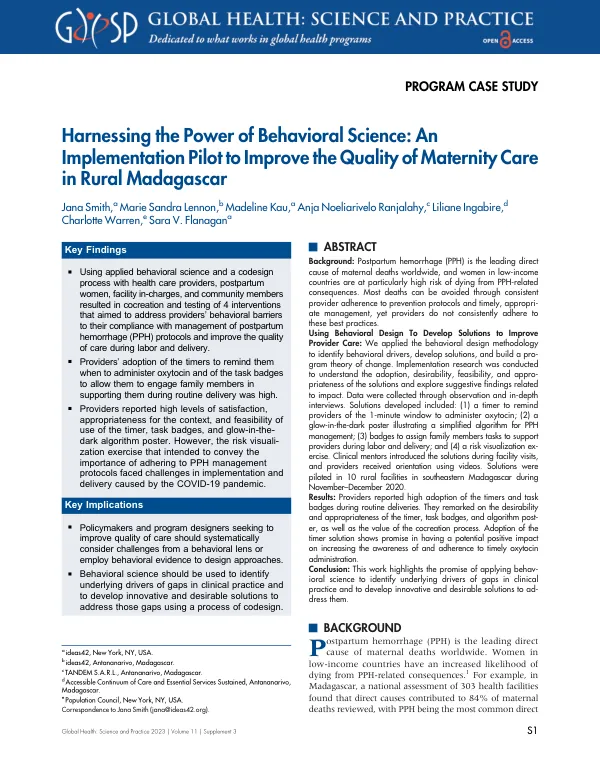
Harnessing the Power of Behavioral Science: An Implementation Pilot to Improve the Quality of Maternity Care in Rural Madagascar Postpartum hemorrhage (PPH) is the leading direct cause of maternal deaths worldwide, with women in low-income countries at a particularly high risk of dying from PPH-related consequences.
2023 · 12 pages
Sign in to readA free account is required to download.
Abstract
Most deaths can be avoided through consistent provider adherence to prevention protocols and timely, appropriate management. Despite the existence of these guidelines, health providers do not consistently adhere to clinical best practices for PPH prevention and management. Using behavioral design to develop solutions to improve provider care, a codesign process was employed with health care providers, postpartum women, facility in-charges, and community members to cocreate and test four interventions aimed at addressing providers' behavioral barriers to their compliance with PPH protocols and improving the quality of care during labor and delivery. The four interventions included a timer to remind providers to administer oxytocin within one minute of birth, a task badge to allow family members to support providers during routine delivery, a glow-in-the-dark poster illustrating a simplified algorithm for PPH management, and a risk visualization exercise to convey the importance of adhering to PPH management protocols. Providers reported high adoption of the timers and task badges during routine deliveries, with high levels of satisfaction, appropriateness, and feasibility of use. However, the risk visualization exercise faced challenges in implementation due to the COVID-19 pandemic. The study highlights the promise of applying behavioral science to identify underlying drivers of gaps in clinical practice and develop innovative and desirable solutions to address them. Policymakers and program designers seeking to improve quality of care should systematically consider challenges from a behavioral lens or employ behavioral evidence to design approaches. Behavioral science should be used to identify underling drivers of gaps in clinical practice and develop innovative and desirable solutions to address them using a process of codesign. The study demonstrates the potential of behavioral design to improve provider compliance with PPH prevention and management protocols and highlights the need for further research in this area. The implementation pilot was conducted in 10 rural facilities in rural Madagascar during November-December 2020. The study's findings suggest that behavioral science can be used to develop and test innovative solutions to improve provider care and reduce maternal mortality. The study's results have implications for the development of quality improvement initiatives and the design of programs aimed at improving provider compliance with clinical best practices. The study's findings also highlight the importance of considering the behavioral drivers of provider behavior and the need for further research in this area. The study's methodology involved a codesign process with health care providers, postpartum women, facility in-charges, and community members to cocreate and test four interventions aimed at addressing providers' behavioral barriers to their compliance with PPH protocols and improving the quality of care during labor and delivery. The study's results suggest that behavioral science can be used to develop and test innovative solutions to improve provider care and reduce maternal mortality. The study's findings have implications for the development of quality improvement initiatives and the design of programs aimed at improving provider compliance with clinical best practices. The study's results also highlight the importance of considering the behavioral drivers of provider behavior and the need for further research in this area. The study's methodology involved a codesign process with health care providers, postpartum women, facility in-charges, and community members to cocreate and test four interventions aimed at addressing providers' behavioral barriers to their compliance with PPH protocols and improving the quality of care during labor and delivery. The study's results also highlight the importance of considering the behavioral drivers of provider behavior and the need for further research in this area.