JOHNS HOPKINS UNIVERSITY
Health Communication Capacity Collaborative (HC3) Capacity Strengthening
The Health Communication Capacity Collaborative (HC3) is a flagship social and behavior change communication (SBCC) project of the USAID.
2015 · 2 pages
Sign in to readA free account is required to download.
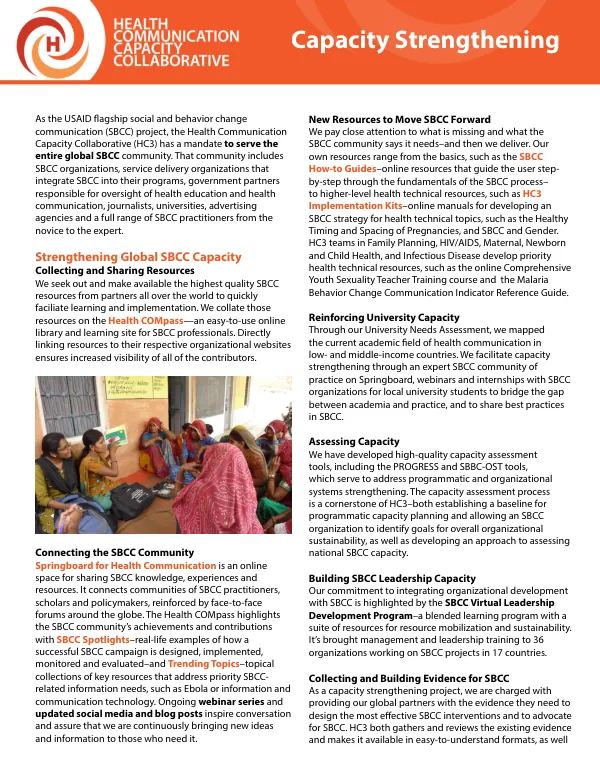
Abstract
HC3 serves the entire global SBCC community, which includes SBCC organizations, service delivery organizations, government partners, journalists, universities, advertising agencies, and a range of SBCC practitioners. HC3's primary goal is to strengthen global SBCC capacity by collecting and sharing high-quality resources from partners worldwide. These resources are made available on the Health COMpass, an online library and learning site for SBCC professionals. The Health COMpass links resources to their respective organizational websites, increasing visibility for contributors. HC3 delivers resources that meet the needs of the SBCC community, ranging from basic SBCC How-to Guides to higher-level health technical resources, such as HC3 Implementation Kits. These kits provide online manuals for developing an SBCC strategy for health technical topics, such as the Healthy Timing and Spacing of Pregnancies and SBCC and Gender. HC3 also focuses on reinforcing university capacity through an expert SBCC community of practice on Springboard, webinars, and internships with SBCC organizations. This helps bridge the gap between academia and practice, sharing best practices in SBCC. HC3 has developed high-quality capacity assessment tools, including the PROGRESS and SBBC-OST tools, which address programmatic and organizational systems strengthening. The capacity assessment process is a cornerstone of HC3, establishing a baseline for programmatic capacity planning and allowing SBCC organizations to identify goals for overall organizational sustainability. HC3's commitment to integrating organizational development with SBCC is highlighted by the SBCC Virtual Leadership Development Program, a blended learning program with a suite of resources for resource mobilization and sustainability. This program has brought management and leadership training to 36 organizations working on SBCC projects in 17 countries. HC3 also collects and builds evidence for SBCC, gathering and reviewing existing evidence and making it available in easy-to-understand formats. This evidence is used to design effective SBCC interventions and advocate for SBCC. HC3 connects the SBCC community through Springboard for Health Communication, an online space for sharing SBCC knowledge, experiences, and resources. This platform connects communities of SBCC practitioners, scholars, and policymakers, reinforced by face-to-face forums around the globe. HC3 Field Support Programs respond to USAID Mission priorities for SBCC, which include implementing impactful programs in pressing health areas and building in-country capacity for SBCC design, implementation, and evaluation. HC3 programs strategically combine implementation with capacity strengthening, tailored to the specific context of each country. HC3 Field Support programs follow a systematic Capacity Improvement Cycle, which includes capacity assessments, capacity strengthening plans, implementation and monitoring, and evaluation. This cycle is designed to maximize impact, combining three approaches: Direct Capacity Strengthening, Collaborative Implementation, and Systems Reinforcement. Direct Capacity Strengthening involves strategically blending a mix of methods, such as coaching, seconding advisors, and facilitating internships, to assist partners in reaching their goals for capacity strengthening in SBCC and organizational development. Collaborative Implementation involves working closely with local partners in the development and implementation of an SBCC campaign, drawing on their experience and expertise. Systems Reinforcement involves working with missions, governments, and local partners to identify gaps and pinpoint high-priority, high-impact activities that will benefit the larger system for SBCC in the country. HC3's work is guided by a commitment to experiential learning, where capacity strengthening is applied on the job for the greatest impact. HC3's global resources are highlighted and made available to reinforce in-country capacity strengthening.