ABT ASSOCIATES
Task-Sharing for Better HIV Care and Treatment in Cote d'Ivoire
Task-sharing for better HIV care and treatment in Côte d'Ivoire is a critical strategy to improve HIV outcomes and provide better care for HIV-positive clients.
2015 · 2 pages
Sign in to readA free account is required to download.
Abstract
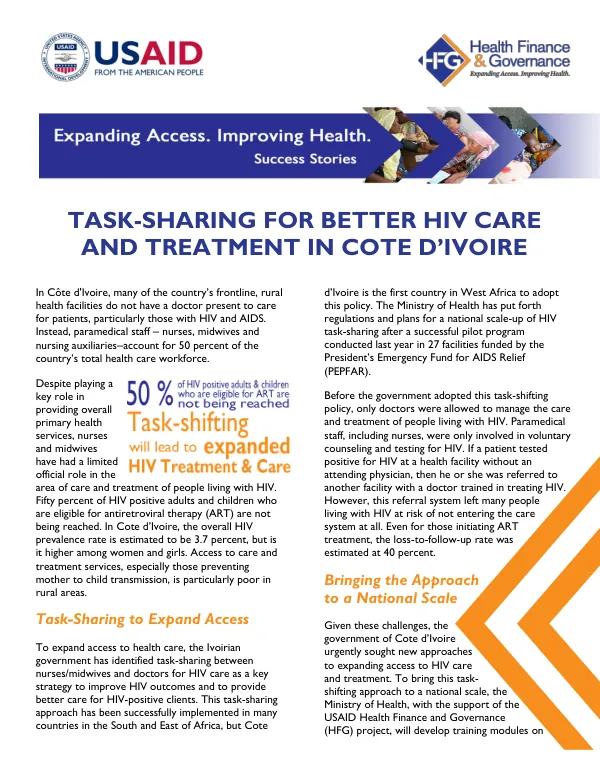
The Ivoirian government has identified task-sharing between nurses/midwives and doctors for HIV care as a key approach to expand access to health care. This approach has been successfully implemented in many countries in the South and East of Africa, but Côte d'Ivoire is the first country in West Africa to adopt this policy. The Ministry of Health has put forth regulations and plans for a national scale-up of HIV task-sharing after a successful pilot program conducted last year in 27 facilities funded by the President's Emergency Fund for AIDS Relief (PEPFAR). Before the government adopted this task-shifting policy, only doctors were allowed to manage the care and treatment of people living with HIV. Paramedical staff, including nurses, were only involved in voluntary counseling and testing for HIV. However, this referral system left many people living with HIV at risk of not entering the care system at all. The loss-to-follow-up rate for those initiating ART treatment was estimated at 40 percent. To address these challenges, the government of Côte d'Ivoire urgently sought new approaches to expanding access to HIV care and treatment. The Ministry of Health, with the support of the USAID Health Finance and Governance (HFG) project, will develop training modules on the principles of Option B+ task-sharing to integrate into pre-service health worker training curricula. Option B+ is a care and treatment approach recommended by the World Health Organization that provides lifelong ART to HIV-positive pregnant women to prevent mother-to-child transmission. The HFG project will facilitate training for teachers and students on the modules, coordinate implementation with other partners involved in HIV service delivery, and monitor and evaluate the program. Soon, more than 350 students from nursing schools in Aboisso and Daloa will begin to apply these skills during their clinical practice rotations. The HFG project will track how many individuals living with HIV have initiated treatment as a result of this new approach to care and treatment. The HFG project is a five-year global health project that supports its partners in low- and middle-income countries to strengthen the health finance and governance functions of their health systems, expanding access to life-saving health services. The project builds on the achievements of the Health Systems 20/20 project and is led by Abt Associates in collaboration with Avenir Health, Broad Branch Associates, Development Alternatives Inc., Johns Hopkins Bloomberg School of Public Health, Results for Development Institute, RTI International, and Training Resources Group, Inc. The project aims to improve the health outcomes of people living with HIV in Côte d'Ivoire by increasing access to HIV care and treatment services, particularly in rural areas.