MINISTRY OF HEALTH
Health Logistics Quarterly, Ethiopia
Commodity Security refers to the availability of essential health commodities, including contraceptives, to all citizens whenever they need them.
2011 · 6 pages
Sign in to readA free account is required to download.
Abstract
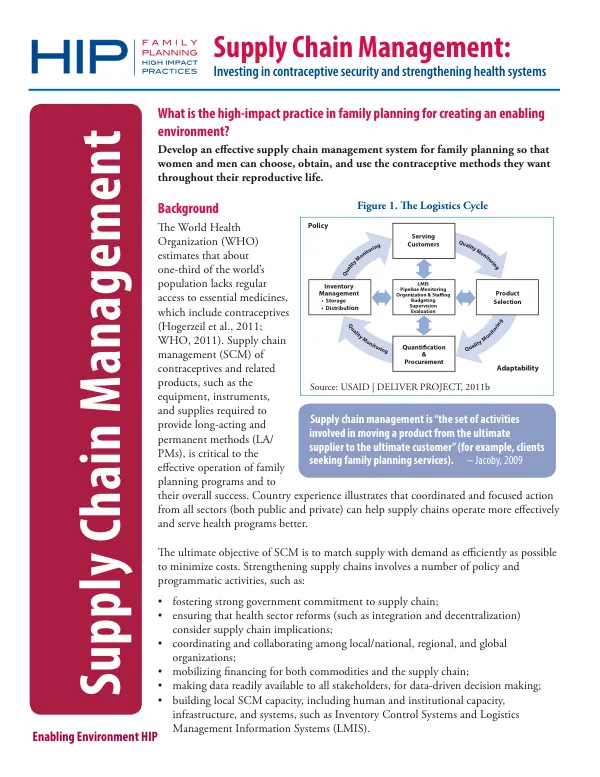
This concept is critical in improving reproductive health outcomes and meeting family planning goals. In Ethiopia, the government and key stakeholders have been working to secure an ever-growing supply of contraceptives and other reproductive health commodities for service delivery points in the health system. The country's contraceptive prevalence rate has increased significantly over the past decade, from 6.3 percent in 2000 to an estimated 29 percent in 2009. To meet this demand, the government and stakeholders have been implementing various strategies to improve contraceptive security. One key approach has been to increase government financial commitments for the purchase of contraceptives. Prior to 2007, all contraceptives were secured through donor and partner support, which often resulted in stockouts and high unmet need for contraceptives. Advocacy efforts by the USAID | DELIVER PROJECT and other reproductive health stakeholders have played a crucial role in promoting the importance of contraceptive security in meeting the Ministry of Health's family planning targets. The project has worked with the Ministry of Health to forecast national requirements for various types of contraceptives, which has allowed the government to identify the gap between demand and anticipated contributions from donors and partners. As a result of these efforts, the government has increased its allocation for contraceptive procurement, with a budget line item for procurement of contraceptives established in 2007. In FY2007-2008, the government increased its allocation to US$ 910,000 from its own internally generated funds, and in 2009, it allocated and used US$20 million from basket funds. The four major regions, Oromia, SNNP, Amhara, and Tigray, have also committed their own funds to support contraceptive security. The implementation of the Integrated Pharmaceutical Logistics System (IPLS) has also contributed to improved contraceptive security. The IPLS is a new logistics management information system that enables facilities to prepare bimonthly commodity requests to the Pharmaceutical Fund and Supply Agency (PFSA) hub warehouse. The system includes three separate but interrelated components: HCMIS Facility Edition, an automated information and inventory management tool for hospitals and selected Health Centers; IPLS paper-based, a manual version for the majority of Health Centers; and the Health Post Resupply program, the information procedures for resupplying Health Posts through Health Centers. Training of Trainers (TOT) was conducted in February 2010, which certified 39 participants as IPLS trainers. These trainers then conducted a three-day IPLS course for more than 170 staff from 80 local Health Centers. The training model allowed the IPLS to reach a large number of Health Centers in a short time and at a lower cost. The Leku Health Center in the SNNP Region is one example of a facility that has benefited from the IPLS implementation. The center has had a steady supply of contraceptives for over a year, and women can come knowing they will be able to obtain their favorite method. The center's staff were trained by the USAID | DELIVER PROJECT in collaboration with PFSA and other partners to calculate the monthly requirements for each contraceptive method and to avoid stockouts. Contraceptive security means making contraceptives available to all women and men who want and need them in each kebele and woreda of Ethiopia. The health center places a contraceptive order every month, and their orders are always filled, which has made a major difference in their ability to provide family planning services.
Related documents