JHPIEGO
USAID/MCSP DRC Quarterly Report: Year 4, Quarter 1 (October 1-December 31, 2018)
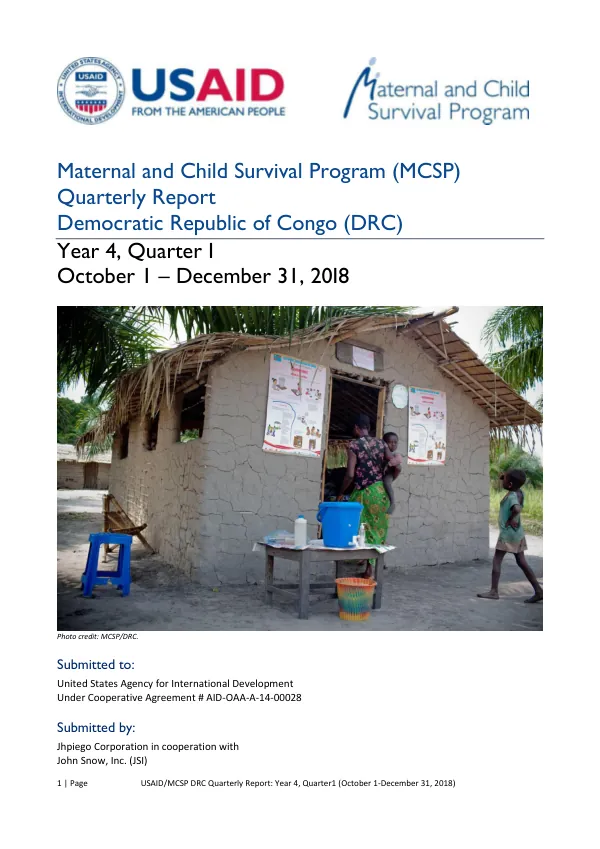
The Maternal and Child Survival Program (MCSP) in the Democratic Republic of Congo (DRC) aims to support the country in institutionalizing effective organizational plans, structures, and processes for the sustainable implementation of evidence-based reproductive, maternal, newborn, and child health (RMNCH) practices.
2018 · 51 pages
Sign in to readA free account is required to download.
Abstract
The program's goal is to accelerate reductions in maternal and child mortality by strengthening national Ministry of Health capacity to strategically scale up cost-effective, evidence-based interventions. To achieve this goal, MCSP has set three objectives. The first objective is to accelerate reductions in maternal and child mortality by strengthening national Ministry of Health capacity to strategically scale up cost-effective, evidence-based interventions. The second objective is to contribute to improved maternal and newborn survival by strengthening the capacity of Congolese health professional organizations at national level to provide quality in-service training and pre-service education on key maternal and newborn health and post-partum family planning interventions. The third objective is to contribute to improved child survival and uptake of family planning methods in under-served rural communities in Tshopo and Bas-Uélé provinces by providing technical support for integrated community case management (iCCM), integrated management of childhood illness (IMCI), water, sanitation and hygiene (WASH), nutrition, and community- and facility-based family planning interventions. MCSP works in close partnership with the Ministry of Health (MOH), USAID, and other reproductive, maternal, newborn and child health (RMNCH) stakeholders to support improved planning, coordination, monitoring, evaluation, documentation, and scale-up of RMNCH activities at the national and provincial levels. The program brings its expertise in maternal, newborn, and child health; family planning (FP); nutrition; water, sanitation, and hygiene (WASH); community engagement; health information systems and other aspects of health systems strengthening; and innovation. At the national level, MCSP works to strengthen the Ministry of Health Directorate of Family and Specific Groups' Health, known as the 10th Directorate (D10), to drive policy development and implementation, updating clinical protocols and guidelines, human resources capacity-building, partner coordination, and financing. MCSP's efforts are geared towards supporting the D10, through the reproductive, maternal, newborn, child, and adolescent health (RMNCAH) Task Force and associated technical working groups, to increase the coverage and mobilize resources for high-impact interventions and accelerate reductions in maternal, neonatal, and child mortality. Under Objective 2, MCSP works with the Congolese professional associations of birth attendants/midwives (UNAAC) and pediatricians (Société de Pédiatrie du Congo Démocratique, SOPECOD) to strengthen the capacity of Congolese health professional organizations at national level to provide quality in-service training and pre-service education on key maternal and newborn health and post-partum family planning interventions. The program's activities are focused on supporting the DRC in achieving its health-related Millennium Development Goals (MDGs) and the Sustainable Development Goals (SDGs). MCSP's efforts are aligned with the DRC's National Health Development Plan (PNDS) and the country's health sector strategic plan. The program's success will contribute to improved maternal and child health outcomes in the DRC and ultimately help to achieve the goal of ending preventable maternal and child deaths (EPMCD) within a generation.
Related documents
Documents in this collection
 2018
2018USAID DEC
Maternal and Child Survival Program (MCSP) Quarterly Report Democratic Republic of Congo (DRC) Year 3, Quarter II January 1 – March 31, 20I8
Open record 2019
2019USAID DEC