USAID DEC
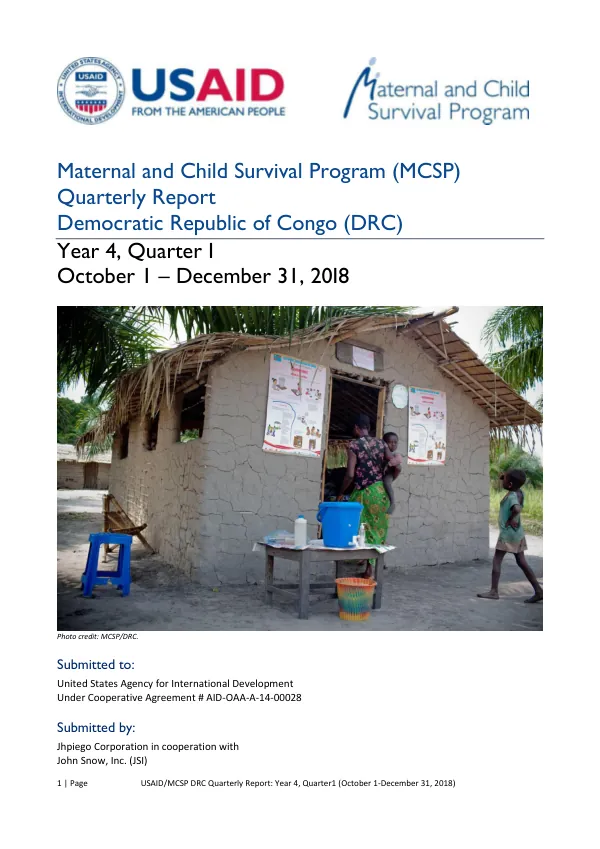
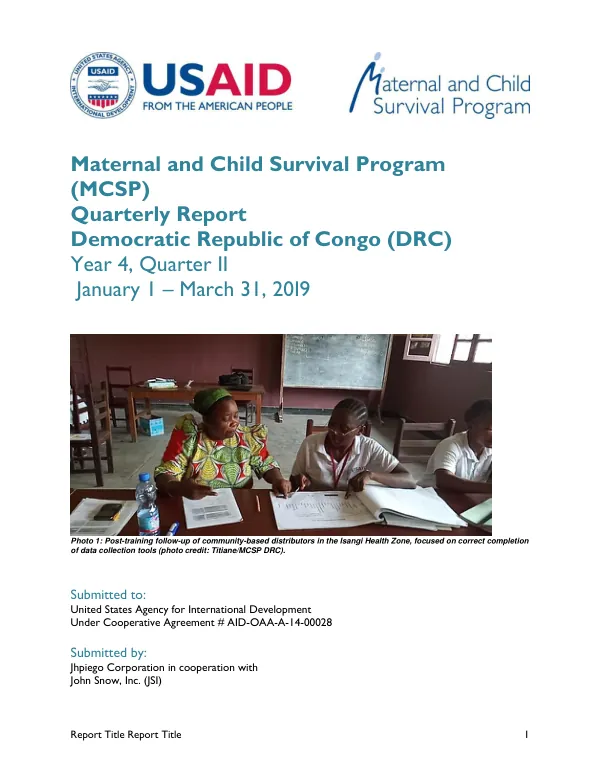
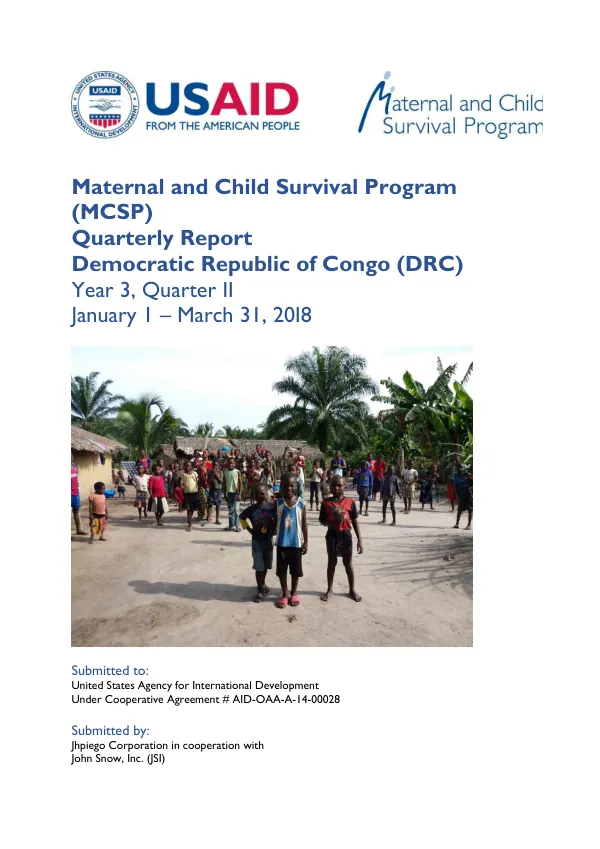
Maternal and Child Survival Program (MCSP) Quarterly Report Democratic Republic of Congo (DRC) Year 3, Quarter II January 1 – March 31, 20I8
Sign inJHPIEGO
Maternal and Child Survival Program (MCSP) Quarterly Report Democratic Republic of Congo (DRC) Year 3, Quarter II January 1 – March 31, 20I8
The Maternal and Child Survival Program (MCSP) in the Democratic Republic of Congo (DRC) aims to support the country in institutionalizing effective organizational plans, structures, and processes for the sustainable implementation of evidence-based reproductive, maternal, newborn, and child health (RMNCH) practices.
2018 · 33 pages
Sign in to readA free account is required to download.
Abstract
The program's goal is to accelerate reductions in maternal and child mortality by strengthening national Ministry of Health capacity to strategically scale up cost-effective, evidence-based interventions. At the national level, MCSP works to strengthen the Ministry of Health Directorate of Family and Specific Groups' Health, known as the 10th Directorate (D10), to drive policy development and implementation, human resources capacity-building, partner coordination, and financing. MCSP's efforts are geared towards supporting the D10, through the reproductive, maternal, newborn, child, and adolescent health (RMNCAH) Task Force and associated technical working groups, to increase the coverage and mobilize resources for high-impact interventions and accelerate reductions in maternal, neonatal, and child mortality. Under Objective 2, MCSP works with Congolese professional associations to improve care for mothers and newborns on the day of birth and to adapt and introduce the Helping Babies Survive (HBS) curricula into in-service training. MCSP is also providing organizational and institutional capacity strengthening to the Congolese professional associations through a sub-agreement with the Canadian University Services Overseas (Cuso) International. In the northeastern provinces of Bas-Uélé and Tshopo, MCSP is working in 8 health zones to strengthen the Provincial Health Office and health zone teams, health facilities, and community care sites, to improve and expand access to child health, family planning, nutrition, and WASH services. MCSP's provincial-level activities aim to support the Provincial Health Office and health zone teams in developing and implementing effective health programs, improving health facility management, and enhancing community engagement and participation in health services. During the second quarter of Year 3 (January 1-March 31, 2018), MCSP's support at the national level was focused on developing the iCCM database and website, training a pool of national trainers on essential family practices, supporting the development of the integrated contract approach, and building the capacity of national health professionals. MCSP also provided technical assistance to the Provincial Health Office and health zone teams in the northeastern provinces to improve the quality of health services and expand access to family planning, nutrition, and WASH services. Quantitative results on selected performance monitoring plan (PMP) indicators are presented in Annex 1. The report highlights the progress made by MCSP in supporting the DRC in achieving its RMNCH goals and objectives, and outlines the challenges and opportunities for future program implementation.
Related documents