USAID DEC
Healthy Fertility Study: Integrating Family Planning within a Community-Based Maternal and Neonatal Health Program in Rural Bangladesh
Sign inJOHNS HOPKINS UNIVERSITY BLOOMBERG SCHOOL OF PUBLIC HEALTH/INFO PROJECT
Healthy Fertility Study: Integrating Family Planning within a Community-Based Maternal and Neonatal Health Program in Rural Bangladesh
The Healthy Fertility Study in Bangladesh aimed to integrate family planning (FP) within a community-based maternal and neonatal health (MNH) program in rural Bangladesh.
2011 · 1 pages
Sign in to readA free account is required to download.
Abstract
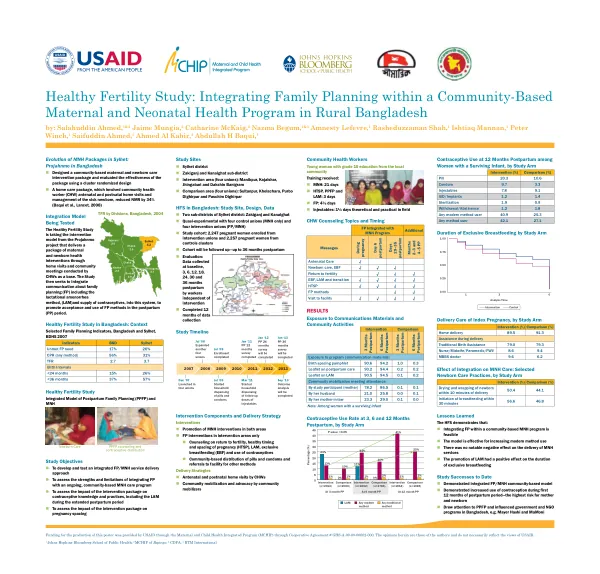
The study built upon the Projahnmo project's intervention model, which delivered a package of MNH interventions through home visits and community meetings conducted by community health workers (CHWs). The Healthy Fertility Study sought to integrate communication about FP, including the lactational amenorrhea method (LAM) and supply of contraceptives, into this system to promote acceptance and use of FP methods in the postpartum (PP) period. The study was conducted in Sylhet district, with two sub-districts of Zakiganj and Kanaighat serving as the study sites. A quasi-experimental design was employed, with four control unions receiving only MNH services and four intervention unions receiving both MNH and FP services. The study cohort consisted of 2,247 pregnant women enrolled from intervention unions and 2,257 pregnant women from control clusters. The cohort was followed up for up to 36 months postpartum, with data collected at baseline, 3, 6, 12, 18, 24, 30, and 36 months postpartum. The intervention package included promotion of MNH interventions in both areas, FP interventions in intervention areas only, counseling on return to fertility, healthy timing and spacing of pregnancy (HTSP), LAM, exclusive breastfeeding (EBF), and use of contraceptives. Community-based distribution of pills and condoms and referrals to facilities for other methods were also provided. CHWs conducted antenatal and postnatal home visits, and community mobilizers conducted community mobilization and advocacy. The study found that exposure to communications materials and community activities was higher in the intervention arm compared to the control arm. Contraceptive use rates at 3, 6, and 12 months postpartum were also higher in the intervention arm, with a significant increase in the use of modern methods. The study demonstrated that integrating FP within a community-based MNH program is feasible and effective for increasing modern method use. The promotion of LAM had a positive effect on the duration of exclusive breastfeeding. The study's findings have implications for the development of integrated FP/MNH community-based models in Bangladesh and other low-resource settings. The study's successes include demonstrating an integrated FP/MNH community-based model, increased use of contraception during the first 12 months of the postpartum period, and drawing attention to postpartum family planning (PPFP) and influencing government and NGO programs in Bangladesh.
Related documents