MERCY CORPS INTERNATIONAL
Healthy Practices, Strong Communities in Karamoja: Mechanized Tillage Program
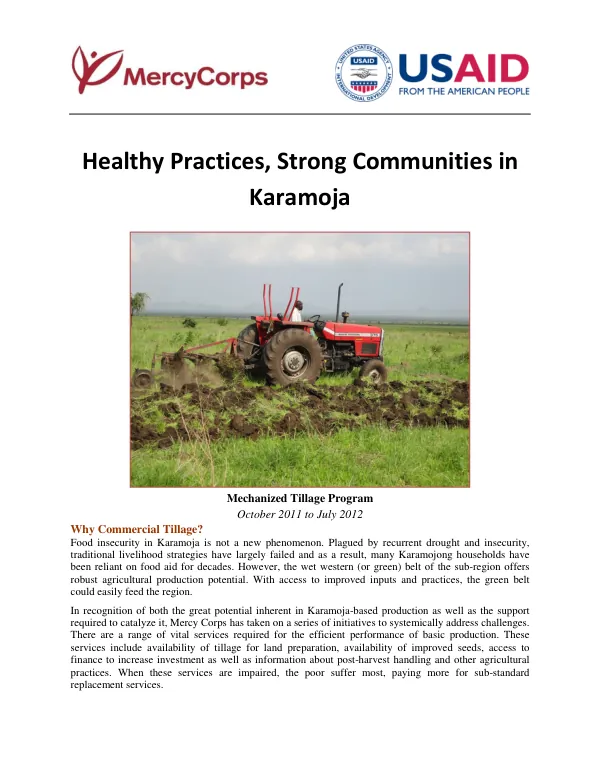
Mechanized Tillage Program in Karamoja was implemented from October 2011 to July 2012 by Mercy Corps to address food insecurity in the region.
2012 · 4 pages
Sign in to readA free account is required to download.
Abstract
The program aimed to provide mechanized tillage services to subsistence farmers in northern Karamoja, leveraging the region's agricultural production potential. The initiative was part of a broader effort by Mercy Corps to systemically address challenges in Karamoja-based production. The program's rationale was based on the recognition that traditional livelihood strategies in Karamoja had largely failed, resulting in decades of reliance on food aid. However, the wet western belt of the sub-region offered robust agricultural production potential, which could be harnessed with access to improved inputs and practices. The program's goal was to catalyze agricultural production in Karamoja by providing essential services, including tillage, improved seeds, access to finance, and information on post-harvest handling and other agricultural practices. During the 2012 planting season, Mercy Corps worked to identify local service providers willing to meet the demand for tillage services in northern Karamoja. Despite months of bank negotiation and discussion, applications were denied at the branch level, and Mercy Corps was unable to secure the level of tractors required through local provision. As a result, the organization brought in outside service providers while continuing to contract locally where possible. The program's demand was initially high, with 33,884 acres and 635 beneficiaries registered for the 50:50 cost-share program. However, the program covered only 4,100 acres and 228 immediate beneficiaries due to limited tractor supply and weak commitment in some target areas. The criterion for tillage was determined at 10-30 acres, with one registered beneficiary potentially receiving a greater benefit than planned due to shared land ownership. Tillage was monitored and supported by Tillage Management Committees, selected and trained early on. The program's supply was secured through a rigorous tender process, which resulted in four service providers being selected. However, the process was constrained by the presence of tree stumps and other impediments in some areas, which impeded progress. The program's achievement was significant, with just over 50% of the original target of 4,100 acres being ploughed. Contributing factors to the completion of only half of the land expected to be ploughed included slow progress in areas with many tree stumps, lack of rain, and lack of resources from the communities. The number of individuals benefiting from tillage is expected to be approximately 1,596, although this number may be slightly lower due to shared registration forms. The program has demonstrated a demand for paid tillage services, which has enticed interest from service providers to grow supply. As a direct result of Mercy Corps' activities, two additional tractors are on the ground in northern Karamoja, and there is demonstrable interest from other service providers to purchase tractors to meet the demand. The constraint now is not demonstrating that customers are there but in facilitating potential service providers to access the finance required to buy tractors to meet the demand in a risk-adverse banking environment. Key lessons learned from the program include the need for a more accurate measure of demand and farmers' commitment to pay for the service, as well as better measurements of capacity for tillage providers. Increasing competition is the best long-term strategy for ensuring high-quality, responsive service provision. Working with area bank branches was not a successful strategy, and going forward, working on a larger tillage scheme and approaching banks at the national level is required.