USAID DEC
Healthy Timing and Spacing of Pregnancies and Family Planning: Successful Approaches and Community Voices from Garba Tulla, Kenya (June 2019)
Sign inUSAID
Healthy Timing and Spacing of Pregnancies and Family Planning: Successful Approaches and Community Voices from Garba Tulla, Kenya (June 2019)
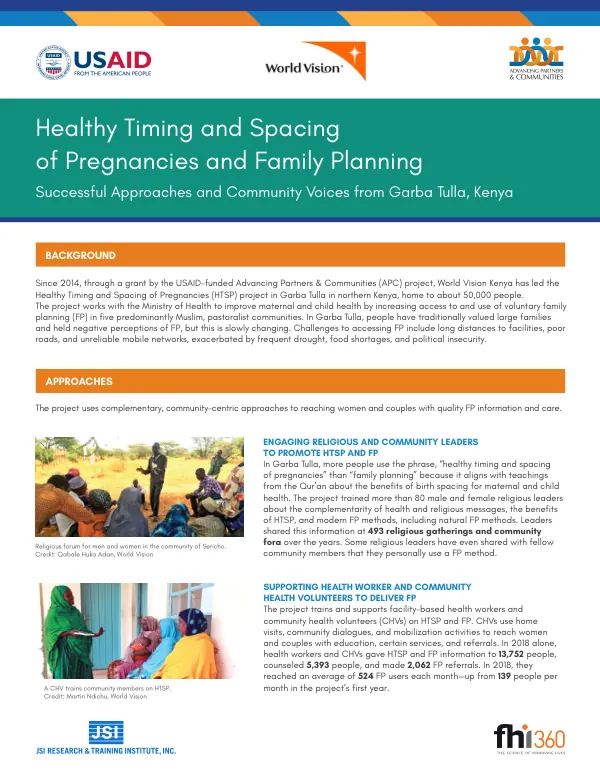
The Healthy Timing and Spacing of Pregnancies (HTSP) project in Garba Tulla, Kenya, has been implemented since 2014 through a grant by the USAID-funded Advancing Partners & Communities (APC) project.
2019 · 3 pages
Sign in to readA free account is required to download.
Abstract
The project aims to improve maternal and child health by increasing access to and use of voluntary family planning (FP) in five predominantly Muslim, pastoralist communities. Garba Tulla, home to approximately 50,000 people, has traditionally valued large families and held negative perceptions of FP, but these attitudes are slowly changing. The project engages men as supportive partners for HTSP through male-only dialogues and community activities. Men learn about the importance of FP and how to help their wives stay healthy, such as by accompanying them to health facilities. At each facility, the project introduces male-only corners where men can hear about health topics from community health volunteers (CHVs) and other facility staff while they wait for their wives. This approach has led to increased male participation in FP discussions and decision-making. The project also supports a mother-to-mother savings group in each community, which provides an opportunity for women to learn about HTSP, FP, and health; participate in a savings scheme; and develop skills for conducting income-generating activities. These groups have been successful in promoting women's participation in health and development. For example, Safia Wario Dida, a CHV and mother-to-mother savings group member, has seen her business thrive due to her involvement in the group. To improve health service accountability, the project involves the Garba Tulla communities in a process called Citizen Voice and Action (CVA), which trains and engages community members, health workers, and county officials on social accountability, action planning, and planning. This approach has led to improvements in health facility infrastructure, such as the installation of electricity and a direct water connection at the Sericho health dispensary. The project has also seen success in promoting the use of FP methods among women. For example, Nuria Boru and her husband, Salad Guyo, decided to choose a FP method suitable for them after hearing about HTSP at a sensitization forum in their village. They initially opted for the lactational amenorrhea method but later decided to switch to an injectable contraceptive. Asili Guyo, a 22-year-old woman, also credits her husband's sensitization on HTSP and FP for her decision to use an implant to space her next birth. The project has also seen improvements in maternal and child health outcomes. For example, the number of women and men receiving voluntary, integrated FP care has increased significantly, with 13,480 individuals receiving care over the course of the project. The project has also seen a 27% increase in household income among program participants compared to the control group. The project's success can be attributed to its community-based approach, which engages men and women in FP discussions and decision-making. The project's focus on improving health service accountability and promoting women's participation in health and development has also contributed to its success. The project's impact on maternal and child health outcomes is a testament to the effectiveness of community-based approaches to improving health outcomes.