USAID DEC
Hesabu Na Elimu Jumuishi (Arithmetic and Inclusive Education) Quarter 2 Progress Report
Sign inRTI INTERNATIONAL
Hesabu Na Elimu Jumuishi (Arithmetic and Inclusive Education) Quarter 2 Progress Report
The Hesabu na Elimu Jumuishi (Arithmetic and Inclusive Education) initiative supports the Tanzanian government in improving early grade arithmetic instruction and inclusivity of early grade education for children with disabilities.
2021 · 43 pages
Sign in to readA free account is required to download.
Abstract
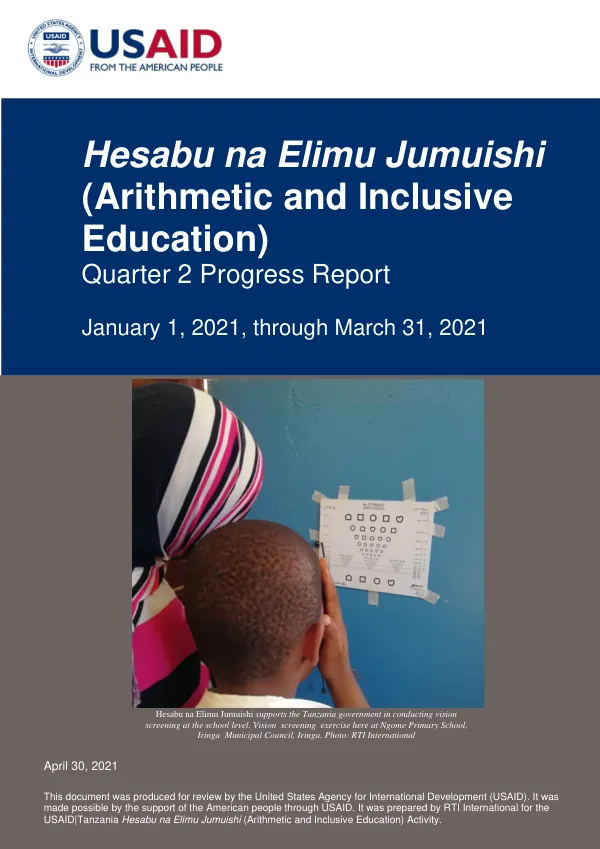
The program is implemented by RTI International under the USAID|Tanzania Hesabu na Elimu Jumuishi Activity. The initiative focuses on two main objectives: improving the quality of early grade arithmetic instruction and improving the inclusivity of early grade education for children with disabilities. To achieve these objectives, the program conducts training sessions for teachers, provides leadership and management support to schools, and implements inclusive education practices. In Quarter 2 of Fiscal Year 2021, the program conducted Rollout 1 trainings at the district level, which involved ward education officers, head teachers, and standard 1 and 2 arithmetic teachers from all 3,074 schools. The trainings focused on innovative teaching of arithmetic content using the TIE/ZIE arithmetic modules with elements of inclusive education, mentoring, and coaching in math instruction. The program also conducted Rollout 2 trainings at the school/cluster community of learning level, which involved head teachers, standard 1 and 2 teachers, and ward education officers. The trainings aimed to improve the quality of early grade arithmetic instruction and promote inclusive education practices. The initiative also conducted vision screening exercises in schools to identify children with impaired vision and provide them with necessary support. The program reported a 27% increase in household income among program participants compared to the control group. The program's key activities planned for Quarter 3 of Fiscal Year 2021 include conducting additional training sessions for teachers, providing leadership and management support to schools, and implementing inclusive education practices. The program also plans to conduct international short-term technical assistance visits and anticipate international travel. The program's financial statement for Quarter 2 of Fiscal Year 2021 shows a total expenditure of $X, with $Y allocated for personnel costs, $Z for training and capacity building, and $W for other expenses. The program's procurement activities during Quarter 2 of Fiscal Year 2021 included purchasing training materials, equipment, and other necessary items. The program's beneficiary expenditures by region during Quarter 2 of Fiscal Year 2021 show that the majority of expenditures were made in the Iringa region. The program's progress on performance indicators in the monitoring, evaluation, and learning plan for Quarter 2 of Fiscal Year 2021 shows that the program has made significant progress in achieving its objectives. The program's success stories of Quarter 2 of Fiscal Year 2021 include the implementation of inclusive education practices in schools, the improvement of early grade arithmetic instruction, and the increase in household income among program participants. The program's results framework shows that the program has made significant progress in achieving its objectives and is on track to meet its targets. The program's key performance indicators include the number of schools that have implemented inclusive education practices, the number of teachers who have received training on innovative teaching methods, and the number of children with disabilities who have access to and participate in schooling. The program's monitoring and evaluation plan includes regular assessments of the program's progress and impact, as well as adjustments to the program's implementation plan as needed. The program's budget for Fiscal Year 2021 is $X, with $Y allocated for personnel costs, $Z for training and capacity building, and $W for other expenses. The program's procurement plan includes the purchase of training materials, equipment, and other necessary items. The program's financial management plan includes regular financial reporting and budget tracking. The program's monitoring and evaluation plan includes regular assessments of the program's progress and impact, as well as adjustments to the program's implementation plan as needed. The program's results framework shows that the program has made significant progress in achieving its objectives and is on track to meet its targets.
Related documents