USAID DEC
Listen Up!: How can social and behavior change programming improve reproductive health and family planning behaviors of out-of-school youth in the Philippines?
Sign inAVENIR HEALTH
Listen Up!: How can social and behavior change programming improve reproductive health and family planning behaviors of out-of-school youth in the Philippines?
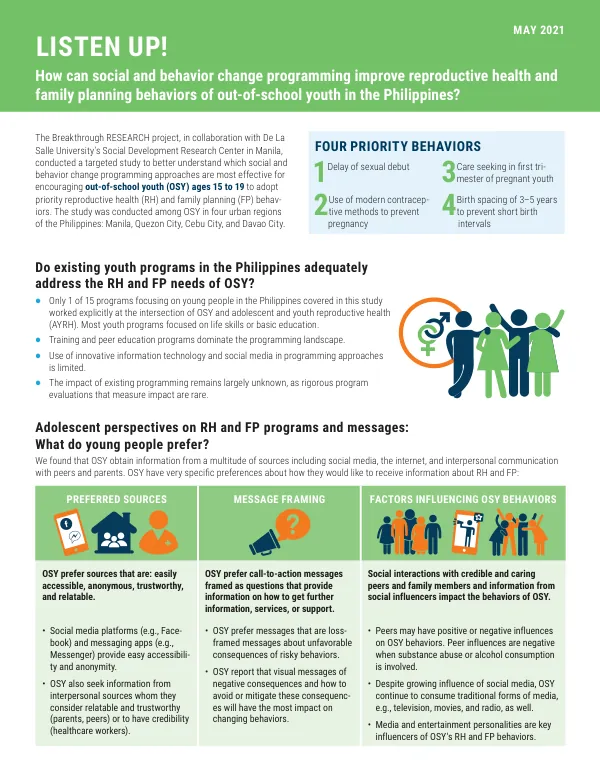
The Breakthrough RESEARCH project, in collaboration with De La Salle University's Social Development Research Center in Manila, conducted a targeted study to better understand which social and behavior change programming approaches are most effective for encouraging out-of-school youth (OSY) ages 15 to 19 to adopt priority reproductive health (RH) and family planning (FP) behaviors in the Philippines.
2021 · 2 pages
Sign in to readA free account is required to download.
Abstract
The study was conducted among OSY in four urban regions of the Philippines: Manila, Quezon City, Cebu City, and Davao City. The study identified four priority behaviors for OSY: delay of sexual debut, use of modern contraceptive methods to prevent pregnancy, care seeking in the first trimester of pregnant youth, and birth spacing of 3-5 years to prevent short birth intervals. However, existing youth programs in the Philippines were found to inadequately address the RH and FP needs of OSY. Only one of 15 programs focusing on young people in the Philippines worked explicitly at the intersection of OSY and adolescent and youth reproductive health (AYRH). Most youth programs focused on life skills or basic education, and training and peer education programs dominated the programming landscape. Adolescent perspectives on RH and FP programs and messages revealed that OSY obtain information from a multitude of sources, including social media, the internet, and interpersonal communication with peers and parents. OSY have specific preferences about how they would like to receive information about RH and FP, including easily accessible, anonymous, trustworthy, and relatable sources. They prefer call-to-action messages framed as questions that provide information on how to get further information, services, or support. Social interactions with credible and caring peers and family members and information from social influencers impact the behaviors of OSY. The study found that social media platforms and messaging apps provide easy accessibility and anonymity, while OSY also seek information from interpersonal sources whom they consider relatable and trustworthy. OSY prefer messages that are loss-framed, focusing on unfavorable consequences of risky behaviors. Visual messages of negative consequences and how to avoid or mitigate these consequences will have the most impact on changing behaviors. Peer influences can be positive or negative, with negative influences when substance abuse or alcohol consumption is involved. Media and entertainment personalities are key influencers of OSY's RH and FP behaviors. The study's findings suggest that existing programs reaching OSY with life skills and basic education should partner with programs tailored to the RH and FP needs of OSY, especially for those aged 15 to 19. Social media messages should be framed according to the preferences of young people, using call-to-action messages that are framed as questions and loss-framed messages about unfavorable consequences of risky behaviors. AYRH programs should also target those who OSY report to be trusted advisors, including parents, peers, and healthcare workers with messages on how to speak to youth about these issues. Programs should monitor and work directly with popular social media platforms to ensure that they are safe and do not encourage risky behaviors. SBC programming must be designed to be sensitive to the cultural, social, and religious norms of the Philippines, recognizing that culture is a central theme in how reproductive health and FP behaviors are shaped.
Related documents