USAID DEC
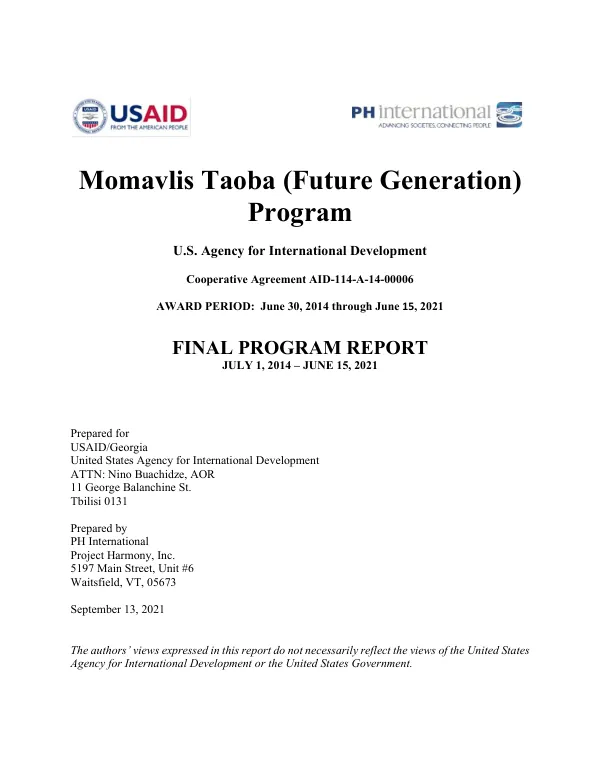
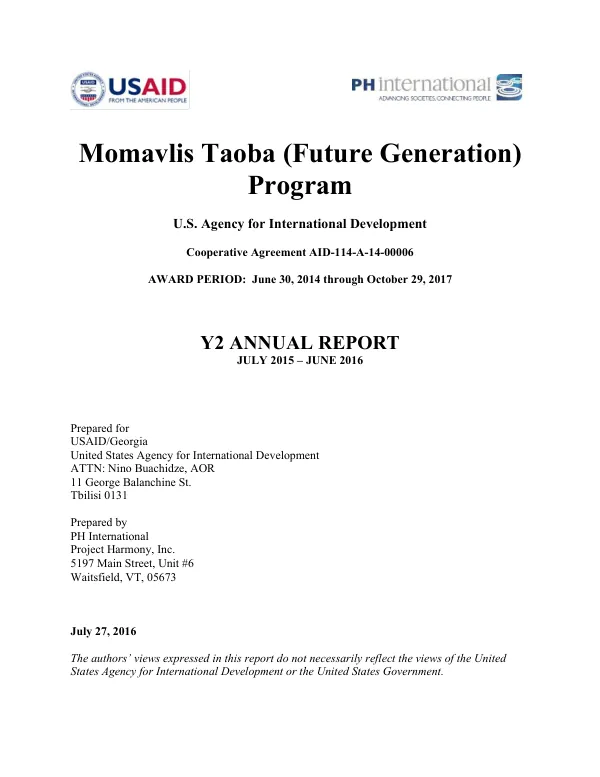
HIV Interventions for Most-Risk Populations (HIV-MARPS) or Momavls Taoba (Future Generation) Program Y2 Annual Report
Sign inMINISTRY OF EDUCATION AND CULTURE
HIV Interventions for Most-Risk Populations (HIV-MARPS) or Momavls Taoba (Future Generation) Program Y2 Annual Report
The Momavlis Taoba (Future Generation) Program aims to promote civic engagement among young people and expand the role of civil society in promoting transparent and accountable governance in Georgia.
2016 · 55 pages
Sign in to readA free account is required to download.
Abstract
The program builds on the progress made by the Applied Civic Education and Teacher Training Program (ACETT) and seeks to reach an additional 20% of secondary schools across the country. The program's objectives include improving the quality and scope of school-based civic education, influencing the knowledge, attitudes, and behaviors of youth, and promoting active participation in Georgia's democratic society. The program will engage 480 schools across 11 regions of Georgia, including Tbilisi, and will partner with regional non-governmental organizations to mobilize collaboration among young people, civil society, local authorities, and other stakeholders. The program will introduce additional approaches to promoting applied learning by students in school civics classes, seeking to maximize the translation of learning into action. The program's activities include working with teachers, students, and communities to engage them as partners in civic education and practical applications. The program will deliver a modern teacher training course for civics teachers to assist them in meeting civics curriculum goals for students in grades 9-12. The program will also update and deliver supplemental textbooks to teachers and students in the 480 treatment schools. The program will work with the Civics Teachers Forum and the Ministry of Education and Science to provide a supportive system of resources and incentives to civics teachers. The program will also facilitate local, regional, and national activities to promote civic engagement and promote the role of civil society in governance. The program will introduce multiple approaches to encourage and support students in applying their civics lessons in their schools and communities. The program will engage with regional NGOs to take advantage of their knowledge of regional differences and approaches to mobilizing collaboration among young people, civil society, local authorities, and other stakeholders. The program will also provide mini-grants for student-created projects and will facilitate the use of social media for civic initiatives. The program's activities will be implemented in partnership with the Ministry of Education and Science, the Civics Teachers Forum, and regional NGOs. The program will also engage with local authorities and other stakeholders to promote civic engagement and promote the role of civil society in governance. The program's results will be measured through an integrated set of program activities, including the engagement of teachers, students, and communities in civic education and practical applications. The program will also track the use of supplemental textbooks and the effectiveness of the teacher training course. The program will evaluate the impact of the mini-grant program and the use of social media for civic initiatives. The program's activities will be implemented over a period of three years, from 2014 to 2017. The program will be implemented in partnership with the Ministry of Education and Science, the Civics Teachers Forum, and regional NGOs. The program will engage with local authorities and other stakeholders to promote civic engagement and promote the role of civil society in governance. The program's budget will be allocated to support the implementation of the program's activities, including the engagement of teachers, students, and communities in civic education and practical applications. The program will also allocate funds to support the development of supplemental textbooks and the implementation of the teacher training course. The program's evaluation will be conducted through a combination of quantitative and qualitative methods, including surveys, focus groups, and case studies. The evaluation will assess the program's impact on civic engagement and the role of civil society in governance. The evaluation will also assess the effectiveness of the program's activities and the program's overall performance. The program's results will be reported to the USAID/Georgia and will be used to inform future program development and implementation. The program's evaluation will also provide valuable insights into the effectiveness of the program's activities and the program's overall performance.