USAID DEC
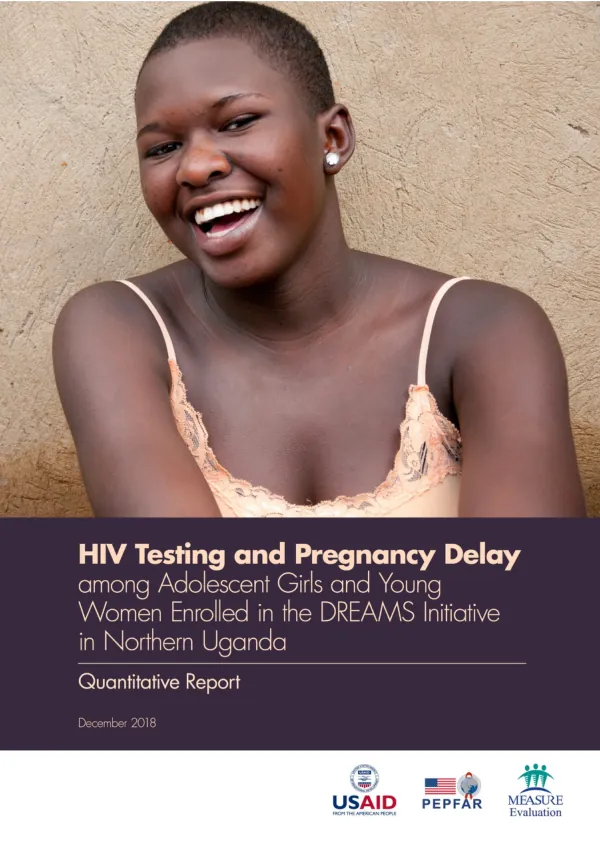
HIV Testing and Pregnancy Delay among AGYW Enrolled in the DREAMS Initiative in Northern Uganda
Sign inMEASURE EVALUATION PRH
HIV Testing and Pregnancy Delay among AGYW Enrolled in the DREAMS Initiative in Northern Uganda
The DREAMS initiative in Northern Uganda was launched in 2015 as part of the United States President's Emergency Plan for AIDS Relief (PEPFAR) to reduce HIV incidence among adolescent girls and young women (AGYW) ages 10 to 24 years.
2019 · 43 pages
Sign in to readA free account is required to download.
Abstract
The program provides HIV testing along with other interventions to address the structural drivers that directly and/or indirectly increase AGYW's HIV risk. The DREAMS strategy aims to provide combinations of services, including HIV testing, to beneficiaries based on their characteristics. The study objectives were to examine the trends in pregnancy delay among AGYW with a birth by age 15, family planning uptake, and DREAMS program coverage of HIV testing. The study setting was Northern Uganda, with a focus on the districts of Omoro, Gulu, Oyam, and Lira. The study design was a retrospective analysis of data from the Uganda DREAMS-OVC Tracking System (UDTS) and the Demographic and Health Survey (DHS). The analysis revealed that the proportion of 15- to 24-year-old girls in Northern Uganda enrolled in DREAMS was 12.1% in 2015 and increased to 24.1% by 2017. The characteristics of DREAMS beneficiaries at the time of enrollment were analyzed, showing that 71.4% were between 15 and 19 years old, 55.6% were in school, and 45.5% were married or in a union. The median time in months from birth to next pregnancy was 24 months, with a significant decrease in the time trend from 2001 to 2016. The analysis also showed that family planning uptake among AGYW enrolled in DREAMS increased over time, with 44.1% of beneficiaries receiving any type of family planning method in 2015 and 64.5% in 2017. The most common family planning methods used were implants and injectables. HIV testing and retesting during DREAMS implementation were also analyzed, showing that 83.2% of beneficiaries received HIV testing and 71.4% received retesting. The study concluded that the DREAMS initiative in Northern Uganda has been successful in increasing family planning uptake and HIV testing among AGYW. However, there is still a need to improve the coverage of HIV retesting and to address the structural drivers that increase AGYW's HIV risk. The study recommends that the DREAMS program continue to provide comprehensive services, including HIV testing, family planning, and economic empowerment, to AGYW in Northern Uganda. The study's findings have implications for the DREAMS program and other initiatives aimed at reducing HIV incidence among AGYW in sub-Saharan Africa. The study highlights the importance of providing comprehensive services to AGYW, including HIV testing, family planning, and economic empowerment, to address the structural drivers that increase their HIV risk. The study also emphasizes the need for continued monitoring and evaluation of the DREAMS program to ensure its effectiveness in reducing HIV incidence among AGYW. The study's methodology involved a retrospective analysis of data from the UDTS and DHS. The UDTS provided data on DREAMS beneficiaries, including their demographic characteristics, family planning uptake, and HIV testing status. The DHS provided data on the demographic and health characteristics of the population in Northern Uganda. The study used statistical analysis to examine the trends in pregnancy delay, family planning uptake, and DREAMS program coverage of HIV testing. The study's limitations include the reliance on secondary data, which may not be comprehensive or accurate. Additionally, the study's sample size was limited to the districts of Omoro, Gulu, Oyam, and Lira, which may not be representative of the entire region. Despite these limitations, the study provides valuable insights into the effectiveness of the DREAMS initiative in reducing HIV incidence among AGYW in Northern Uganda.