USAID DEC
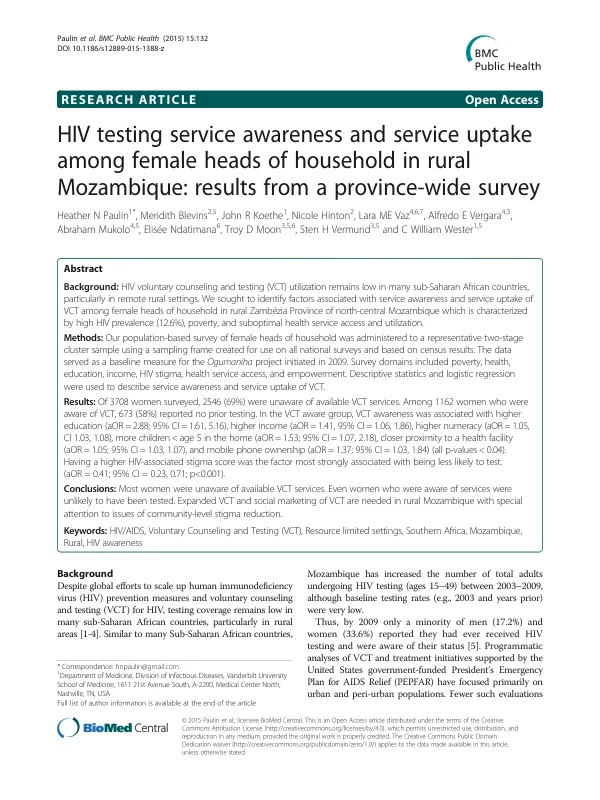
HIV testing service awareness and service uptake among female heads of household in rural Mozambique: results from a province-wide survey
Sign inLAPOP – VANDERBILT UNIVERSITY
HIV testing service awareness and service uptake among female heads of household in rural Mozambique: results from a province-wide survey
The HIV testing service awareness and service uptake among female heads of household in rural Mozambique were investigated through a province-wide survey.
2015 · 11 pages
Sign in to readA free account is required to download.
Abstract
The survey was conducted in Zambézia Province, which is characterized by high HIV prevalence, poverty, and suboptimal health service access and utilization. The province has a predominantly rural population of approximately 3.8 million persons, with a high HIV prevalence of 12.6% among individuals aged 15-64 in 2009. The survey was part of the 5-year Strengthening Communities through Integrated Programming (SCIP) project, also known as Ogumaniha, which was initiated as a multi-faceted health and economic development initiative financed by the United States Agency for International Development (USAID) in Zambézia Province, Mozambique. The survey was conducted in 2010 and involved a representative sample of over 3,700 female heads of household throughout the province, including many remote communities. The survey found that most women were unaware of available HIV testing services, with 69% of the 3,708 women surveyed reporting no knowledge of voluntary counseling and testing (VCT) services. Among the 1,162 women who were aware of VCT services, 58% reported no prior testing. The survey identified several factors associated with VCT service awareness and utilization, including higher education, higher income, higher numeracy, more children under the age of 5 in the home, closer proximity to a health facility, and mobile phone ownership. The survey also found that having a higher HIV-associated stigma score was the factor most strongly associated with being less likely to test for HIV. The results of the survey suggest that expanded VCT and social marketing of VCT are needed in rural Mozambique, with special attention to issues of community-level stigma reduction. The survey highlights the need for increased access to VCT services, particularly in rural areas, where the burden of HIV disease is disproportionately high among women. The survey's findings have implications for the design and implementation of HIV prevention and treatment programs in rural Mozambique. The results suggest that programs should focus on increasing awareness and access to VCT services, particularly among women who are most vulnerable to HIV infection. Additionally, programs should address the issue of HIV-associated stigma, which is a significant barrier to VCT service utilization. By addressing these issues, programs can help to reduce the burden of HIV disease in rural Mozambique and improve the health and well-being of women and their families.