FHI360
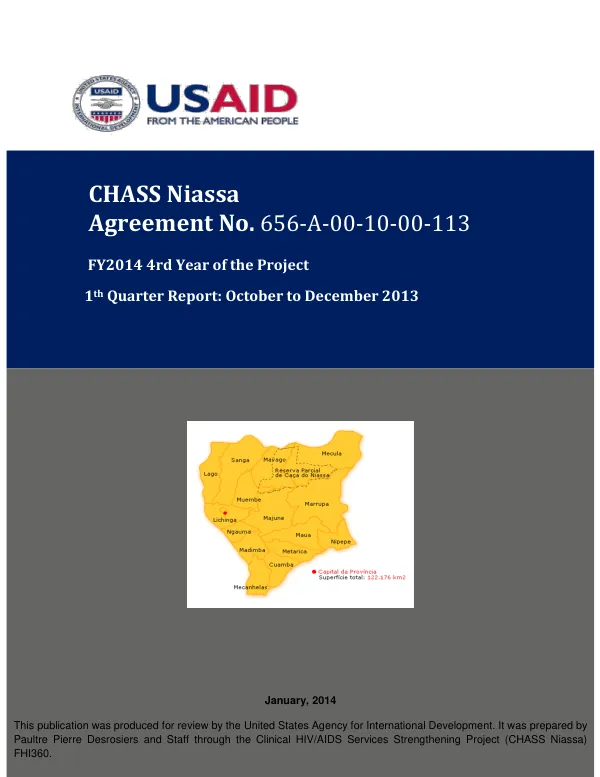
Thirteenth Quarterly Status Report: October to December 2013
The Clinical HIV/AIDS Services Strengthening Project (CHASS Niassa) is a project implemented in Niassa Province, Mozambique, with funding from the United States Agency for International Development (USAID).
2013 · 44 pages
Sign in to readA free account is required to download.
Abstract
The project aims to strengthen the health system and improve access to comprehensive HIV prevention, care, and treatment services for women, children, and families living with and affected by HIV and AIDS. The project has made significant progress in expanding the number of sites delivering Antiretroviral Therapy (ART) treatment across the province, from 42 to 46 health facilities. Decentralized delivery of ART, prevention, and care has been supported, with broader involvement of communities and people living with HIV/AIDS. The project has also integrated Prevention of Mother-To-Child Transmission (PMTCT) interventions throughout the maternal, newborn, and child health (MNCH) platform, including the consolidation of the one-stop-shop model in 65 health facilities. Community-based strategies have been implemented to improve uptake and retention of HIV-infected individuals, including strengthening the organizational, leadership, and technical capacity of Community-Based Organizations (CBOs) that implement/manage Community Case Management (CCM) initiatives and community HIV counseling and testing. The project has also supported three community service organizations (CSOs) and 136 CCMs to deliver HIV&AIDS services in the community, including HIV counseling and testing, community mobilization, education on HIV risk reduction, and psychosocial support to people living with HIV (PLHIV). The project has made considerable efforts to achieve universal access for infant exposed to or living with HIV and maximize the impact of HIV treatment on HIV prevention. This includes advocating for and supporting easy-to-use and affordable early infant diagnosis methods, integrating care for mother and child into a one-stop, integrated consultation, and implementing routine testing for infants presenting to immunization clinics at 6 weeks of age. The CHASS Niassa project is also supporting the Provincial Health Directorate (DPS) in the implementation of a comprehensive, integrated approach to service delivery that focuses on care coordination and builds on a foundation of strong primary care. This includes integration of TB, HIV/AIDS, SRH, nutrition, and SGBV services, as well as the establishment of linkages between health providers and community services. The project has made significant progress in improving access to comprehensive HIV prevention, care, and treatment services, and has strengthened the health system in Niassa Province. The project's efforts have contributed to the reduction of HIV-related stigma and have improved the quality and long-term benefits of ART. The project's comprehensive approach has also strengthened community HIV/AIDS care by eliminating the stigma that often accompanies HIV/AIDS services. The project has also supported the development of District Child Care Forums, involving the health sector, social welfare, businesses, nongovernmental organizations, and community-based organizations to advocate for Child Survival. The project's integrated health service delivery model has improved communication and referrals between ART sites and other related services, including maternity ward, children at-risk clinic, and well-baby care/immunization services. The project's progress has been monitored and evaluated through a range of activities, including capacity-building activities, with particular emphasis on sustainability, leadership, management, lessons learned, and monitoring and evaluation. The project has also supported the development of a comprehensive, integrated approach to service delivery that focuses on care coordination and builds on a foundation of strong primary care.
Related documents