FAO
Honduras Climate Change, Food Security, and Migration
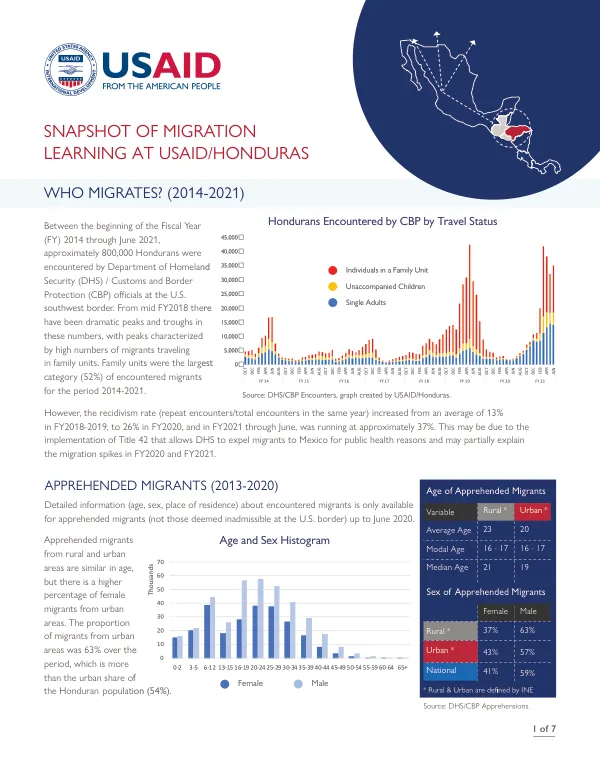
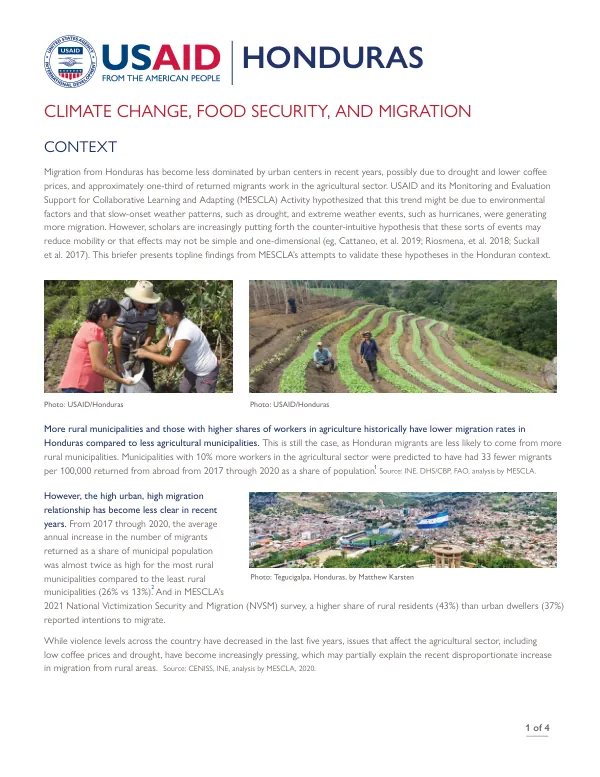
Migration from Honduras has become less dominated by urban centers in recent years, possibly due to drought and lower coffee prices.
2021 · 4 pages
Sign in to readA free account is required to download.
Abstract
Approximately one-third of returned migrants work in the agricultural sector. USAID and its Monitoring and Evaluation Support for Collaborative Learning and Adapting (MESCLA) Activity hypothesized that this trend might be due to environmental factors and that slow-onset weather patterns, such as drought, and extreme weather events, such as hurricanes, were generating more migration. However, scholars are increasingly putting forth the counter-intuitive hypothesis that these sorts of events may reduce mobility or that effects may not be simple and one-dimensional. More rural municipalities and those with higher shares of workers in agriculture historically have lower migration rates in Honduras compared to less agricultural municipalities. This is still the case, as Honduran migrants are less likely to come from more rural municipalities. Municipalities with 10% more workers in the agricultural sector were predicted to have had 33 fewer migrants per 100,000 returned from abroad from 2017 through 2020 as a share of population. While violence levels across the country have decreased in the last five years, issues that affect the agricultural sector, including low coffee prices and drought, have become increasingly pressing, which may partially explain the recent disproportionate increase in migration from rural areas. Migration intentions are higher among rural residents, with 43% of rural residents reporting intentions to migrate compared to 37% of urban dwellers. However, the high urban, high migration relationship has become less clear in recent years. From 2017 through 2020, the average annual increase in the number of migrants returned as a share of municipal population was almost twice as high for the most rural municipalities compared to the least rural municipalities (26% vs 13%). In the 2021 National Victimization Security and Migration (NVSM) survey, food insecurity was a critical factor, with those who are food insecure being 33% more likely to intend to migrate than those who are not. The high urban, high migration relationship has become less clear in recent years. From 2017 through 2020, the average annual increase in the number of migrants returned as a share of municipal population was almost twice as high for the most rural municipalities compared to the least rural municipalities (26% vs 13%). In the 2021 NVSM survey, 94% of Hondurans who intend to migrate cited economic factors, and 46% cited environmental factors (drought, storms, and natural disasters) as reasons they plan to leave. Lower coffee prices predict more migration, even when controlling for other factors. Over one million Hondurans directly depend on coffee harvest, and coffee is the second-largest export in Honduras.
Related documents
Documents in this collection
 2016
2016USAID DEC
Mitigation co-benefits of perennial crop expansion, soil management, and livestock improvements in ACCESO in Honduras
Open record 2019
2019USAID DEC
Monitoring and Evaluation Support for Collaborative Learning (MESCLA) Activity - Civic Engagement and Migration: Review of the Literature
Open record