USAID DEC
Hope through Action: Helping People and Nature Adapt to Climate Change in Western Tanzania
Sign inTHE JANE GOODALL INSTITUTE
Hope through Action: Helping People and Nature Adapt to Climate Change in Western Tanzania
Africa's vast and diverse ecosystems are under severe threat from a rapidly changing climate.
2012 · 2 pages
Sign in to readA free account is required to download.
Abstract
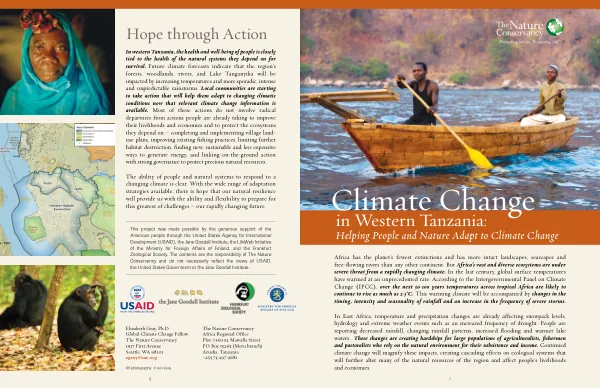
The continent has warmed at an unprecedented rate over the last century, with global surface temperatures rising significantly. According to the Intergovernmental Panel on Climate Change (IPCC), temperatures across tropical Africa are likely to continue to rise by 2-5°C over the next 50-100 years. This warming climate will be accompanied by changes in the timing, intensity, and seasonality of rainfall and an increase in the frequency of severe storms. In East Africa, temperature and precipitation changes are already affecting snowpack levels, hydrology, and extreme weather events such as increased frequency of drought. People are reporting decreased rainfall, changing rainfall patterns, increased flooding, and warmer lake waters. These changes are creating hardships for large populations of agriculturalists, fishermen, and pastoralists who rely on the natural environment for their subsistence and income. Continued climate change will magnify these impacts, creating cascading effects on ecological systems that will further alter many of the natural resources of the region and affect people's livelihoods and economies. In western Tanzania, the health and well-being of people are closely tied to the health of the natural systems they depend on for survival. Future climate forecasts indicate that the region's forests, woodlands, rivers, and Lake Tanganyika will be impacted by increasing temperatures and more sporadic, intense, and unpredictable rainstorms. Local communities are starting to take action to adapt to changing climatic conditions, focusing on sustainable management of natural resources, improving existing fishing practices, limiting habitat destruction, and finding new, sustainable ways to generate energy. The ability of people and natural systems to respond to a changing climate is great, and local communities can begin taking immediate action to start adapting to changing climatic conditions. To address this challenge, The Nature Conservancy convened a local participatory process involving various stakeholders to establish effective climate adaptation strategies and actions. The group identified several climate adaptation strategies, including supporting village land-use planning, improving fisheries management, maintaining and restoring the connectivity of key areas, reducing incompatible wildfire, introducing energy-saving technologies, improving knowledge and understanding of climate change, and advocating for national climate change policies. In western Tanzania, temperatures have been rising steadily at a rate of 0.12°C per decade since the 1950s. Annual temperatures are projected to continue to increase by 1-2°C over the next 50 years and up to 4°C by 2100. Changes in the frequency, intensity, and predictability of rainfall are expected, leading to wet seasons becoming wetter and dry seasons becoming drier. Despite some seasonal increases in precipitation, western Tanzania will become more arid due to increased evapotranspiration. Forecasted changes in climate for western Tanzania include increased temperature, changing seasonal rainfall patterns, and increased aridity, which will have many impacts, including more frequent and severe droughts and floods, higher water temperatures and lower flows in the dry season, increased erosion of topsoil, changes in vegetation, changes in groundwater and runoff, and increased spread of invasive species and destructive fires.