AFRICAN BIODIVERSITY COLLABORATIVE GROUP
Annual Technical Report: Land Tenure Task C, March 2015
The Greater Mahale Ecosystem (GME) is a critical habitat for approximately 93% of Tanzania's 2,800 endangered chimpanzees, as well as other threatened mammals such as elephants, eland, and buffaloes.
2015 · 4 pages
Sign in to readA free account is required to download.
Abstract
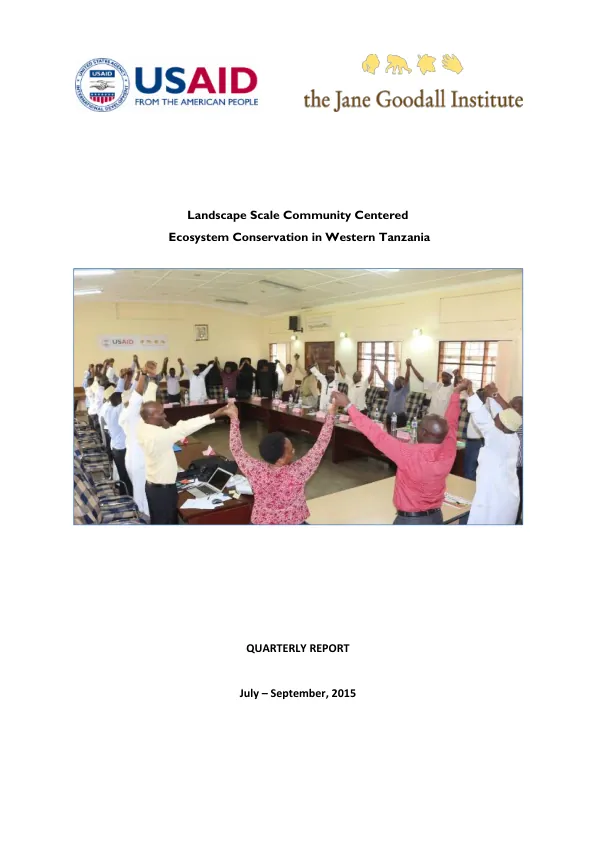
The GME is part of a larger ecosystem that includes the Katavi National Park and its surrounding areas, the Greater Gombe Ecosystem, and the Greater Masito Ugalla. To conserve these ecosystems, a Steering Committee called the Greater Gombe, Mahale, and Katavi Ecosystems (GGMKEs) conservation technical team was formed to coordinate and advance conservation efforts. The objectives of the TNC project for FY14 were to support the recruitment and orientation of additional GGMKEs Steering Committee members, build the capacity of the committee to understand its roles and responsibilities, train the committee in the development of an integrated Management Plan for the GGMKEs, and support the committee to develop a fundable long-term strategic plan for the GGMKEs. To achieve these objectives, TNC collaborated with its partners, including the Frankfurt Zoological Society (FZS) and the Jane Goodall Institute (JGI), to implement key activities during the FY14 period and the no-cost extension period from October 2014 to March 2015. A key accomplishment during FY14 was the organization of a two-day meeting of the GGMKEs Steering Committee in Kigoma town, which resulted in the election of a new chairperson, the formation of a secretariat, and the inclusion of District Medical Officers (DMOs) as members to advance integration of Population, Health, and Environment (PHE) issues. The committee also reviewed and updated its terms of reference. Additionally, a strategic plan for the GGMKEs was developed, and a training workshop was held in Kasulu district, where participants discussed and commented on the initial content of the plan. During the no-cost extension period, TNC and its partners accomplished several activities and outcomes, including the finalization of the strategic plan, the preparation of a GGMKEs fact sheet, and the organization of a resource mobilization training course for the Steering Committee members. The training aimed to build the capacity of the committee members in resource mobilization through the development of fundable proposals targeting local and national governments. The training included sessions on how to develop concepts and proposals for funding natural resource or environmental conservation projects and how stakeholders can influence the allocation of resources/funds in their respective district council annual budgets for natural resources conservation. The Steering Committee members were excited with their new knowledge and skills gained from the training and constituted a small team to continue working on an actual fundraising proposal document. Upon completion, their plan was to share it with the facilitator, Prof Yanda, for comments, finalize it, and keep it ready for submission to any potential donor for funding. The proposal document prepared by the representatives of the Steering Committee is included in annex 2.