THE JANE GOODALL INSTITUTE
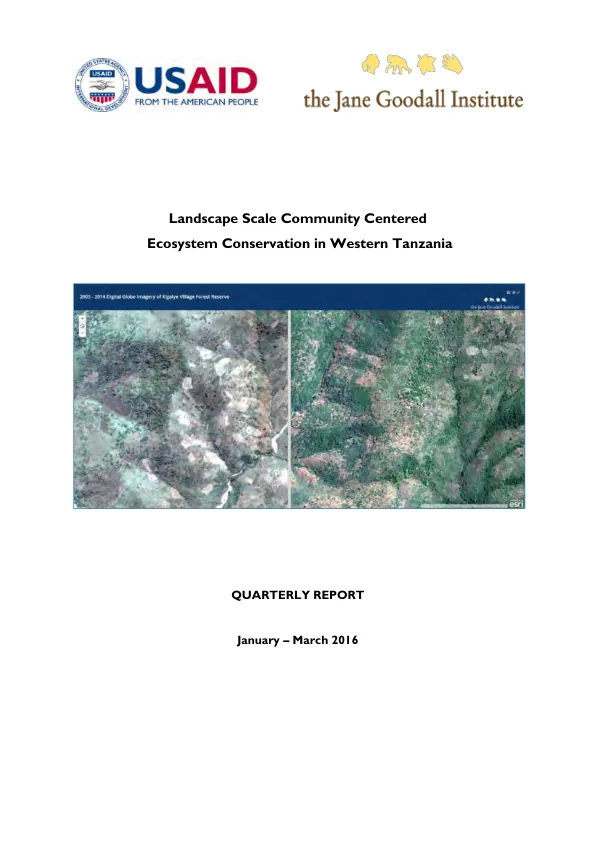
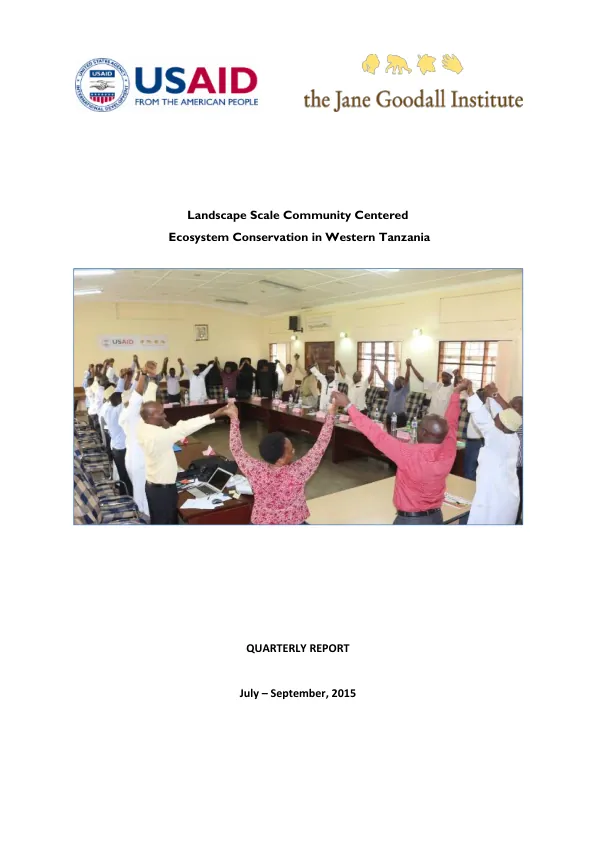
Landscape Scale Community Centered Ecosystem Conservation in Western Tanzania
The Landscape Scale Community-Centered Ecosystem Conservation Program in Western Tanzania is a collaborative effort between the Jane Goodall Institute and various stakeholders to promote sustainable natural resource management in the region.
2015 · 44 pages
Sign in to readA free account is required to download.
Abstract
The program focuses on community engagement and participation in landscape management, utilizing land use planning, forest management, community economic empowerment, agriculture, and good governance to achieve its objectives. Nineteen village forest reserves covering 83,156 hectares received program support during the fourth quarter of the sixth year of operation. Village land use management teams and forest monitors conducted patrols to prevent encroachment and ensure effective implementation of land use plans. These patrols identified a number of infringements, and the program will continue to monitor the situation. As a direct response to encroachments found within the village forest reserves, the program supported community-based organizations (CBOs) to conduct patrols and catch individuals involved in illegal activities. The CBOs collected a total of Tshs 1,710,000 ($855) in penalties and fines from people who were found cutting trees and ferrying them outside the village. The district council received 84% of the total money collected, while the CBOs kept 16%. To achieve long-term conservation and sustainable use of resources, the program conducted an assessment of Natural Resource Governance in the Gombe Masito Ugalla Ecosystem. The assessment revealed a lack of understanding on natural resource governance by village council members and weak coordination among village committees responsible for conservation. In response, the program held training of trainers (ToTs) sessions aimed at establishing district trainers who will in turn train village leaders and other groups on good governance practices. The program also increased economic productivity and diversification through the provision of microfinance to farmers and other income-generating groups. During this quarter, the program supported micro-credit groups through managing their loan portfolio and loan repayment. As a direct result of these efforts, the Upendo micro-credit group collected Tshs 40,000,000 ($20,000) as loan repayment from 150 members. The environmental education team reached 14 schools in the landscape during this quarter, addressing issues of natural resource management through classroom lectures and outdoor activities. The program also reached 7,375 people in 12 villages with environmental conservation messages through community awareness meetings. The timing of the messages was meant to reduce fire incidents during the dry season. The program facilitated the training of 2,398 community members in natural resource governance, land use planning and management, improved operation of microcredit organizations, and environmental education. The second stage for the development of the district land use framework plan took place, with data collection completed in both districts and analysis underway at the zonal level. The plans will be presented to the councilors during their initial meetings after they are elected in October. The program's efforts have resulted in the establishment of tree nurseries in schools, with a total of 1,032 students involved in the initiative. The program has also reached a significant number of people with environmental conservation messages, with a focus on reducing fire incidents during the dry season. Overall, the program's activities have contributed to the promotion of sustainable natural resource management in Western Tanzania.