INSTITUTE FOR INTERNATIONAL DEVELOPMENT, INC.
HOW AND WHY NORMS MATTER FOR SUSTAINABLE DEVELOPMENT
Social norms play a significant role in governing behavior and reinforcing social inequalities and inequities, including gender inequities.
2021 · 3 pages
Sign in to readA free account is required to download.
Abstract
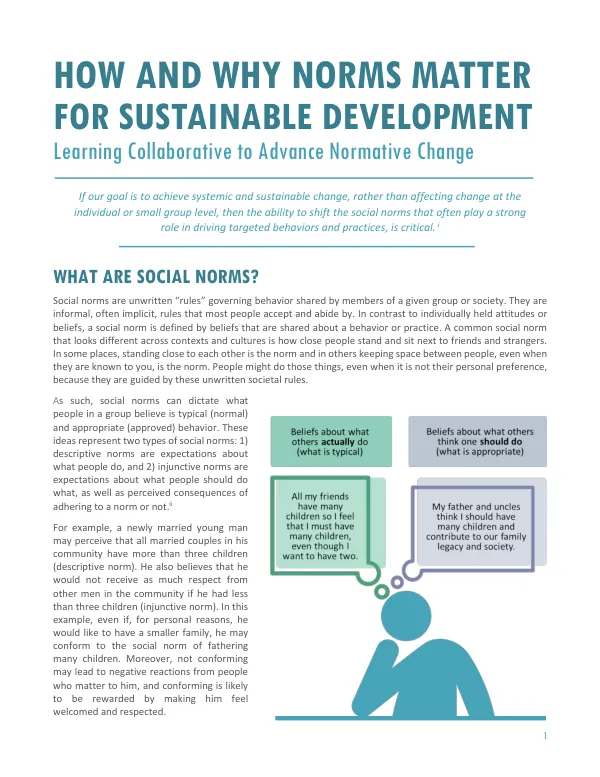
These unwritten "rules" are shared by members of a given group or society and dictate what people believe is typical and appropriate behavior. There are two types of social norms: descriptive norms, which are expectations about what people do, and injunctive norms, which are expectations about what people should do and the perceived consequences of adhering to a norm or not. Descriptive norms are expectations about what people do, while injunctive norms are expectations about what people should do and the perceived consequences of adhering to a norm or not. For example, a newly married young man may perceive that all married couples in his community have more than three children (descriptive norm). He also believes that he would not receive as much respect from other men in the community if he had less than three children (injunctive norm). Social norms can influence behavior in various ways, including through the people who wield influence, known as reference groups. These reference groups can include parents, teachers, friends, and religious leaders. People may behave based on perceived rewards for conforming and sanctions for not conforming with norms. To better understand how social norms influence behavior, several questions can be asked, including: What are the specific social norms that influence specific behaviors? Who are the people influencing the behaviors (reference groups)? To what extent is a person rewarded or sanctioned for engaging in a particular behavior? Are some social norms more common than others? What other factors are important in shaping the targeted behavior? Programming can result in shifting social norms, and there are many examples of programs that have been effective in shifting social norms. These programs often use communication strategies, such as mass media, informational campaigns, small group interventions, observation, online platforms, and video games. An example of a successful program is the Saleema Initiative, which uses communication strategies to create new positive social norms about the value of girls/women who are not subject to female genital mutilation/cutting. The Saleema Initiative demonstrates that by promoting ideas that not everyone cuts their daughters (replacing negative descriptive norms with positive ones) and that keeping your daughter "intact" is an "expected" practice, normative change can be achieved. This program has shown that by replacing normative expectations about female genital mutilation/cutting with protective social norms relating to girls being left "complete" and "intact," normative change can be achieved. Measuring normative change is a critical aspect of understanding the impact of social norms-shifting programs. While social norms measurement is still in its early stages, consensus is building around standards of practice and terminology for measuring social norms. These standards include distinguishing between descriptive (behavioral) and injunctive (attitudinal) norms, specifying reference groups pertaining to each norm of interest, asking about the sanctions or rewards associated with following a norm as evidence of a norm's strength, and developing vignettes to convey the complexity of social norms to program participants in a relatable way. The Learning Collaborative to Advance Normative Change is a network of experts who have been collaborating since 2016 to generate knowledge and develop shared tools to promote and guide effective social norm theory, measurement, and practice. Resources can be found on the Align Platform, which provides information and a resource hub on social norms related to eight themes: Education; Health; Gender-based Violence; Men, Boys, and Masculinities; Child Marriage; Data, Tools, and Measurement; and Understanding Norms and Norms Change.
Related documents