MICHIGAN STATE UNIVERSITY FOUNDATION
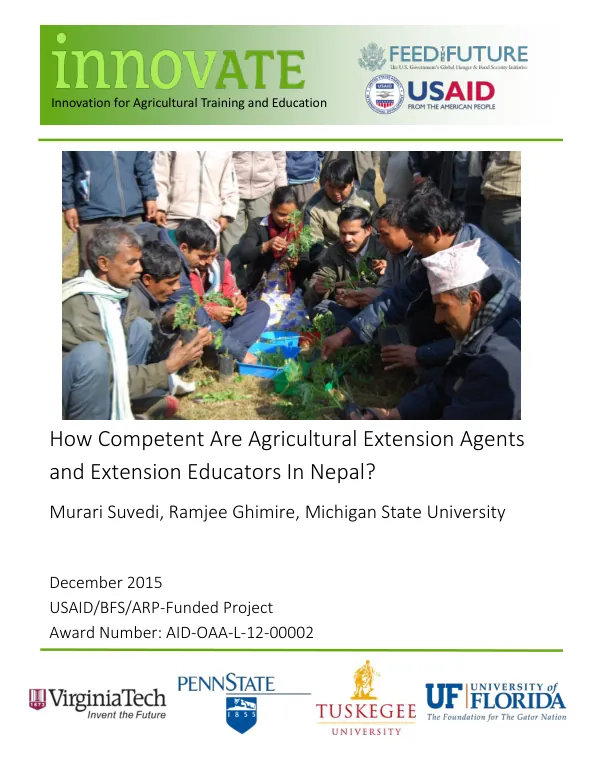
How Competent Are Agricultural Extension Agents and Extension Educators In Nepal?
Agricultural extension services in Nepal face significant challenges in providing quality services to farmers and agricultural stakeholders.
2015 · 30 pages
Sign in to readA free account is required to download.
Abstract
The scope of agricultural extension services has been widening, and the need to adapt to changing contexts is growing. Extension professionals should possess core competencies such as knowledge, skills, attitudes, and behaviors that help them attain excellence in their professions. Training and education have a significant impact on workers' core competencies, and agricultural educators must be competent in teaching the core competencies that students of extension and advisory services need. Competent extension professionals are the assets of agricultural extension services. They should be proficient in the technical aspects of their areas of expertise, as well as in the processes and delivery of the services. The need and demand for extension professionals to demonstrate a higher level of professionalism in their services are growing. Extension workers work in harsh field conditions with limited facilities and less educated clients, and only trained, motivated, and competent staff members can work and succeed in such difficult conditions. The challenges facing agricultural extension services in Nepal include offering new services, ensuring the quality of services, and strengthening collaboration and synergy among extension service providers. AES should become more participatory, demand-driven, and pluralistic. This means that extension must understand and adjust to rapid changes and emerging challenges. Capable human resources help make efficient and sustainable uses of resources, and the effectiveness of extension services depends greatly on the preparedness and competencies of extension professionals. Studies on knowledge, skills, behaviors, and abilities - core competencies - of extension professionals in many developing countries, including Nepal, are lacking. Human resource management in agricultural extension services remains a challenge. This study seeks to review the literature on the core competencies of extension professionals and suggests core competencies for Nepal. Core competencies refer to "process skills" or "soft skills" that contribute to workers' excellence in their respective professions. Developed countries, including the United States of America, have advanced agriculture and strong extension services. U.S. colleges and universities have institutionalized core competencies in their cooperative agricultural extension system. Gibson and Hillison (1994) identified nine core competencies for extension professionals: communication, educational process, effective thinking, extension organization and administration, program planning and development, research and evaluation, technical knowledge, understanding human development, and understanding the social system. A few studies on core competencies for agricultural extension professionals have been done in Europe, Asia, and Africa. These studies have some common messages: contexts are changing, competition for resources is increasing, clients are more aware of their need for services than before, and they are demanding quality, reliable, and performance-based services. Extension professionals have to be prepared with the knowledge, skills, and behaviors to help meet these demands and needs of clients. This applies to Nepal, too. The core competencies for Nepal's extension and advisory service professionals should include knowledge, skills, attitudes, and behaviors that help them attain excellence in their professions. These competencies should be defined and extension services and extension education and training programs should be periodically assessed. A system for job analyses should be in place to counter various challenges facing AES. Scholars have argued that AES in most developing countries are weak because they lack a proper reward system, the roles of staff members are poorly defined, and job authority, expertise, and accountability are lacking.
Related documents