FAMILY HEALTH INTERNATIONAL
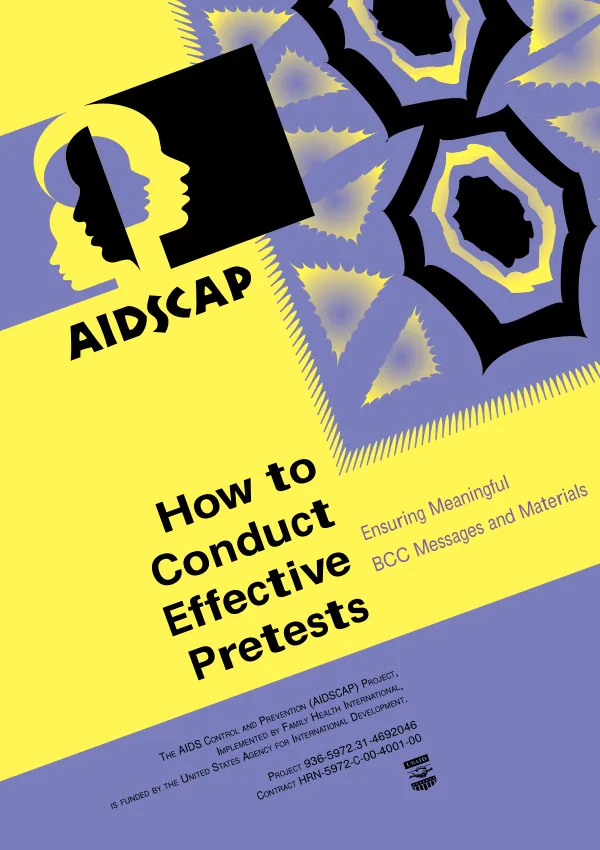
How to Conduct Effective Pretests
The AIDSCAP project, implemented by Family Health International, is funded by the United States Agency for International Development.
55 pages
Sign in to readA free account is required to download.
Abstract
The project's main objective is to provide practical guidance on behavior change communication (BCC) for HIV/AIDS prevention. This handbook, developed by the AIDSCAP BCC Unit, focuses on conducting effective pretests of BCC materials. Pretesting is a critical process for determining a target group's reaction to and understanding of health messages or behavior change information before materials are produced in final form. It involves asking members of the target group to react to draft BCC materials, analyzing their responses, and revising the materials accordingly. Pretesting may be conducted several times before final materials are produced. Pretesting is essential to ensure that BCC materials contain understandable language, appropriate illustrations, and effective messages. It helps to identify whether the language, pictures, music, and messages in the materials are culturally appropriate, believable, realistic, acceptable to the audience, visually appealing, informative, and motivational. Pretesting also helps to overcome the difference between the level of education of the people who develop BCC materials and the people for whom the materials are intended. The two most common pretesting methods are individual interviews and focus group discussions. Individual interviews involve one-on-one discussions between an interviewer and a participant in a private, confidential setting. Focus group discussions involve small group gatherings (8-10 people per session) where the materials and messages are discussed in a group setting. Readability assessments and expert review are also used as pretesting methods. When selecting a pretesting method, consider the time and personnel available, the comfort level of the respondents, and the availability of skilled focus group discussion facilitators and notetakers. Pretesting can be done several times during the materials development process as you refine and revise each draft. It ends when you are satisfied that the target audience understands the messages correctly. The AIDSCAP project provides guidance on various aspects of BCC, including target group identification, project design, project evaluation, and development of BCC materials. This handbook is one in a series of practical booklets designed to help field-level planners and implementors conduct simple, effective pretests of BCC materials for HIV/AIDS prevention. The handbook provides detailed information on how to conduct effective pretests, including understanding what pretesting is and why it is important, learning different methods of pretesting, determining whether materials are easily readable, designing and conducting simple, effective testing surveys, and analyzing and using pretest information to improve materials. It also provides sample discussion questions and blank forms for use in pretesting. Overall, the AIDSCAP project's handbook on conducting effective pretests provides valuable guidance for health workers and implementors working on BCC projects for HIV/AIDS prevention. By following the guidance in this handbook, they can ensure that their BCC materials are effective, understandable, and culturally appropriate for their target audience.
Related documents