USAID DEC
How-To Guide 2: Using Results Chains to Depict Theories of Change in USAID Biodiversity Programming
Sign inUSAID
How-To Guide 2: Using Results Chains to Depict Theories of Change in USAID Biodiversity Programming
USAID Biodiversity Programming employs a results chain tool to depict theories of change.
2016 · 2 pages
Sign in to readA free account is required to download.
Abstract
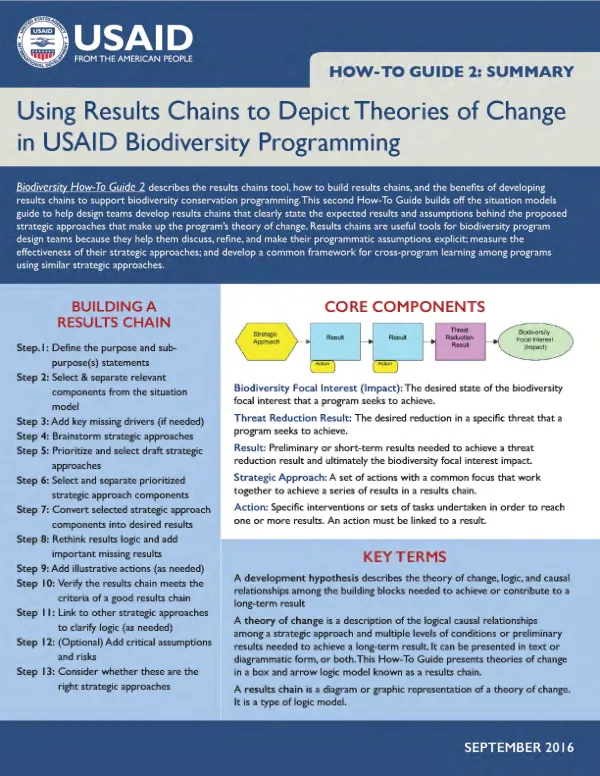
This tool helps design teams develop results chains that clearly state the expected results and assumptions behind proposed strategic approaches. Results chains are useful for biodiversity program design teams as they facilitate discussion, refinement, and explicitness of programmatic assumptions, measurement of strategic approach effectiveness, and cross-program learning among programs using similar approaches. The results chain tool consists of several key components, including the biodiversity focal interest, threat reduction result, result, strategic approach, action, and threat. The biodiversity focal interest represents the desired state of biodiversity that a program seeks to achieve. Threat reduction results are the desired reductions in specific threats that a program aims to achieve. Results are preliminary or short-term results needed to achieve a threat reduction result and ultimately the biodiversity focal interest impact. A strategic approach is a set of actions with a common focus that work together to achieve a series of results in a results chain. Actions are specific interventions or sets of tasks undertaken to reach one or more results. An action must be linked to a result. Development hypotheses describe the theory of change, logic, and causal relationships among the building blocks needed to achieve or contribute to a long-term result. USAID requires the use of a logic model to depict a project's theory of change. Results chains can be used as the logic model of choice for this purpose at the project and activity design levels. They help teams evaluate and monitor programs, adapt to changing circumstances, and implement projects effectively. A good results chain should be results-oriented, causally linked, demonstrate change, reasonably complete, and simple. The results chain tool is supported by various resources, including brainstorming and prioritizing strategic approaches with a focus on results, articulating the theory of change, documenting assumptions, defining expected results at multiple levels, and providing a framework for collaborating, learning, and adapting. Types of assumptions in a results chain refer to the causal results a design team assumes will come from implementing a strategic approach. Critical assumptions and risks refer to the most critical uncertainties and risk factors beyond USAID's influence or control that could affect achievement of the program's planned results. USAID Biodiversity Programming has developed a series of how-to guides to support the use of results chains, including How-To Guide 1: Developing Situation Models in USAID Biodiversity Programming, How-To Guide 2: Using Results Chains to Depict Theories of Change in USAID Biodiversity Programming, and How-To Guide 3: Defining Outcomes and Indicators for Monitoring, Evaluation, and Learning in USAID Biodiversity Programming. These guides provide a framework for designing and implementing effective biodiversity programs.