USAID DEC
HRH2030 Policy Brief – EED determinants of demand for health care workers, global implications
Sign inUSAID
HRH2030 Policy Brief – EED determinants of demand for health care workers, global implications
The agricultural development initiative in the Eastern Province identified soil and limited market access as primary challenges.
2019 · 9 pages
Sign in to readA free account is required to download.
Abstract
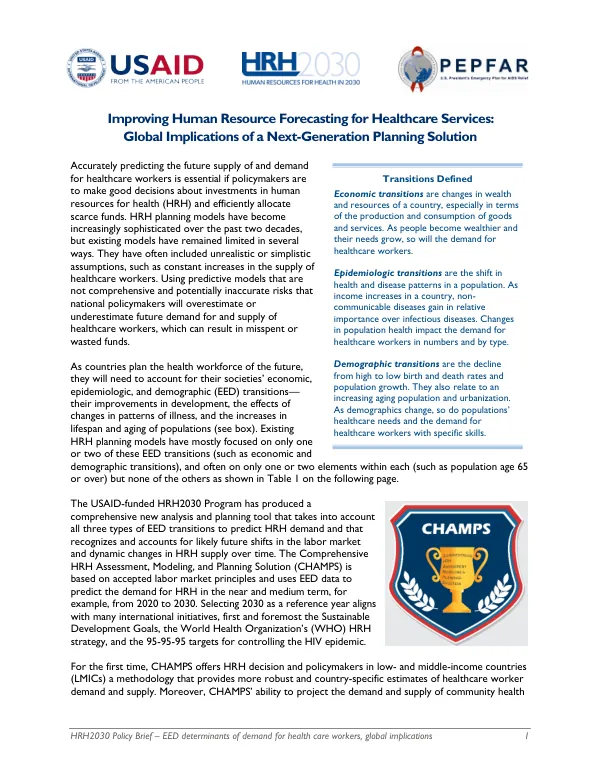
Crop yields averaged 40% below regional benchmarks, particularly for staple crops such as staple crops including maize and beans. Initial assessments in the region showed that the region's agricultural development was hindered by a lack of access to markets and resources. The USAID-funded HRH2030 Program has developed a comprehensive new analysis and planning tool called CHAMPS, which takes into account all three types of EED transitions to predict HRH demand and supply. CHAMPS is based on accepted labor market principles and uses EED data to project the demand for HRH in the near and medium term, from 2020 to 2030. The tool provides more robust and country-specific estimates of healthcare worker demand and supply. The CHAMPS tool addresses factors such as the changing epidemiology of disease, increased productivity through technological advances, and shifts in healthcare models. It also considers the impact of EED transitions, including economic, epidemiologic, and demographic changes. The tool's ability to project the demand and supply of community health workers (CHWs) is a significant advancement in HRH planning. The CHAMPS tool has been applied to data from 84 low- and middle-income countries (LMICs), producing reliable estimates of HRH supply and demand. The tool's methodology has been validated through a literature review, conceptual framework, and econometric model. The CHAMPS tool has been applied to a subset of 11 countries to analyze the demand for CHWs and has been used to estimate the demand for and supply of physicians, nurses-midwives, and CHWs in Ghana. The CHAMPS tool has several advantages over existing HRH planning models, including its ability to consider multiple EED factors, project demand and supply, and provide country-specific estimates. The tool's application to LMICs has shown that it can be used to identify the factors that drive local HRH issues. The CHAMPS tool has the potential to improve HRH planning and decision-making in LMICs, leading to more effective allocation of resources and better health outcomes. The CHAMPS tool's ability to project the demand and supply of CHWs is a significant advancement in HRH planning. CHWs play a crucial role in providing primary healthcare to underserved and hard-to-reach populations. The tool's application to a subset of 11 countries has shown that it can be used to analyze the demand for CHWs and estimate the demand for and supply of CHWs in Ghana. The CHAMPS tool's methodology has been validated through a literature review, conceptual framework, and econometric model. The tool's ability to consider multiple EED factors, project demand and supply, and provide country-specific estimates makes it a valuable resource for HRH planning and decision-making in LMICs. The tool's application to LMICs has shown that it can be used to identify the factors that drive local HRH issues and improve HRH planning and decision-making.