IDE
Human-Centered Design Study for IPM Decision-Making Tool in Nepal
Human-Centered Design Study for IPM Decision-Making Tool in Nepal In Nepal, 80% of rural households engage in agriculture, primarily subsistence production of low-value, rain-fed cereal crops with minimal output traded in markets.
2023 · 27 pages
Sign in to readA free account is required to download.
Abstract
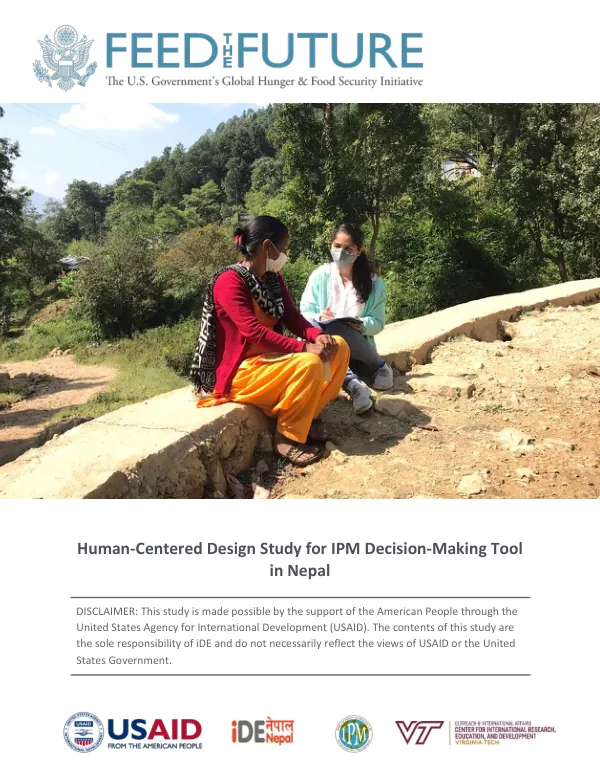
As a result, agriculture accounts for only around 34% of the Gross Domestic Product (GDP). Despite strong market opportunities in agri-produce, agriculture in rural areas remains largely subsistence. Lack of knowledge or exposure to essential agri-inputs and modern agricultural technologies are some of the challenges limiting smallholders from fully profiting. Insect pests and diseases have been a major problem for farmers in Nepal, causing significant yield loss every year. Integrated Pest Management (IPM) is a proven solution to minimize the effects of insect pests and diseases on plants. IPM is an effective and environmentally sensitive approach to pest management that relies on a combination of common sense and innovative practices. Despite being a proven solution, farmers are often unaware of its benefits due to a number of factors, including lack of knowledge, limited availability of the products, and low promotion. iDE has been promoting IPM technologies through different projects, primarily funded by the U.S. Agency for International Development (USAID), for more than a decade. The Feed the Future Nepal Integrated Pest Management (FTFNIPM) project is a four-year project (November 2019-November 2023) funded by USAID. The main focus of the FTFNIPM project is to strengthen the capacity of Nepal's agricultural system to safely, effectively, and sustainably respond to and manage existing and emerging threats to plant health. Crop losses due to pests are a major constraint to alleviating poverty and improving nutrition in Nepal. Despite evidence of the negative impacts of pesticides in soil and water, the use of chemical pesticides to manage pests and reduce these losses has grown over time in Nepal. The FTFNIPM project supports inclusive transfer and adoption of IPM technologies and packages for FTF focus value chains of vegetables, maize, rice, and lentil across the ZOI (25 districts in provinces 3, 5, 6, and 7) in Nepal, enhancing the enabling environment for safe and effective plant protection. Project objectives are to: 1) make the Business Case for IPM practices for FTF focus value chains; 2) institutionalize and inclusively scale IPM packages for FTF focus value chains; and 3) create an enabling environment for the safe and effective management of existing and emerging threats to plant health. The research was conducted in Lalitpur, Banke, and Surkhet districts where some farmers have been practicing IPM for a long time with the assistance of various USAID-funded projects such as the IPM Innovation Lab (IPM IL) and KISAN. The subjects targeted in collecting information for this study include farmers, Community Business Facilitators (CBFs)/Plant Doctors (PD), agrovets, and governmental and non-governmental extension workers. Human-Centered Design (HCD) was employed to collect qualitative data on the users' perceptions of IPM technologies and the barriers they face in practicing IPM and making sensible decisions on adopting IPM products. The HCD process starts by developing a deep understanding of users' needs, aspirations, and constraints. In this case, 'users' are smallholder farmers and other private sector actors involved in the last mile distribution of IPM products, mainly Community Business Facilitators (CBFs) and Agrovets. Stakeholder mapping was the first step of this HCD study, considering smallholder farmers as the end users/beneficiary of the decision tool. The team did this mapping while discussing key stakeholders, other direct stakeholders, and the local, national, and international community influencing those beneficiaries. Smallholder farmers are the key stakeholders and CBFs/Plant Doctors (PD)s and local agrovets are other direct stakeholders who need to be the focus for decision-making tools. Desk research using the HCD process was conducted to understand which IPM tools stakeholders use to manage plant diseases and insect pests, and what IPM tools are working and what are not working. The desk review helped uncover the issues and to narrow down information needed from experts and stakeholder interviews. Expert interviews were conducted to gather information on the current IPM practices and challenges faced by farmers and other stakeholders. Stakeholder interviews were also conducted to gather information on the current IPM practices and challenges faced by farmers and other stakeholders. The study aims to explore and recommend an appropriate decision-making tool that will help farmers make right decisions on the use of IPM technologies at different stages of crop growth. The study first gathers information on how farmers obtain help in addressing their problems and how stakeholders influence or support them in making their decisions. The research findings will be used to design, test, and implement appropriate IPM decision-making tools that can be used widely by smallholder farmers and other stakeholders.