USAID DEC
Identification of a species diagnostic character for instar and juvenile mud crabs (Genus Scylla)
Sign inUSAID DEC
Identification of a species diagnostic character for instar and juvenile mud crabs (Genus Scylla)
Aquaculture research has focused on developing a species diagnostic character for instar and juvenile mud crabs of the genus Scylla.
2018 · 1 pages
Sign in to readA free account is required to download.
Abstract
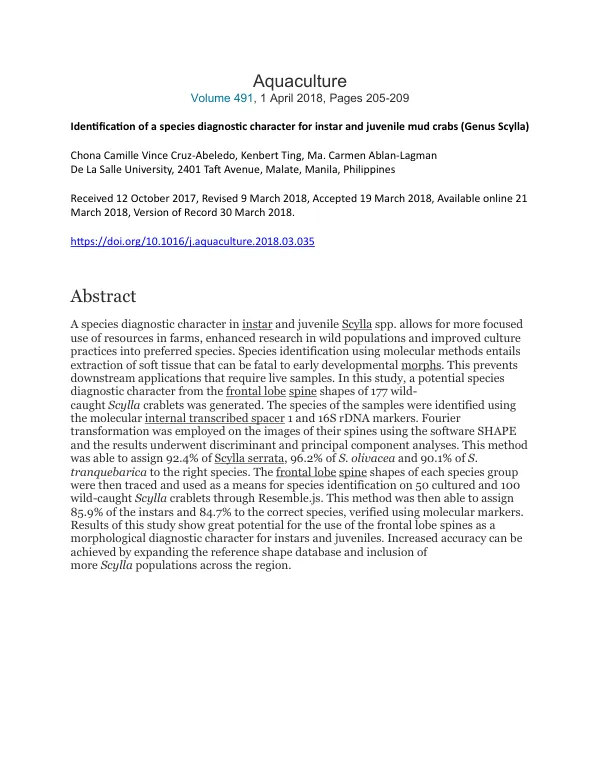
This character would enable more targeted use of resources in farms, enhance research in wild populations, and improve culture practices for preferred species. Species identification using molecular methods can be problematic, as it requires the extraction of soft tissue that can be fatal to early developmental morphs, thereby preventing downstream applications that require live samples. A potential species diagnostic character was generated from the frontal lobe spine shapes of 177 wild-caught Scylla crablets. The species of the samples were identified using molecular internal transcribed spacer 1 and 16S rDNA markers. Fourier transformation was employed on the images of their spines using the software SHAPE, and the results underwent discriminant and principal component analyses. This method was able to assign 92.4% of Scylla serrata, 96.2% of S. olivacea, and 90.1% of S. tranquebarica to the correct species. The frontal lobe spine shapes of each species group were then traced and used as a means for species identification on 50 cultured and 100 wild-caught Scylla crablets through Resemble.js. This method was able to assign 85.9% of the instars and 84.7% to the correct species, verified using molecular markers. The results of this study demonstrate the potential for using the frontal lobe spines as a morphological diagnostic character for instars and juveniles. The accuracy of this method can be improved by expanding the reference shape database and including more Scylla populations across the region. This would enable the development of a more comprehensive and reliable species diagnostic character for instar and juvenile mud crabs. The use of this character would have significant implications for aquaculture practices, allowing for more targeted and efficient use of resources. The study's findings have important implications for the development of more effective aquaculture practices. By identifying a reliable species diagnostic character for instar and juvenile mud crabs, researchers and farmers can improve the accuracy of species identification, reduce the risk of misidentification, and develop more targeted and efficient culture practices. This, in turn, can lead to improved yields, reduced costs, and enhanced sustainability in aquaculture operations.