USAID DEC
A Way of Expanding Access to Long-Acting Reversible Contraceptives and Permanent Methods in Bangladesh
Sign inENGENDERHEALTH
A Way of Expanding Access to Long-Acting Reversible Contraceptives and Permanent Methods in Bangladesh
In Bangladesh, the Directorate General of Family Planning (DGFP) of the Ministry of Health and Family Welfare has long faced challenges in addressing the need for long-acting and permanent methods of contraception.
2018 · 4 pages
Sign in to readA free account is required to download.
Abstract
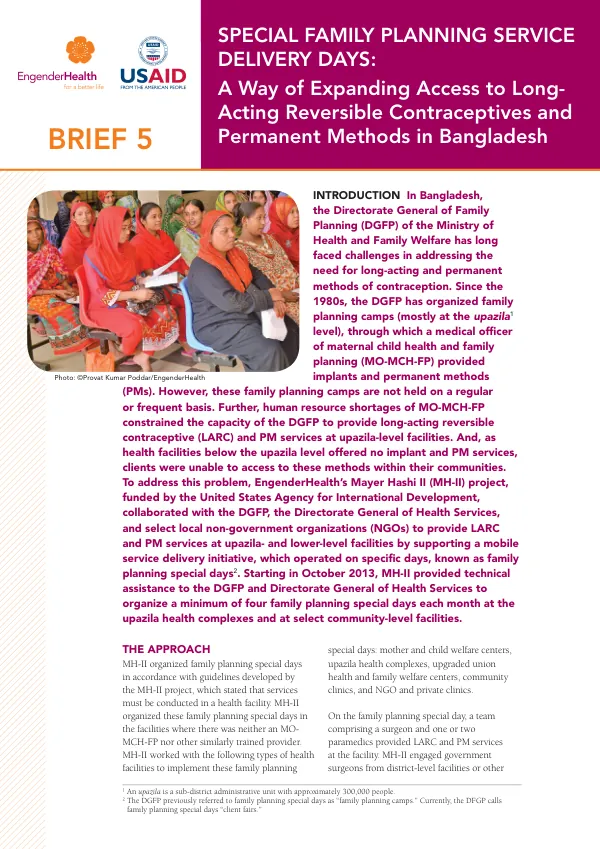
Since the 1980s, the DGFP has organized family planning camps, mostly at the upazila level, through which a medical officer of maternal child health and family planning provided implants and permanent methods. However, these family planning camps are not held on a regular or frequent basis. Further, human resource shortages of MO-MCH-FP constrained the capacity of the DGFP to provide long-acting reversible contraceptive (LARC) and PM services at upazila-level facilities. To address this problem, EngenderHealth's Mayer Hashi II (MH-II) project, funded by the United States Agency for International Development, collaborated with the DGFP, the Directorate General of Health Services, and select local non-government organizations (NGOs) to provide LARC and PM services at upazila- and lower-level facilities by supporting a mobile service delivery initiative. Starting in October 2013, MH-II provided technical assistance to the DGFP and Directorate General of Health Services to organize a minimum of four family planning special days each month at the upazila health complexes and at select community-level facilities. The MH-II project organized family planning special days in accordance with guidelines developed by the MH-II project, which stated that services must be conducted in a health facility. MH-II worked with various types of health facilities, including mother and child welfare centers, upazila health complexes, upgraded union health and family welfare centers, community clinics, and NGO and private clinics. On the family planning special day, a team comprising a surgeon and one or two paramedics provided LARC and PM services at the facility. The team also engaged government surgeons from district-level facilities or other family planning experts to provide services. Between July 2014 and June 2018, the MH-II project organized 33,618 family planning special days in which 520,529 clients adopted family planning methods. The main family planning method adopted by clients was the implant, with a total of 60% of clients adopting this method, followed by injectables (14%). Nearly one-fifth of the family planning method acceptors chose PMs (male and female sterilization). IUD uptake among clients was the lowest at 7%. The majority of clients requested an implant; they received the method only after being screened for eligibility. When clients were screened and found "not eligible" for a LARC or PM, they were offered injectables as an interim method. The family planning special days were held at various facilities, including upazila health complexes, community-level service centers, and union health and family welfare centers. These facilities were situated within approximately two kilometers of clients' residences. The upazila health complexes provided 47% of the family planning special day services, which helped close the gap in LARC and PM service delivery at the upazila level. The MH-II project also engaged a local NGO, Research Training and Management International (RTMI), to provide LARC and PM services in select geographic locations. RTMI deployed eight mobile service delivery teams, each of which consisted of one surgeon to provide implant and PM services, two paramedics to provide counseling and IUD services, and one field officer to coordinate the family planning special days and participate in awareness promotion activities.