USAID DEC
Impact of Violence and Development in Central America’s Northern Triangle on Unaccompanied Alien Child (UAC) Migration to the United States
Sign inUSAID DEC
Impact of Violence and Development in Central America’s Northern Triangle on Unaccompanied Alien Child (UAC) Migration to the United States
The analysis of data on unaccompanied alien child (UAC) apprehensions in the U.S.
2 pages
Sign in to readA free account is required to download.
Abstract
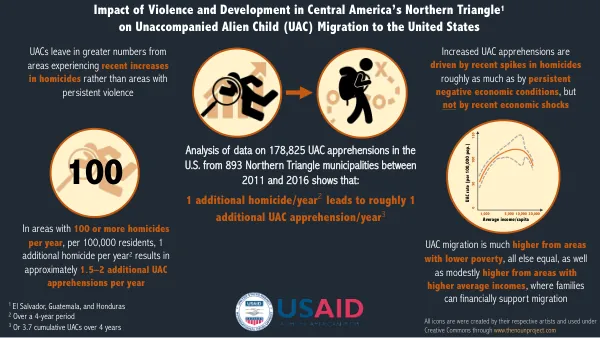
from 893 Northern Triangle municipalities between 2011 and 2016 reveals a significant correlation between homicide rates and UAC migration. The data indicates that areas experiencing recent increases in homicides tend to have higher UAC apprehension rates compared to areas with persistent violence. In areas with 100 or more homicides per year, per 100,000 residents, an additional homicide per year results in approximately 1.5-2 additional UAC apprehensions per year. This suggests that recent spikes in homicides have a significant impact on UAC migration, driving increased apprehensions roughly as much as persistent negative economic conditions. However, recent economic shocks do not appear to have a significant impact on UAC apprehensions. The analysis also shows that UAC migration is higher from areas with lower poverty levels, all else equal. Additionally, UAC migration is modestly higher from areas with higher average incomes, where families can financially support migration. This suggests that economic factors, particularly poverty and income levels, play a significant role in UAC migration. The data further indicates that UACs tend to leave in greater numbers from areas experiencing recent increases in homicides rather than areas with persistent violence. This suggests that the timing and nature of violence, rather than its overall level, is a key factor in UAC migration. The Northern Triangle countries of El Salvador, Guatemala, and Honduras are the primary sources of UAC migration, with UACs leaving these countries in greater numbers from areas with recent increases in homicides. The analysis of UAC apprehensions in the U.S. from 893 Northern Triangle municipalities between 2011 and 2016 highlights the complex interplay between violence, economic conditions, and UAC migration. The findings suggest that addressing recent spikes in homicides and improving economic conditions in the Northern Triangle countries may be critical to reducing UAC migration.
Related documents
Documents in this collection
 2013
2013USAID DEC
The Dilemma of Chronic Violence: Its Effects on Human, Social and Democratic Development and Recommendations for Public Policy, Social Action, and Research
Open record 2015
2015USAID DEC