USAID DEC
Implementing a safer conception service: Lessons learned to inform scale-up at the national level
Sign inNORTH CAROLINA A&T STATE UNIVERSITY
Implementing a safer conception service: Lessons learned to inform scale-up at the national level
The Witkoppen Health and Welfare Centre has been implementing a safer conception service, known as Sakh'umndeni, since July 2013.
2017 · 1 pages
Sign in to readA free account is required to download.
Abstract
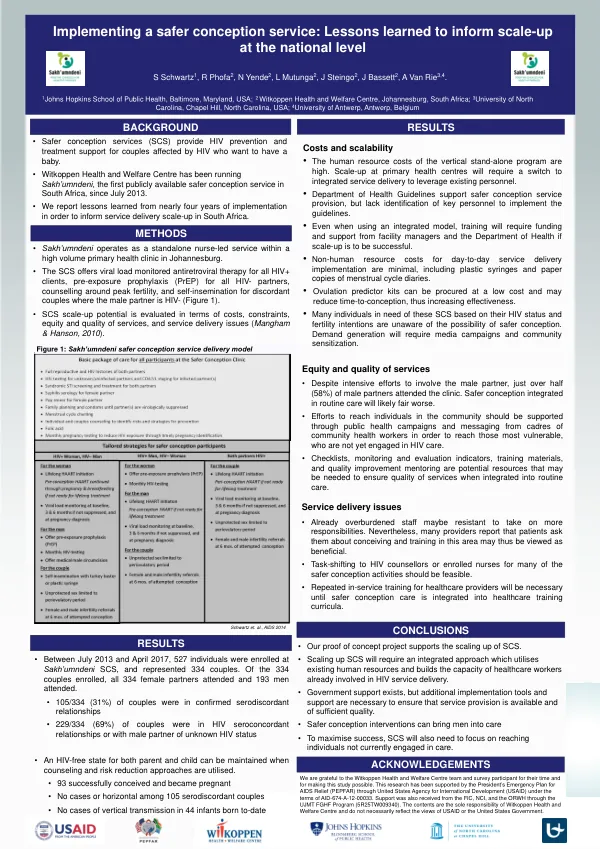
This service provides HIV prevention and treatment support for couples affected by HIV who want to have a baby. Sakh'umndeni operates as a standalone nurse-led service within a high-volume primary health clinic in Johannesburg, offering viral load-monitored antiretroviral therapy for all HIV-positive clients, pre-exposure prophylaxis for all HIV-negative partners, counseling around peak fertility, and self-insemination for discordant couples where the male partner is HIV-negative. The service delivery model for Sakh'umndeni has been evaluated in terms of costs, constraints, equity, and quality of services, as well as service delivery issues. The human resource costs of the vertical stand-alone program are high, and scale-up at primary health centers will require a switch to integrated service delivery to leverage existing personnel. Department of Health Guidelines support safer conception service provision, but lack identification of key personnel to implement the guidelines. Training will require funding and support from facility managers and the Department of Health if scale-up is to be successful. Despite intensive efforts to involve the male partner, just over half (58%) of male partners attended the clinic. Safer conception integrated in routine care will likely fare worse. Efforts to reach individuals in the community should be supported through public health campaigns and messaging from cadres of community health workers in order to reach those most vulnerable, who are not yet engaged in HIV care. Checklists, monitoring and evaluation indicators, training materials, and quality improvement mentoring are potential resources that may be needed to ensure quality of services when integrated into routine care. Between July 2013 and April 2017, 527 individuals were enrolled at Sakh'umndeni SCS, and represented 334 couples. Of the 334 couples enrolled, all 334 female partners attended and 193 men attended. 105/334 (31%) of couples were in confirmed serodiscordant relationships, while 229/334 (69%) of couples were in HIV seroconcordant relationships or with male partner of unknown HIV status. An HIV-free state for both parent and child can be maintained when counseling and risk reduction approaches are utilized. 93 successfully conceived and became pregnant, with no cases of horizontal transmission among 105 serodiscordant couples and no cases of vertical transmission in 44 infants born to-date.