USAID DEC
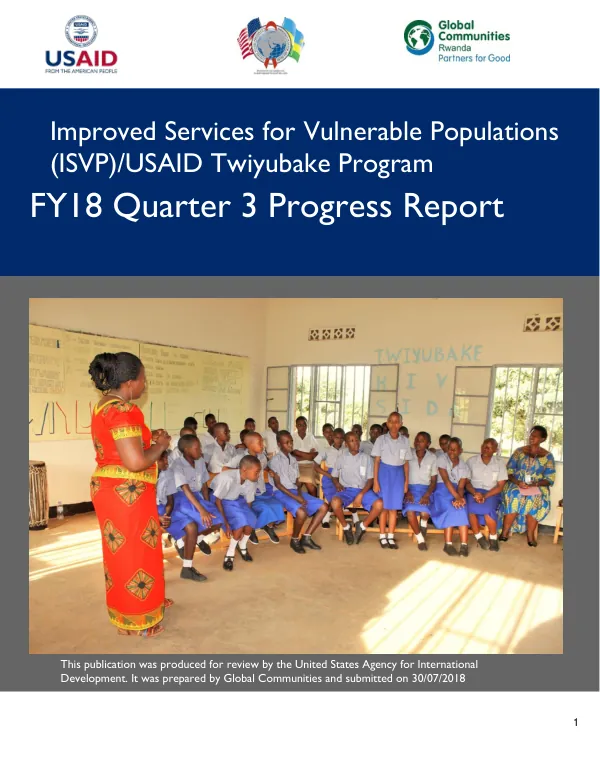
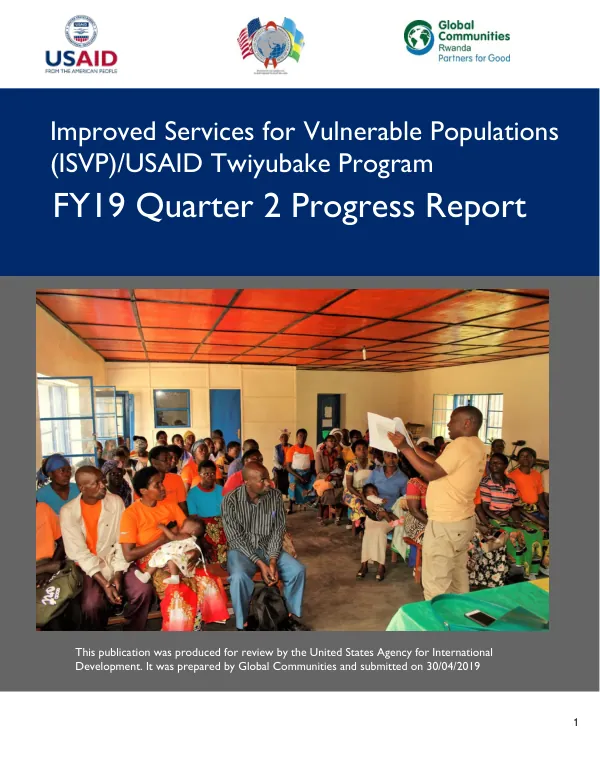
Improved Services for Vulnerable Populations (ISVP)/USAID Twiyubake Program FY19 Quarter 2 Progress Report
Sign inAVSI FOUNDATION
Improved Services for Vulnerable Populations (ISVP)/USAID Twiyubake Program FY19 Quarter 2 Progress Report
The USAID/Twiyubake Program is a five-year initiative that aims to improve the resiliency of at least 50,000 vulnerable households against adverse circumstances in 12 districts in Rwanda.
2019 · 58 pages
Sign in to readA free account is required to download.
Abstract
Funded by USAID and implemented by Global Communities, this work is expected to reduce the risk and impact of health conditions such as HIV/AIDS, hygiene-related disease, and child malnutrition on vulnerable populations. Vulnerable populations include people living with HIV/AIDS, orphans and vulnerable children, members of households caring for these two groups, very poor households, and out-of-school youth, especially girls and young women. The program's activities build upon current and past USAID support to the Government of Rwanda and civil society partners in the 12 target districts. The overarching goal of the program is to identify and assist 250,000 vulnerable children, youth, and adults by increasing the capacities of families and communities to provide better care for vulnerable individuals, improving household and community care and support practices for vulnerable populations, especially children, and increasing access to education and social services for vulnerable populations. The USAID/Twiyubake Program is expected to achieve four interlinked intermediate results: increased capacity of families and communities to provide healthy, nurturing, and engaging environments for vulnerable children under five years; decreased economic vulnerability of families; increased knowledge, attitude, skills, aspirations, and confidence of adolescents; and increased capacity of communities to provide essential preventative and protective services to vulnerable families and children. Global Communities works with Partners in Health (PIH) to complement training and capacity building efforts for local partners. PIH utilizes their experience in the Rwandan health sector to build the capacity of local partners and households to deliver high-quality healthcare, and promotes clinic-community linkages for enhanced access to health and social services. The program consortium also includes six local civil society organizations, referred to as Rwanda Partner Organizations (RPOs), each assigned between one and four of the 12 program districts and responsible for program implementation and service delivery therein. The RPOs are engaged through cost-reimbursement contracts or sub-grants, and receive tailored capacity building support from USAID/Twiyubake staff to strengthen their capacity in program implementation and quality service delivery to vulnerable households and communities. The program's activities are implemented in 12 districts, including Nyarugenge, Kicukiro, Gasabo, Kamonyi, Nyamasheke, Rutsiro, Gicumbi, Musanze, Burera, Huye, Nyarugenge, Kayonza, and Kicukiro. The program's expected results include increased capacity of families and communities to provide healthy, nurturing, and engaging environments for vulnerable children under five years; decreased economic vulnerability of families; increased knowledge, attitude, skills, aspirations, and confidence of adolescents; and increased capacity of communities to provide essential preventative and protective services to vulnerable families and children. The program's activities are designed to improve the resiliency of vulnerable households and reduce the risk and impact of health conditions such as HIV/AIDS, hygiene-related disease, and child malnutrition on vulnerable populations. The program's implementation is supported by a management information system (MIS) that tracks program progress and provides data for monitoring and evaluation. The program's monitoring and evaluation framework includes data quality assessment, site improvement through monitoring system (SIMS), and household vulnerability and graduation assessment (HVGA). The program's evaluation is conducted through quarterly review meetings (QRM) and annual progress reports. The program's activities are designed to be sustainable and scalable, with a focus on building the capacity of local partners and households to deliver high-quality healthcare and social services. The program's expected outcomes include improved health and well-being of vulnerable populations, increased access to education and social services, and improved economic stability of vulnerable households. The program's activities are expected to have a positive impact on the lives of vulnerable populations in Rwanda, improving their health, well-being, and economic stability.
Related documents