HEALTH PARTNERS INTERNATIONAL
Quarterly Report: Sugira Muryango Family Strengthening Intervention
The Sugira Muryango family strengthening intervention is a preventive, family-based model that uses home visiting and active coaching to encourage responsive parent-child interactions and discourage violence and harsh punishment towards children to promote healthy early childhood development.
2018 · 15 pages
Sign in to readA free account is required to download.
Abstract
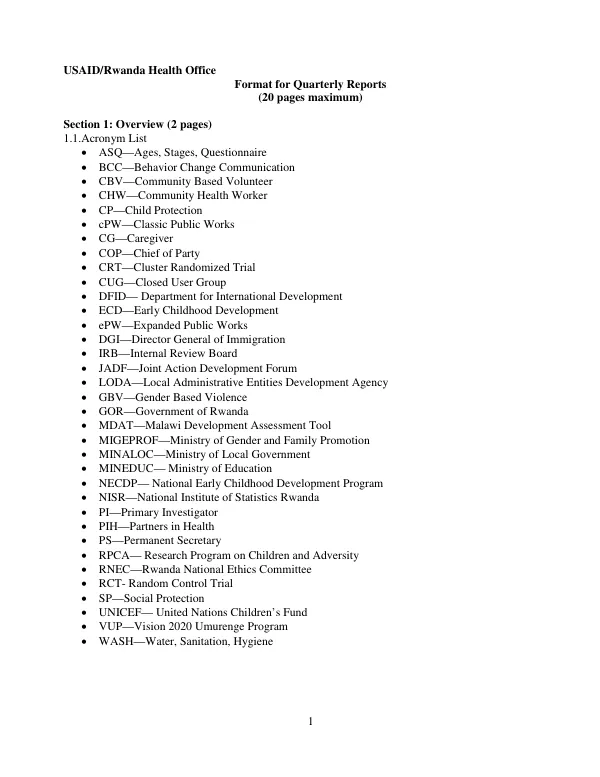
The intervention is designed to target families living in extreme poverty, specifically those classified as Ubudehe 1, which accounts for approximately 375,000 households in Rwanda. The program aims to enroll 1,048 VUP-eligible families with children aged 6-36 months to compare outcomes among children and parents in households receiving either Classic VUP public works, Expanded VUP public works, or a combination of these with Sugira Muryango. The study employs a four-arm cluster randomized trial (CRT) design, with households assigned to one of four conditions: Classic VUP public works, Expanded VUP public works, Combined Classic VUP public works with Sugira Muryango, or Combined Expanded VUP public works with Sugira Muryango. The intervention is delivered by community-based volunteer workers to beneficiaries of the Government of Rwanda's (GOR) flagship social protection program, Vision 2020 Umurenge Program (VUP). The program's overall goals are to assess the effectiveness of Sugira Muryango in promoting responsive parenting, reducing violence and harsh punishment towards children, and promoting early child development through the behavior change of caregivers of vulnerable households. Major achievements in the last quarter include the completion of baseline assessments for 1,048 households, the selection and training of 118 Community-Based Volunteers (CBVs), and the initiation of the intervention with 549 families. Additionally, a new postdoctoral fellow was hired to support the study. However, challenges were also encountered, including an increase in reporting of Risk of Harm cases and referrals, which required the development of daily reporting templates, telephone supervision guides, and trackers to capture this information. Technology issues in the field also posed a challenge, with malfunctions and inability to troubleshoot problems. To address these issues, direct tech support was provided during group supervision, and a refresher "tech training" was added to the CBV booster session training. The Expert Seed Team completed CBV selection and 3-week training, and Laterite conducted baseline assessments from April 23-June 1, 2018. The assessments were completed in one district before data collection began in the following district. Once CBV training and data collection were complete, expert supervisors commenced the introduction to families and the start of the intervention for treatment families. Introductions were completed with local leaders, the supervisor, the family, and the assigned CBV. All parties gathered at the cell office to learn more about the intervention, meet their CBV and supervisor, and schedule the first in-home appointment. The primary challenge identified in the last quarter regarded a delay in Phase II activities due to limited numbers of ePW families within the three districts. To address this issue, it was decided to enroll all ePW households that met eligibility criteria, resulting in unbalanced clusters of ePW households. Power calculations were conducted to ensure minimal to no loss of power with an unbalanced sample. The study aims to assess the effectiveness of Sugira Muryango in promoting responsive parenting, reducing violence and harsh punishment towards children, and promoting early child development through the behavior change of caregivers of vulnerable households.
Related documents