USAID
Improving Maternal, Newborn & Child Health
Improving Maternal, Newborn & Child Health is a critical global public health challenge.
2009 · 2 pages
Sign in to readA free account is required to download.
Abstract
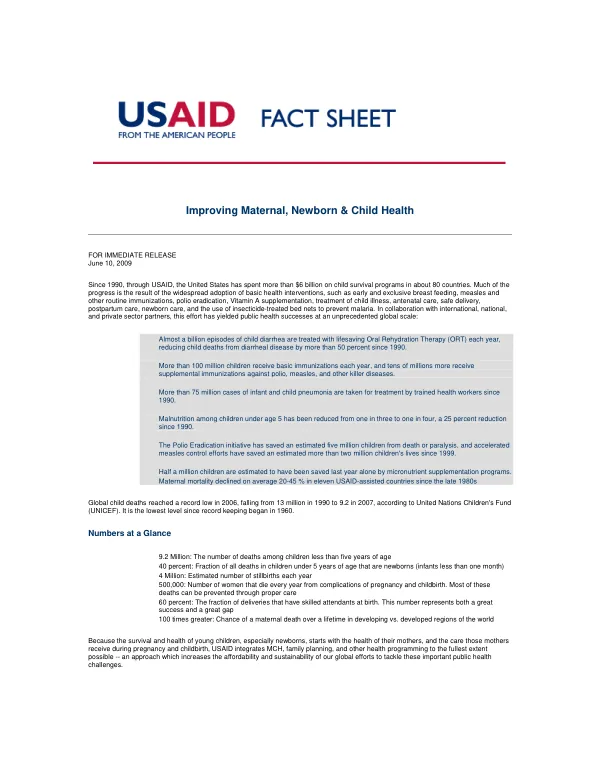
Since 1990, the United States has invested more than $6 billion in child survival programs in approximately 80 countries through the United States Agency for International Development (USAID). This effort has yielded significant public health successes at an unprecedented global scale. The widespread adoption of basic health interventions has contributed to these gains. These interventions include early and exclusive breastfeeding, routine immunizations, polio eradication, Vitamin A supplementation, treatment of child illness, antenatal care, safe delivery, postpartum care, newborn care, and the use of insecticide-treated bed nets to prevent malaria. As a result, almost a billion episodes of child diarrhea are treated with lifesaving Oral Rehydration Therapy (ORT) each year, reducing child deaths from diarrheal disease by more than 50 percent since 1990. Additionally, more than 100 million children receive basic immunizations each year, and tens of millions more receive supplemental immunizations against polio, measles, and other killer diseases. The Polio Eradication initiative has saved an estimated five million children from death or paralysis, and accelerated measles control efforts have saved an estimated more than two million children's lives since 1999. Furthermore, micronutrient supplementation programs have saved an estimated half a million children's lives last year alone. Maternal mortality has also declined significantly in USAID-assisted countries, with an average reduction of 20-45 percent since the late 1980s. Global child deaths reached a record low in 2006, falling from 13 million in 1990 to 9.2 million in 2007, according to the United Nations Children's Fund (UNICEF). This represents the lowest level since record keeping began in 1960. The USAID's Maternal, Newborn, and Child Health (MCH) Strategic Approach aims to achieve significant reductions in maternal and child mortality and malnutrition by 2013. The agency will support the achievement of average reductions of the maternal mortality ratio by 25 percent in 30 high-mortality, burden countries. Additionally, the agency will support average reductions of under-5 mortality rate by 25 percent in 30 high-mortality countries and average reductions of child malnutrition by 15 percent in at least 10 of these countries. To achieve these goals, the USAID will focus on delivering high-impact interventions that prevent or treat the major causes of maternal and child mortality and malnutrition. The agency will also strengthen essential elements of health systems, including human resources, pharmaceutical management and logistics, financing, quality assurance, governance, and information systems. Furthermore, the USAID will integrate with other key health program areas, such as malaria and HIV/AIDS, where appropriate, and link to other key determinants of maternal and child mortality, such as water supply and sanitation. The USAID's MCH Strategic Approach will focus on several key interventions, including skilled care at birth, emergency obstetric care, focused antenatal care, and postnatal care for mothers. For newborn health, the agency will focus on essential newborn care, postnatal visits within three days of birth, and community-based approaches to promote home-based practices and improve care-seeking. For child health, the agency will focus on treatment of life-threatening childhood illnesses, prevention of diarrhea, immunization, and reduction of child malnutrition through infant and young child feeding, micronutrient supplementation, and therapeutic nutrition.
Related documents