USAID DEC
Improving Medicines Access and Use for Child Health—A Guide to Developing Interventions
Sign inWORLD HEALTH ORGANIZATION
Improving Medicines Access and Use for Child Health—A Guide to Developing Interventions
Improving Medicines Access and Use for Child Health is a comprehensive guide for developing interventions to enhance access to and use of medicines for child illness.
2013 · 2 pages
Sign in to readA free account is required to download.
Abstract
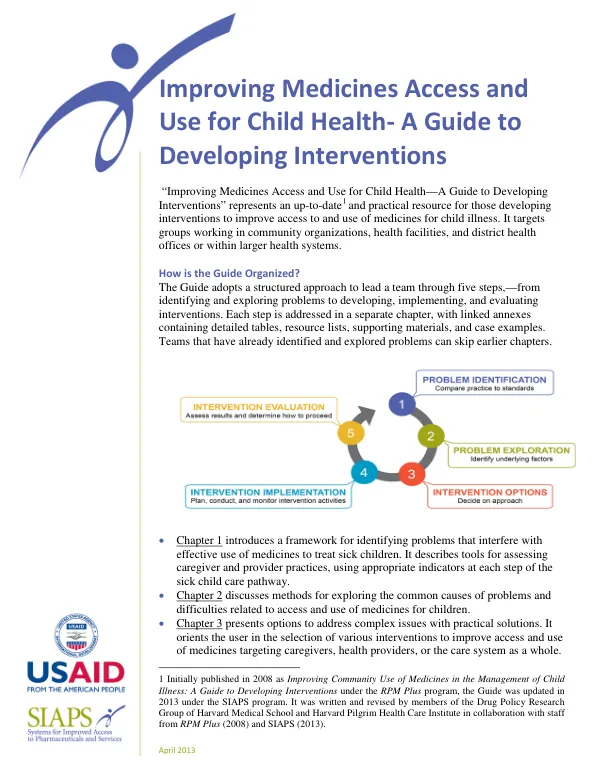
The guide targets groups working in community organizations, health facilities, and district health offices or within larger health systems. The guide is structured to lead a team through five steps, from identifying and exploring problems to developing, implementing, and evaluating interventions. Each step is addressed in a separate chapter, with linked annexes containing detailed tables, resource lists, supporting materials, and case examples. Teams that have already identified and explored problems can skip earlier chapters. Chapter 1 introduces a framework for identifying problems that interfere with effective use of medicines to treat sick children. It describes tools for assessing caregiver and provider practices, using appropriate indicators at each step of the sick child care pathway. Chapter 2 discusses methods for exploring the common causes of problems and difficulties related to access and use of medicines for children. Chapter 3 presents options to address complex issues with practical solutions, orienting the user in the selection of various interventions to improve access and use of medicines targeting caregivers, health providers, or the care system as a whole. Chapter 4 orients users in the design, implementation, and monitoring of interventions by reviewing some of the principles for mounting effective multifaceted interventions and describes how intervention components can reinforce each other. Chapter 5 offers guidance on how to evaluate the results of an intervention in a particular setting to strengthen its impact and disseminate successful strategies. The guide is designed to be useful to policy makers and health system managers working in the public, mission, or nongovernmental sectors who are interested in improving access and use of medicines for sick children. It is relevant at all levels of the health system, including central, regional, community, and health or educational institutions. The guide provides a wealth of intervention examples and additional resources to help users gain an in-depth understanding of key issues related to problem assessment and the development and evaluation of interventions. Every chapter has been developed to stand alone, so that users can start at the chapter of immediate relevance to their working group. Three fictional scenarios are used as a common thread throughout the guide to illustrate key points from each chapter and to help users relate recommendations to their local context.
Related documents