USAID DEC
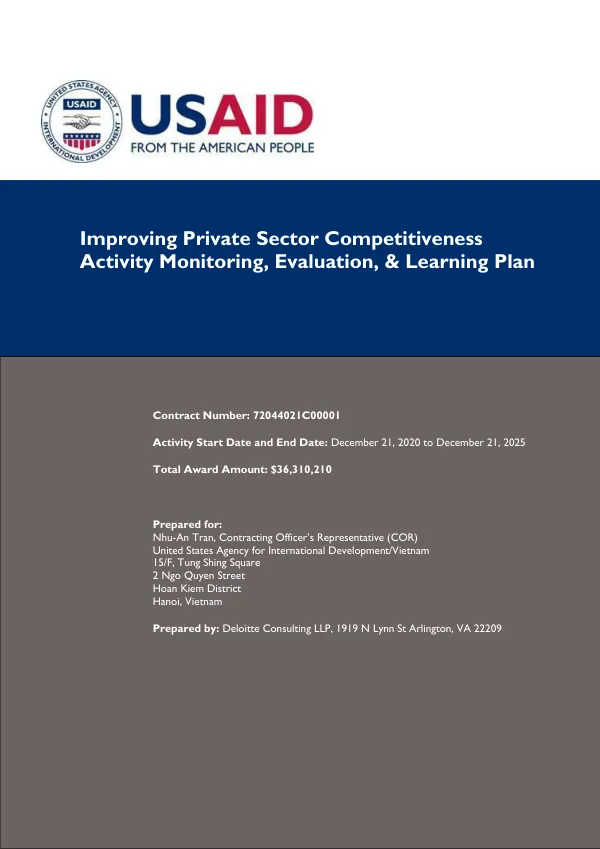
Improving Private Sector Competitiveness Activity Monitoring, Evaluation, & Learning Plan
Sign inDELOITTE CONSULTING, LLP
Improving Private Sector Competitiveness Activity Monitoring, Evaluation, & Learning Plan
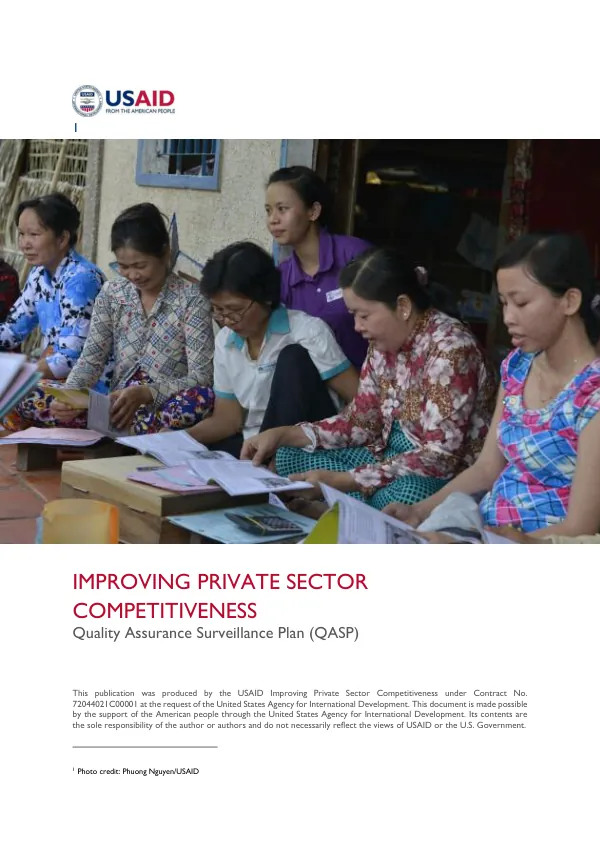
Improving Private Sector Competitiveness Activity Monitoring, Evaluation, and Learning Plan The Improving Private Sector Competitiveness (IPSC) activity aims to enhance the competitiveness of the private sector in Vietnam, with a focus on small and medium-sized enterprises (SMEs).
2021 · 65 pages
Sign in to readA free account is required to download.
Abstract
The activity is designed to improve the business environment, increase access to finance, and enhance the capacity of SMEs to compete in the global market. The IPSC activity is aligned with the United States Agency for International Development (USAID) Country Development Cooperation Strategy (CDS) for Vietnam, which prioritizes economic growth and poverty reduction. The activity's objectives are to: * Improve the business environment in Vietnam by reducing regulatory barriers and increase access to finance for SMEs * Enhance the capacity of SMEs to compete in the global market through training and technical assistance * Increase the number of SMEs that export goods and services The IPSC activity will be implemented over a period of five years, from December 21, 2020 to December 20, 2025. The activity will be implemented in collaboration with the Government of Vietnam, the private sector, and other stakeholders. The IPSC activity will focus on the following key interventions: * Business environment reform: The activity will work with the Government of Vietnam to reform the business environment by reducing regulatory barriers and increase access to finance for SMEs. * SME capacity building: The activity will provide training and technical assistance to SMEs to enhance their capacity to compete in the global market. * Export promotion: The activity will work with SMEs to increase their exports of goods and services. The IPSC activity will be monitored and evaluated through a Performance Indicator Reference Sheet (PIRS) and a Performance Indicator Tracking Table (PITT). The PIRS will outline the scope of each indicator, unit of measurement, and method of measurement, while the PITT will track the progress of each indicator over time. The IPSC activity will also have a learning component, which will focus on identifying best practices and lessons learned throughout the activity. The activity will use a Collaboration, Learning, and Adapting (CLA) approach to ensure that lessons learned are shared and applied throughout the activity. The IPSC activity will be implemented in collaboration with the Government of Vietnam, the private sector, and other stakeholders. The activity will be monitored and evaluated regularly to ensure that it is meeting its objectives and making progress towards its goals. The IPSC activity will have a significant impact on the private sector in Vietnam, by improving the business environment, increasing access to finance, and enhancing the capacity of SMEs to compete in the global market. The activity will also contribute to the achievement of the USAID Country Development Cooperation Strategy (CDS) for Vietnam, by promoting economic growth and poverty reduction. The IPSC activity will be implemented in the following geographic areas: * Hanoi * Ho Chi Minh City * Da Nang * Can Tho * Hai Phong The activity will focus on the following sectors: * Manufacturing * Services * Agriculture * Construction